Kathmandu Valley and Bardiya National Park Tour
Experience the Cultural and the Wildlife Wonders
Experience the Cultural Richness of Kathmandu Valley and the Wildlife Wonders of Bardiya National Park
The Kathmandu Valley and Bardiya National Park Tour is a 8-day tour starting and finishing in Kathmandu. We run it as a private trip on your own dates, or as a small group departure.
Seven UNESCO monument zones inside one valley. Newar architecture, living Hindu and Buddhist practice, and a festival calendar that runs all year. Newari khaja sets, momo, and a restaurant scene in Thamel and Jhamsikhel that outstrips the rest of the country.
This is a cultural trip, not a trek. Expect vehicle transfers, guided site visits and short walks of an hour or two, with the option to add a longer hike where the itinerary allows. Nothing beyond ordinary city travel. Winter air quality in the valley is the main comfort issue, and we plan the outdoor sections for the morning.
Best time to go. Year round. October to March gives the clearest air; the monsoon from June to August is green and quiet with afternoon rain.
Permits and getting there. UNESCO World Heritage site entry fees for Durbar Squares, Boudhanath, Pashupatinath and Swayambhunath, all included in your tour price. Everything is within an hour's drive. We use private air-conditioned vehicles with a licensed cultural guide.
Where you sleep. Hotels in Thamel, Lazimpat, Boudha or Patan depending on the tour, from comfortable three-star to heritage properties in Bhaktapur and Patan.
Why book with us. Trekking Team is a family company in Gongabu, Kathmandu, running trips since 1991 under TAAN licence 1106. About ten thousand people have travelled with us and we hold more than 630 TripAdvisor reviews. Every departure runs with a government-licensed guide, permits arranged before you arrive, insured and equipped staff, and a fixed price. If the dates or the route do not suit you, write to us and we will rebuild the itinerary around what you want.
Trip Summary
Duration
Difficulty
Max Elevation
Start point
End point
Daily Activity
Group Size
Best Season
Trip Outline
- Day 1Arrival in Kathmandu
- Day 2Sightseeing in Kathmandu
- Day 3Sightseeing in Patan and Bhaktapur, sunset views from Nagarkot
- Day 4Fly to Nepalgunj, drive to Bardiya National Park
- Day 5Bardiya National Park
- Day 6Bardiya National Park
- Day 7Drive to Nepalgunj, fly to Kathmandu
- Day 8Final Departure
Included
- All transfers in the itinerary, by private vehicle or domestic flight as listed
- National park entry permits and all activity fees
- Licensed naturalist guide for every activity inside the park
- Jeep safari, guided jungle walk with two armed naturalists, and a canoe or float trip
- Lodge accommodation on a full board basis, twin share
- Tharu village visit and cultural programme
- All government taxes, VAT and company service charges
Not Included
- International flights and the Nepal visa fee
- Travel insurance, which we require you to hold
- Drinks, laundry and items of a personal nature
- Elephant-back safari, which we do not book on welfare grounds
- Additional activities beyond those listed
- Tips for your naturalist, driver and lodge staff
- Anything not listed under what is included
Get started on your journey
Detailed itinerary
Arrival in Kathmandu
You will be met in the arrivals hall at Tribhuvan International Airport and driven to your hotel, usually 30 to 45 minutes depending on traffic. Nepal issues visas on arrival: fill in the form at the electronic kiosks before the payment desk, and bring a passport photograph and cash in a major currency to speed it up.
Once you have settled in, your guide comes to the hotel for a briefing on the days ahead. Kathmandu sits at about 1,400 m so there is no altitude concern tonight. If you land early enough, the walk from Thamel down towards the Durbar Square area is a good first hour in the city.
Altitude: 1,350 m | Overnight: 3-5 Stars | Meals: Breakfast
Travel duration
Elevation
Meal
Accommodation
Sightseeing in Kathmandu
A full day in Kathmandu with a licensed cultural guide and a private vehicle.
Kathmandu Durbar Square is the old royal complex of the Malla kings and later the Shah dynasty, a dense cluster of pagoda temples, courtyards and palace wings built between the twelfth and eighteenth centuries. The Kumari Ghar here houses Nepal's living goddess, a young girl chosen from the Newar Shakya community who appears at her carved window most afternoons. Much of the square was damaged in the 2015 earthquake and the restoration, done with traditional joinery and reused timber, is itself worth watching.
Pashupatinath is the most important Hindu temple in Nepal and one of the great Shiva shrines of the subcontinent, a UNESCO site on the banks of the Bagmati. Non-Hindus cannot enter the main temple, but the far bank gives an open view across the ghats where open-air cremations take place through the day. It is confronting the first time and also completely ordinary here, a public part of life rather than something hidden.
Swayambhunath sits on a hill west of the city, reached by 365 stone steps through a forest full of rhesus macaques, which is where the nickname Monkey Temple comes from. The stupa is one of the oldest religious sites in the valley, with the Buddha's eyes painted on all four sides and a spire of thirteen gilded rings. The terrace gives the best single view over Kathmandu.
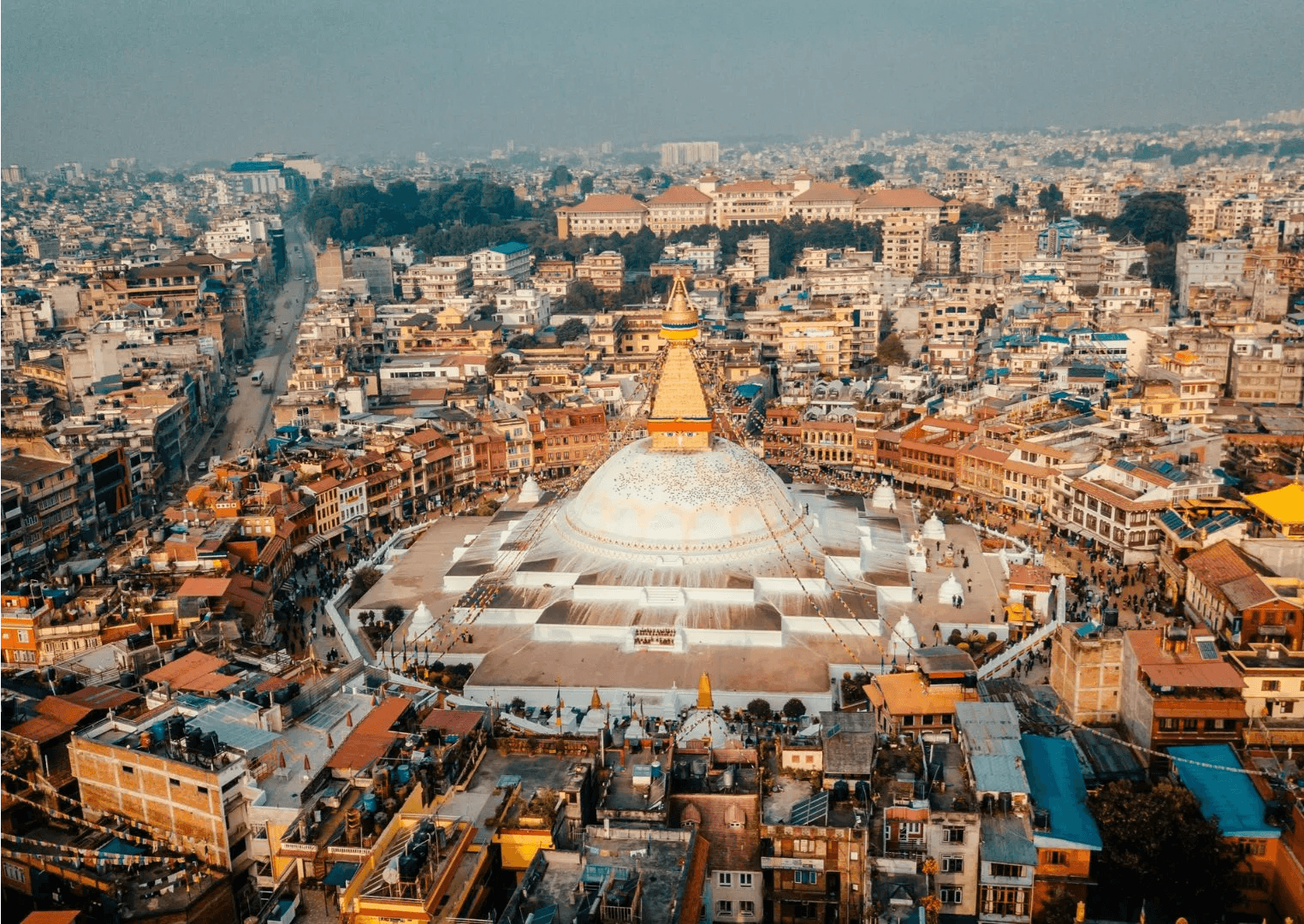
Boudhanath is one of the largest stupas in the world and the centre of Tibetan Buddhist life in Nepal, particularly since 1959 when refugees settled around it. The white dome is 36 m across, ringed by prayer wheels and surrounded by more than fifty gompas. Walk the kora clockwise at dusk with the local crowd as the monks come out of evening puja: it is the most atmospheric hour in Kathmandu.
Altitude: 1,350 m | Overnight: 3-5 Stars | Meals: Breakfast
Travel duration
Elevation
Meal
Accommodation
Sightseeing in Patan and Bhaktapur, sunset views from Nagarkot
Patan in the morning, Bhaktapur through the afternoon, then up to the valley rim for sunset.
Patan, or Lalitpur, holds the finest concentration of Newar architecture in Nepal. Its Durbar Square has the Krishna Mandir, carved from stone in 1637, the Golden Temple with its gilded facade and resident tortoises, and the Patan Museum, widely considered the best museum in the country. The surrounding lanes are still full of working metalworkers and thangka painters.
Bhaktapur is the best preserved of the valley's three medieval cities and the one where the old town still functions as a town rather than a monument. Brick lanes open into Durbar Square, Taumadhi Square with the five-tiered Nyatapola temple, and Dattatreya Square with the Peacock Window. Pottery Square is a working pottery. Try the juju dhau, the local king curd served in a clay bowl.
Nagarkot is a ridge village at about 2,175 m on the eastern rim of the valley, an hour and a half from Kathmandu, and it is where people go for the Himalayan sunrise. On a clear morning the view runs from Ganesh Himal and Langtang across to Gauri Shankar and, on the best days, Everest on the far eastern horizon. October to March are the clear months.
Altitude: 2,175 m | Overnight: Hotel | Meals: Breakfast
Travel duration
Elevation
Meal
Accommodation
Fly to Nepalgunj, drive to Bardiya National Park
Early flight west to Nepalgunj in the Terai, then a drive of two to three hours north to Thakurdwara on the edge of Bardiya National Park. The change from the hill air of Kathmandu to the heat of the lowlands is abrupt and is part of what makes this trip work.
Bardiya National Park in the far west is larger, wilder and far less visited than Chitwan, and it holds Nepal's highest density of Bengal tiger. Sightings here are realistic rather than lucky, particularly from the river beds between February and April. Wild elephant, rhino, swamp deer and Gangetic dolphin in the Karnali are the other draws.
The afternoon is for settling into the lodge, a briefing from your naturalist and a first walk along the buffer zone as the light goes.
Altitude: 300 m | Overnight: Lodge | Meals: Breakfast
Travel duration
Elevation
Meal
Accommodation
Bardiya National Park
A full day in the park. Depending on conditions your naturalist will choose between a full-day jeep safari deep into the reserve and a walking day along the river beds, which is where the tiger sightings happen.
Walking in Bardiya is done with two licensed naturalists and it is a genuinely different experience from a vehicle: you read tracks, listen for the alarm calls of langur and spotted deer, and move quietly. The briefing on what to do if you meet a rhino on foot is not a formality and you should listen to it.
Late afternoon is usually spent at a machan or sitting quietly at a river bend, which is how most good sightings actually occur.
Altitude: 300 m | Overnight: Lodge | Meals: Breakfast
Travel duration
Elevation
Meal
Accommodation
Bardiya National Park
A second full day in the park, using whichever of the jeep, the walk or the float safari you did not do yesterday.
The float safari drifts down the Karnali in a raft or dugout, past gharial and mugger crocodile on the sandbanks, with a real chance of Gangetic river dolphin in the deeper pools. It is the quietest way to move through the park and often the most productive.
In the evening there is time in the Tharu villages around Thakurdwara. The Tharu are the indigenous people of the Terai, with their own language and longhouse architecture, and the community museums are worth doing properly rather than as an evening show.
Altitude: 300 m | Overnight: Lodge | Meals: Breakfast
Travel duration
Elevation
Meal
Accommodation
Drive to Nepalgunj, fly to Kathmandu
A final dawn drive or walk if the timings allow, then the road back to Nepalgunj and the flight to Kathmandu.
The afternoon is free in the city. This is the point where most people buy the things they had been looking at all week.
Altitude: 1,350 m | Overnight: 3-5 Stars | Meals: Breakfast
Travel duration
Elevation
Meal
Accommodation
Final Departure
Transfer to the airport about three hours before your international flight. If you have a late departure we will hold a day room or arrange a final few hours in the city rather than leave you sitting in the terminal.
If you would rather not go home yet, this is the easy point to extend: a few days in Pokhara, a wildlife stay in Chitwan or Bardiya, a short Bhutan add-on, or a trek. Tell us before you travel and we will build it in at cost.
Altitude: 1,350 m | Meals: Breakfast
Travel duration
Elevation
Meal
Accommodation
Getting ready
No special training is needed. Comfortable shoes for uneven cobbles and stone steps at the heritage sites, and a light layer for early mornings, will cover it.
Permits and paperwork
UNESCO World Heritage site entry fees for Durbar Squares, Boudhanath, Pashupatinath and Swayambhunath, all included in your tour price.
Nepal issues visas on arrival at Tribhuvan International Airport: 15, 30 or 90 days, payable in cash in most major currencies or by card. Bring two passport photographs and make sure your passport has at least six months validity.
Money, tipping and costs on the ground
Nepali rupees are the only currency accepted on the trail. Draw cash in Kathmandu or Pokhara before you leave; ATMs have a per-transaction limit of around NPR 35,000 and charge a fee, and above the roadhead there are no machines and no card terminals.
Budget for drinks, souvenirs and any meals not listed in the itinerary.
Tipping is customary and genuinely matters to the crew, but it is not compulsory and never demanded. As a guide to the guide: around USD 8 to 12 per day for your trekking guide and USD 6 to 8 for each porter, pooled by the group and handed over at the end.
Staying in touch
Wi-Fi everywhere, 4G across the valley, and a tourist SIM at the airport.
Ncell and Nepal Telecom tourist SIM cards are sold at Kathmandu airport and take about ten minutes. Bring your passport.
Health and safety
No vaccinations are legally required for Nepal, but hepatitis A, typhoid and tetanus are sensible and a rabies course is worth discussing if you are travelling for a long time. Check with a travel clinic six to eight weeks before you fly.
Drink bottled or treated water and be sensible about street food in the first few days.
Our guides carry a comprehensive first aid kit. We hold a 24-hour operations line in Kathmandu throughout your trip, and we run rescue coordination ourselves rather than handing it to a third party.
Booking and cancellation
A deposit confirms your dates and the balance is due before departure. If your plans change we will move your booking to another date rather than treat it as a cancellation wherever the ground operators allow it.
Written quotes are fixed. We do not add fuel or permit surcharges after you have booked, and if a government fee rises between your booking and your departure we absorb it.
Questions before you commit are welcome and never rushed. Write to us with what you actually want and we will tell you plainly whether this trip is the right one, including when the answer is that a different route would suit you better.
Ready to start your journey?
Start planning your dream trip today. Enquire now for more information or customize this trip to tailor it to your needs and make it truly unforgettable.