Everest Base Camp Trek Day 1: What to Do from Lukla to Phakding
By Trekking Team | Research updated: 6 November 2026
The first surprise on the Everest Base Camp trek is that you walk downhill.
After the flight to Lukla, the trail drops towards a valley of cultivated slopes, stone houses and bridges. Bells announce approaching pack animals. Carved prayers occupy rocks beside the path. There are places to stop for tea long before there is any need to stop from exhaustion.
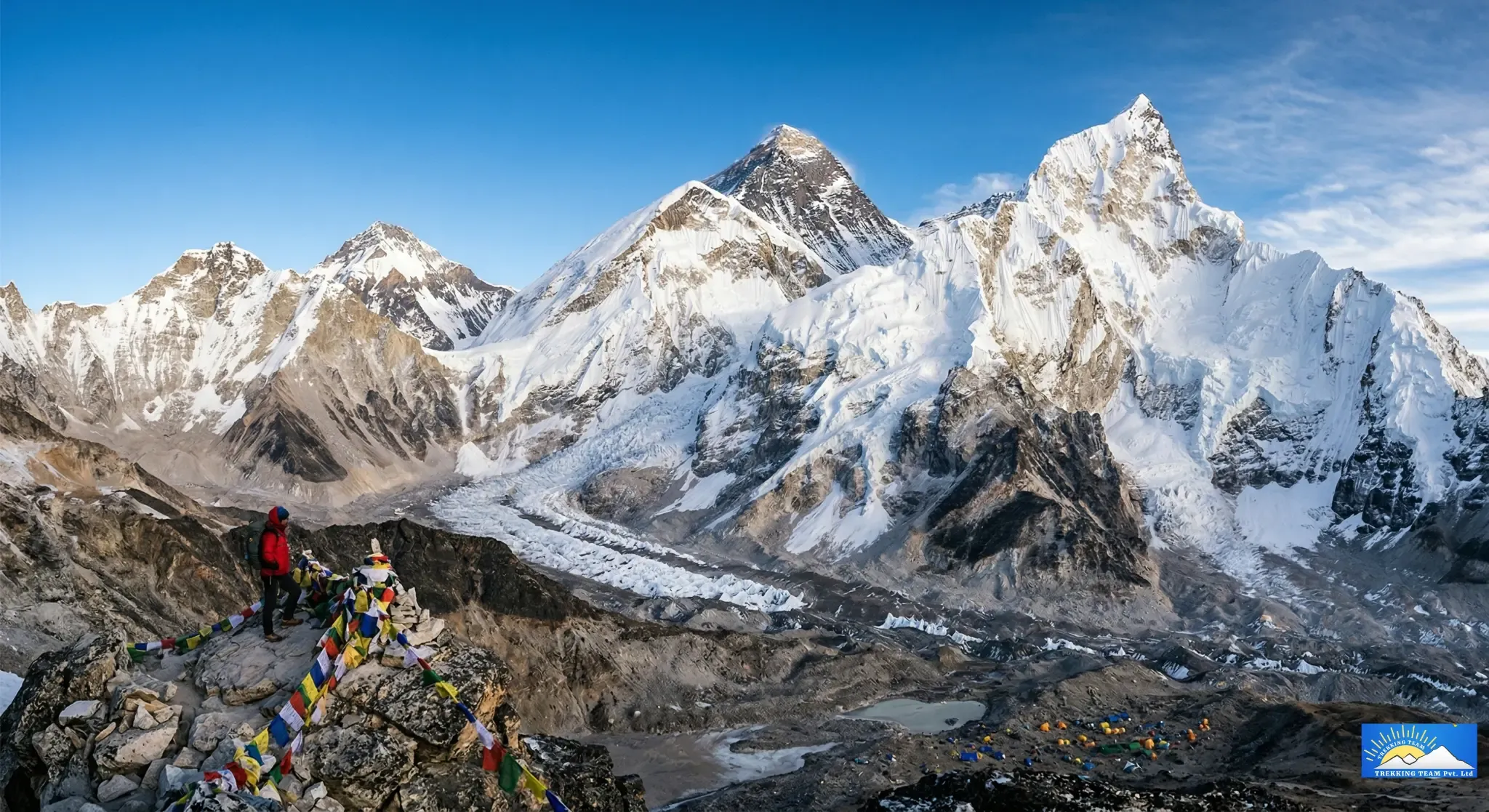
On an itinerary, this day can look like little more than a transfer: land, walk, sleep in Phakding. Give it your attention, though, and it becomes your introduction to how the Everest region works—its villages, its Buddhist traditions and the people whose working day shares the same trail as your holiday.
The distance is modest. There is no reason for the experience to be.
This guide also compares Phakding with Monjo, the alternative first-night stop farther up the valley, so you can choose a start that fits your energy, interests and arrival time.
What should you do on the first day of the Everest Base Camp trek?
Fly to Lukla, have breakfast and organise your bags, then walk to Phakding via Chheplung, Thado Koshi and Ghat. Allow roughly 3–4 hours for the main walk, with more time for meals and stops. Pause at Ghat’s Buddhist landmarks, settle into your lodge, and consider a gentle village walk or an optional monastery visit if you arrive early and feel well.
This guide covers Day 1 of walking. On Trekking Team’s 16-day Everest Base Camp itinerary, the flight to Lukla and walk to Phakding fall on Day 3, after arrival and preparation in Kathmandu.
Lukla to Phakding: distance, altitude and walking time
| Detail | What to expect |
|---|---|
| Starting point | Lukla, approximately 2,860 metres |
| Overnight stop | Phakding, approximately 2,610 metres |
| Walking distance | Roughly 8–9 kilometres; airport, lodge location and detours affect the total |
| Main walking time | Usually around 3–4 hours; allow longer for a leisurely day |
| Overall altitude change | About 250 metres lower at the overnight stop, with uphill sections along the way |
| Main route | Lukla → Chheplung → Thado Koshi → Ghat → Phakding |
| Terrain | Village paths, stone steps, uneven ground and suspension bridges |
| Overnight accommodation | A lodge or teahouse in Phakding |
| Optional extra | A locally confirmed monastery visit above Phakding, subject to time, access and how you feel |
These are planning figures, not measurements to the door of every lodge. Published accounts differ: one trekker recorded about nine kilometres, while another took four and a half hours with substantial rests. Neither makes a slower day a problem.[2][3]
Phakding is lower than Lukla, but “downhill overall” does not mean downhill throughout. Expect small climbs, steps and pauses where people or animals need to pass. A light daypack helps; so does abandoning any idea of matching someone else’s pace.
Before the walk: make the flight day easier
Check whether you are departing from Kathmandu or Ramechhap
Your first trekking day may begin well before the airport opens. Some Lukla flights operate from Kathmandu; others depart from Manthali Airport in Ramechhap, requiring a separate road transfer. Tara Air confirms that the departure airport depends on operating arrangements and that peak-season flights may use Ramechhap.
Check the airport on your actual ticket. Ask when your transfer leaves and whether an overnight stay near Manthali would give you more rest. A short flight after several hours on the road feels different from a short flight after a full night’s sleep.
Keep breakfast expectations flexible. Carry a familiar snack, essential medication and the layers you will need after landing. Put your passport and flight information somewhere accessible without emptying your bag.
Pack for the flight and the walk as two separate jobs
Your airline’s baggage allowance and your porter arrangement are different things. Tara Air currently lists an allowance of 10 kg checked baggage plus 5 kg hand baggage for the relevant adult fares; verify the allowance on your own booking rather than applying that figure to every airline or ticket.[5]
Before handing over your main trekking bag, move the day’s essentials into your daypack: waterproof jacket, warm layer, sun protection, water-treatment supplies, snacks, personal medication, blister care, phone and a headlamp. Keep valuables and travel documents with you.
The useful question is: Could I comfortably finish today if I did not see my main bag until the lodge?
Let the weather decide the flight—not your walking timetable
Cloud, wind and visibility can delay Lukla flights. Keep flexibility at the end of the trek as well as at the beginning; the return flight also needs suitable conditions.
If you land late, shorten the day’s extras. If there is insufficient daylight to reach Phakding comfortably, discuss staying in Lukla with your guide. A helicopter is not a guaranteed solution to bad weather, and a delay is not a reason to rush the trail.
For dated transport information, check our Nepal travel advisory covering roads, flights and trekking access, then reconfirm your own arrangements close to departure.
What to do in Lukla after landing
Give yourself a proper pause before starting to walk. Collect and identify your bags, meet the rest of your trekking team and have something to eat. This is also the moment to find out which bag your porter will carry and which lodge you are aiming for.
Learn names. Agree on a meeting point if the group separates. Tell your guide about an uncomfortable boot, a poor night’s sleep or a medical concern now, while everyone has time to respond.
Use breakfast to settle the small questions that otherwise follow you down the trail: where to obtain safe drinking water, whether lunch is planned en route or in Phakding, and which entry documents must stay within reach. The municipality publishes Trek-Card information, while the national park checkpoint lies farther along the route, beyond Monjo; it is not at Phakding.
There is room for a photograph in Lukla, too. Take it from a permitted public area, without obstructing airport staff or people moving luggage. Then put the camera away for the first few minutes of walking. Adjust your straps, feel how your boots sit and let your legs settle into a pace you can sustain.
The walk from Lukla to Phakding, village by village
Lukla to Chheplung: notice the inhabited landscape
The opening section leads down from Lukla towards Chheplung, also written Cheplung. The route moves through a lived-in landscape, with houses, cultivated ground and everyday traffic rather than uninterrupted wilderness.
Look beyond the next lodge sign. Ask your guide what is growing beside the path and how supplies reach the villages. Do not assume every person carrying a load is working for a trekking group, or that every local person belongs to the same community.
This is a good place to establish a habit for the whole journey: stop to look, then walk. Reading your camera screen while descending uneven steps adds little to either activity.
Thado Koshi: leave time for a mountain-view tea stop
Around Thado Koshi, clear conditions can reveal Kusum Kanguru, a striking peak above the valley. A firsthand account in the Nepali Times describes this mountain view during the Lukla–Phakding walk.
Ask your guide to identify the peak you are seeing. It is easy to arrive in the Everest region and label every impressive snowy mountain “Everest.” Knowing the name changes the photograph—and often makes you notice the mountain again farther along the trail.
If the view is open, this is a worthwhile place for an unhurried tea break. If cloud hides it, enjoy the stop without turning it into a waiting game. Save your appetite for what the day actually offers.
Ghat: stop at the prayers carved into the trail
Ghat gives the first day a cultural focus. Mani stones and walls, chortens and prayer wheels are part of the route’s Buddhist landscape; independent walking accounts describe these features along the lower trail.
Do more than collect a photograph. Ask your guide to explain one carved inscription or the purpose of one structure. A single object understood properly is more memorable than a dozen photographed without context.
When passing Buddhist mani walls and chortens, follow the clockwise convention: keep the sacred structure on your right, taking the left-hand path where the trail divides around it. Follow local directions where the layout requires it.
Do not climb on carved stones, rest a bag on a shrine or interrupt worship for a picture. Ask before photographing people. You can give this stop ten or fifteen minutes without turning it into an organised performance; the value is in paying attention.
Ghat to Phakding: finish at the right lodge
Continue towards Phakding, where the first overnight stop brings you into the Dudh Koshi valley. Arrival does not necessarily mean the first building with “Phakding” on its sign. Confirm your lodge with your guide before following another group across a bridge or taking a side path.
On arrival, take off your boots and deal with any rubbing before it becomes tomorrow’s blister. Put on a dry layer if needed. Order a meal or tea, check your room and give yourself time to decide whether you want to go out again.
There is no obligation to fill every hour left in the afternoon.
What can you do beyond the usual Lukla–Phakding itinerary?
Visit the monastery above Phakding—when the day allows it
The most worthwhile cultural addition is a possible walk towards the monastery area associated with Rimijung, above Phakding. Nepal Tourism Board identifies Rimijung and its Pemachholing Gompa as places to explore Sherpa culture away from the main Everest trail.
Names appear in different spellings, and descriptions of walking times vary considerably. Ask your guide to identify the exact monastery and path from your lodge, check whether visitors are welcome that day, and estimate the return time. Treat it as an uphill outing, not an automatic stroll after lunch.
Access is not guaranteed. A published trek diary describes attending prayers during a visit, while a separate traveller account found a monastery closed to outsiders. Neither establishes current opening hours.
Go if you have arrived early, feel well and have enough daylight for an easy return. Skip it after a tiring transfer, a late landing or any concerning symptoms. There is no need to add exertion simply to label the afternoon “acclimatisation.”
If you are welcomed inside, follow the host’s instructions about shoes, seating and photography. A prayer service is a religious observance; attendance, filming or a private explanation should never be promised in advance without an actual arrangement.
Make a small photographic story of the first day
Choose five subjects rather than fifty versions of the same view: your team preparing to leave Lukla, a cultivated slope, the surface of a mani stone, the river from a safe viewpoint, and your first evening at the lodge.
Ask permission for portraits. Avoid pointing a camera into homes or photographing children as a substitute for introducing yourself. On bridges, cross first and choose a place where you can stop without blocking anyone.
A few notes make the photographs better later. Record the village name, the mountain name and something your guide explained. By the end of the trek, those details are surprisingly easy to mix up.
Sit down for a conversation that is not about kilometres
With your guide’s help, ask a lodge host about a subject they are happy to discuss: a vegetable in the meal, how winter changes the village, or how the business developed. Let the conversation follow their interest, and accept that a busy kitchen may have no time for it.
Buying tea or a meal is a straightforward way to support a local business. Access to a private home, school, kitchen or religious space still requires an invitation. An ordinary exchange can be enough; it does not need to become a staged “local experience.”
Take a gentle village walk—or simply stay put
If you want fresh air after lunch, ask for an easy route near your lodge. Keep away from unstable riverbanks and do not turn the afternoon into a search for an unofficial shortcut or a hidden viewpoint.
You could also write a few lines while the day is fresh. What did you notice between the airport and the lodge? What surprised you? What would you like your guide to explain tomorrow?
For a tired trekker, a warm drink and an early night may be the best use of the afternoon. Extra activity should improve the journey you are having.
A sensible schedule for the first trekking day
Use the flight as the starting point rather than building the day around fixed clock times.
| Part of the day | Suggested approach |
|---|---|
| After landing | Collect bags, meet the team, eat and organise your daypack |
| First walking section | Leave Lukla at a comfortable pace; adjust boots and straps early |
| Along the trail | Choose a tea stop and pause at Ghat’s Buddhist landmarks |
| Arrival in Phakding | Check in, eat, refill drinking water and rest |
| If early and feeling well | Consider the locally confirmed monastery outing or a gentle village walk |
| If late or tired | Drop the optional outing and settle in |
| Evening | Review tomorrow’s plan, prepare your bag and get to bed early |
This is a suggested rhythm, not a flight promise or a timed tour. Your lodge location, walking pace, weather and stops will shape the day.
What to expect from your first teahouse in Phakding
Confirm what your booking includes rather than assuming all lodges offer the same room, bathroom or charging arrangement. Ask whether hot showers, device charging, Wi-Fi and drinking water cost extra, and settle the details before using them.
Keep a warm layer ready for the evening. Organise the room while there is daylight: find the bathroom, put your headlamp within reach and separate tomorrow’s clothes from anything damp. Do not begin a large wash unless you have a realistic way to dry it.
For dinner, choose something familiar and freshly cooked. Dal bhat, where available, gives you a meal built around rice and lentils; soup, potatoes or noodles may also appeal. Ask what the kitchen can prepare well rather than choosing the most elaborate item on the menu. Wash your hands before eating.
Treat connectivity as a convenience. Send an arrival message when service is available, then put your phone on charge if you need it. Tomorrow’s equipment preparation is a better investment than an evening spent repeatedly trying to upload a video.
Water, pack animals and the small habits that matter
Establish your drinking-water routine immediately
Do not drink untreated stream or tap water because it looks clear. Use reliably boiled water or an appropriate treatment system, following its instructions. Some filters do not remove viruses; treatment choice matters, as does the required contact time for chemical products.
Ask where you can refill at each stop. Keep enough capacity for the next walking section and avoid leaving all water preparation until the moment you want to depart.
Carry a small bag for wrappers and used tissues. The Sagarmatha Pollution Control Committee manages waste initiatives along the region’s trekking trails; help by using designated disposal facilities correctly and following local sorting instructions. Do not leave rubbish with a lodge unless staff confirm they can accept it.
Give pack animals and people carrying loads space
When animals approach, pause somewhere wide and stable. Where there is a drop, stand on the uphill or mountain side of the path, with enough room for the load to pass. Follow the handler’s directions and avoid squeezing between animals.
Wait for a clear opportunity to cross a bridge. Do not stop in its middle for photographs while others are trying to pass. If a bridge makes you nervous, tell your guide before stepping onto it; there is no benefit in concealing that either.
Give porters room, too. Step aside before a narrow section and avoid stopping suddenly in front of someone carrying a load. These courtesies are part of learning to use a shared trail well.
Can altitude sickness happen on the first day?
Yes. Sleeping in Phakding means descending from Lukla, but you have still arrived at altitude quickly. Fitness does not remove the risk. Headache with nausea, dizziness, unusual fatigue or loss of appetite deserves attention.
Tell your guide promptly. Do not ascend farther with altitude-illness symptoms; worsening symptoms require descent and medical assessment. Confusion, difficulty walking normally or breathlessness at rest are emergency warning signs requiring urgent help.
Keep exertion gentle, avoid alcohol during the first 48 hours at altitude and discuss any preventive medication with a clinician before the trip. One comfortable night in Phakding does not complete acclimatisation.
Tomorrow’s departure should depend on how you are feeling, not simply on the printed itinerary.
Phakding or Monjo: where should you stay on the first night?
Phakding is usually the better fit for a relaxed first day, a late arrival, a tired group or time spent exploring along the trail. Monjo can suit trekkers who land early, feel well, have sufficient daylight and prefer a longer opening walk followed by a shorter approach to Namche. Phakding is the lower overnight stop; Monjo brings you closer to tomorrow’s climb.
Both are established first-night stops recognised by Nepal Tourism Board. Monjo, sometimes written Monju or Manjo, is farther up the same valley. Choosing it does not require a separate route or mean missing Phakding: you walk through Phakding and continue.
For Trekking Team’s published itinerary, Phakding remains the planned first night. The comparison below helps you decide whether to discuss a Monjo variation before your trip. These are planning recommendations drawn from the route and its trade-offs, not findings that one village is medically suitable for an entire category of people.
Phakding vs Monjo at a glance
| What changes? | Stay in Phakding | Continue to Monjo |
|---|---|---|
| Approximate sleeping altitude | 2,610 m | 2,835 m—about 225 m higher |
| Approximate distance from Lukla | 8–9 km | 12–14 km |
| Suggested walking allowance from Lukla | Around 3–4 hours | Around 5–7 hours |
| First-day effort | Shorter opening stage, with more margin for stops | Adds the rolling valley section beyond Phakding |
| Following day to Namche | Roughly 5–7 hours on the trail | Roughly 3–4 hours on the trail |
| Overnight altitude increase to Namche, at about 3,440 m | About 830 m | About 605 m |
| Time for Ghat, photography and a Phakding outing | Easier to accommodate | Select stops carefully; do not assume time for the monastery as well |
| Response to a delayed flight | More flexible because the walk is shorter | Less margin; reassess before committing |
| Lodge atmosphere | Generally the larger, busier overnight hub | Generally smaller and quieter, although lodge and group arrivals matter |
| Main advantage | An easier arrival day and a lower first night | A shorter walking day into Namche |
| Main compromise | More walking before the Namche climb tomorrow | More effort today and a higher first night |
Distances and times are approximate planning ranges, not guaranteed door-to-door measurements. A mapped traveller route records about 12.6 km from Lukla to Monjo and 5.1 km from Monjo to Namche; other start/end points produce different totals. Our time allowances leave more room than a fast moving-time estimate, but lengthy meals, checkpoint queues, photography and detours can extend them further. Road transfers and flights are additional.
The altitude differences in the table are net differences between overnight stops, calculated from the rounded elevations shown. They are not total climbing: the trail rises and falls between villages.
Who is Phakding best suited to?
First-time Himalayan trekkers who want an unhurried introduction. Phakding gives you an opportunity to test your boots, adjust your pack and understand your guide’s pace before committing to a longer day. You do not need to be an inexperienced walker to appreciate that margin; unfamiliar equipment or a disrupted journey can make it useful to anyone.
Trekkers arriving after a tiring transfer or delayed flight. If you have slept poorly, waited for hours at the airport or arrived later than expected, the shorter walk is a practical advantage. Assess the whole day since waking up, rather than judging your energy only by the kilometres walked since Lukla.
Families and groups with different walking speeds. A shorter target leaves more room for snack stops, bridge nerves, clothing changes and the slowest member’s pace. Families still need an individually appropriate high-altitude itinerary; choosing Phakding alone does not establish that the wider trek is suitable for a child.
Photographers and travellers interested in Buddhist heritage. If Ghat’s mani stones, conversations along the trail and the possible monastery outing are part of why you came, protecting time for them makes sense. Plan the monastery only after checking your energy, daylight and access; it adds uphill walking even when the main day is short.
People carrying substantial packs or wanting a gentle start. The extra walking to Monjo can feel different under a full load. If your shoulders or feet are already uncomfortable, fix the problem and consider ending the day at the planned stop instead of making the discomfort tomorrow’s problem too.
Trekkers who prefer a lower first sleeping altitude. Phakding provides that geographical advantage. It is not a guarantee against altitude illness, and someone with a history of significant altitude problems needs an individual pre-trip plan rather than a village recommendation alone.
Who is Monjo best suited to?
Regular walkers who arrive early, feel well and still have plenty of daylight. Monjo is most convincing when the extra section fits comfortably into the day. Being capable of walking farther is only one condition: food, water, weather, trail conditions and the rest of the group also need to be in your favour.
Trekkers who want to shorten the following day’s walk. Moving the Phakding–Monjo section into Day 1 leaves less distance before Namche on Day 2. This can appeal to someone who prefers a longer day on rolling terrain followed by a shorter day containing the main climb. Two Wandering Soles describe choosing Monjo for this reason in their own trek account.
Small groups with a similar pace and agreed priorities. A couple or private group who all want to continue may find Monjo a useful variation. A single energetic person should not set the overnight destination for tired companions. Reconfirm the decision together after eating in Phakding.
People who value a smaller overnight settlement. Traveller route notes describe Monjo as quieter than Phakding. Treat that as a general impression, not a promise: a large group in your lodge can matter more than the size of the village. Ask about the specific property and room location.
Trekkers happy to trade a Phakding afternoon for progress along the main trail. You can still pause in Ghat and eat in Phakding. What becomes harder is combining a leisurely opening walk, a long lunch, a monastery climb and the continuation to Monjo. Choose the experiences you care about rather than trying to fit both versions of the day into one.
Monjo is not reserved for young people, athletes or veteran trekkers. Equally, being young or fit is not a reason to choose it automatically. Recent acclimatisation may be relevant, but previous trekking experience by itself does not mean you are acclimatised now.
Which stop fits your situation?
| Your situation on Day 1 | Better starting choice | Why |
|---|---|---|
| First Himalayan trek and uncertain about your comfortable pace | Phakding | More room to settle in and make adjustments |
| Early landing, rested, symptom-free and comfortable with a longer walk | Monjo can work | You can redistribute the walking across the first two days |
| Long overnight road transfer or substantial airport delay | Phakding | Reduces the demands of an already long day |
| Family or mixed-pace group needing frequent breaks | Phakding | Easier to keep everyone together without rushing |
| Photography and Buddhist sites are a priority | Phakding | Preserves time for Ghat and a possible local outing |
| Strong walker carrying a heavy pack that is already uncomfortable | Phakding | Current comfort matters more than usual fitness |
| Everyone wants a shorter approach to Namche tomorrow and conditions are good | Monjo can work | Moves the lower-valley walking into today |
| A quieter lodge experience is the priority | Compare actual lodges; consider Monjo | Village size alone does not determine noise or comfort |
| Headache with other concerning symptoms, or feeling increasingly unwell | Stop and seek assessment | Do not continue uphill to Monjo simply to satisfy the plan |
| Very late arrival with too little daylight even for Phakding | Reassess in Lukla | Neither village should become a forced target |
Age alone is a poor way to make this decision. A well-rested older walker may find Monjo entirely manageable; a younger trekker after a sleepless transfer may be much happier stopping in Phakding.
What is the walk from Phakding to Monjo actually like?
The continuation follows the valley through settlements including Toktok and Benkar, with forested stretches, bridges and repeated changes in level before Monjo. It is a proper additional section of the trek, not a flat walk between neighbouring lodges. A firsthand journal describes the forest around Benkar and bridge crossings before reaching Monjo.
Allow approximately two to three additional hours from Phakding, depending on your starting lodge, pace and stops. On a smooth day some walkers cover it faster; a published walking journal took nearly three hours between departures and arrival.
If continuing, use Phakding as a deliberate break. Eat, refill water, check your feet and agree on the remaining route with your guide. Confirm that accommodation is available and that your porter knows the destination. Do not decide to stay in Monjo after your main bag has already been delivered to a booked Phakding lodge without coordinating the change.
At Monjo, keep the evening simple: settle in, have dinner and prepare for the next morning. Check how park-entry formalities will be handled; being near the entrance does not mean every checkpoint can be completed whenever you arrive.
Does Monjo make the climb to Namche easier?
It makes the day shorter, but the steep climb remains. From either overnight stop, the route continues beyond Monjo and Jorsale towards the high suspension bridge and the uphill approach to Namche.
Starting closer may let you reach that climb with fewer hours already on your feet. It does not reduce the steepness or make Namche’s altitude disappear. Nor should an early arrival in Namche become a reason to continue to a higher overnight stop.
The benefit is a change in how you distribute effort. You walk more on your arrival day in exchange for walking less the next morning.
Is Monjo better for acclimatisation because it is higher?
Not automatically. Its first night is higher, while its next overnight step to Namche is smaller. Looking at only one of those numbers gives an incomplete picture. The published CDC guidance emphasises gradual ascent and individual response, and cautions that standard Everest itineraries can still challenge acclimatisation.
Neither two-day approach should be described as risk-free or as meeting every traveller’s acclimatisation needs. The calculated gains to Namche—about 830 m from Phakding and 605 m from Monjo—both warrant attention when planning the transition above 3,000 m. Do not remove the planned Namche acclimatisation stop simply because you slept in Monjo.
For travellers needing a slower introduction, discuss Lukla → Phakding → Monjo → Namche, using three walking days instead of two. This spreads the physical effort and adds a night before Namche; it does not eliminate the substantial final altitude step or replace an individual altitude plan. If symptoms develop, the itinerary must change accordingly.
What about accommodation, comfort and cost?
Compare the actual lodges you are being offered. Ask about the room, bathroom, hot water, bedding, charging, Wi-Fi and meals at each property. The village name alone does not tell you which bed will be more comfortable or which stay will cost less.
For a package trek, clarify whether changing the overnight stop affects a prepaid room, porter arrangements or the quoted price. For either village, check your room booking before committing to an extra walk. Avoid choosing Monjo on the assumption that it must be cheaper or choosing Phakding on the assumption that every lodge has the same facilities.
Our recommendation for this itinerary
Keep Phakding as the default for an unhurried first trekking day. Consider Monjo when the group arrives early, feels well and actively prefers to move more of the walking into Day 1.
Before leaving Phakding, make four checks with your guide: is everyone comfortable continuing, is the remaining daylight sufficient with a margin, are the route and weather suitable, and is the overnight accommodation confirmed? If one answer is uncertain, there is little value in turning an optional extension into a deadline.
Questions trekkers ask about Lukla to Phakding
Is Phakding or Monjo better for the first night?
Phakding suits a shorter, more flexible arrival day. Monjo suits an early, comfortable start when everyone wants to walk farther and shorten the following day. Make the decision around the whole group, daylight and current condition, rather than fitness alone.
How far is Monjo from Phakding?
Plan for roughly 5 km and around two to three hours of additional walking, with variation between lodges and walking speeds. The path has climbs and descents; the modest difference in village elevations understates the effort.
Can you stay in both Phakding and Monjo?
Yes, if your itinerary allows an additional night before Namche. It spreads the walking over three days from Lukla to Namche. Discuss the complete altitude schedule with your guide and, when appropriate, a travel-medicine clinician; the extra stop is not a guarantee against altitude illness.
Is Lukla to Phakding difficult?
It is a comparatively short opening stage, with uneven ground, steps and some uphill sections despite finishing lower than Lukla. Your experience will also depend on your daypack, sleep and response to altitude. Walk at a comfortable pace and leave room for breaks.
How long does the Lukla-to-Phakding trek take?
Plan on around 3–4 hours for the main walk and more time for meals, photographs and cultural stops. A monastery outing is additional. Flight and transfer time are separate from walking time.
Can you see Mount Everest on Day 1?
Do not plan the standard Lukla–Phakding walk around an Everest summit view. The mountain sight to ask about near Thado Koshi is Kusum Kanguru. Visibility depends on cloud, and your guide can identify whatever is visible that day.
Is the famous Hillary Suspension Bridge between Lukla and Phakding?
No. The high bridge associated with the approach to Namche is farther along the route, beyond the first overnight stop. Day 1 has other bridge crossings; reaching one does not mean you have reached that landmark.
What is the best extra activity in Phakding?
For someone who arrives early and feels well, a locally confirmed visit to the monastery area above Phakding is a worthwhile cultural option. For a tired trekker, choose a short village walk or rest. Verify access and the walking time from your actual lodge.
What if the flight arrives late?
Remove optional stops first and ask your guide whether Phakding is still a comfortable destination before dark. If necessary, revise the overnight plan. Never make up time by racing or by removing essential rest later in the itinerary.
How much spending money do I need for Day 1?
That depends on your package inclusions and lodge. Ask whether meals, drinks, charging, showers and Wi-Fi are included, then carry Nepalese rupees for agreed extras and a reserve. A single fixed daily figure would hide those differences.
Begin the trek with time to notice it
By dinner in Phakding, you will have done more than cover the first few kilometres towards Everest. You will have learned your team’s names, found a walking rhythm and started to recognise the features of a trail that will carry you much farther into the mountains.
Leave something in reserve for tomorrow. The climb towards Namche will ask more of your legs. Today offers the chance to look closely, ask questions and arrive with enough energy to enjoy where you are.
Explore Trekking Team’s Everest Base Camp trek to see how this first walking day fits into the full journey. When planning with us, tell us whether you would especially enjoy photography, Buddhist heritage or a gentler opening pace, so we can discuss what fits your itinerary.
Comparison methodology: The suitability tables are editorial recommendations inferred from walking effort, arrival flexibility and stated travel preferences. They are not a survey of traveller outcomes. Rounded elevations are used consistently to calculate overnight differences; time ranges are planning allowances rather than measured averages. Current route conditions and lodge access require a local check.