Giving Back in Nepal: Flood Relief, Dolpo Schools, Mountain Cleanup
In the last week of August, the Bhotekoshi came down in the night and took pieces of three districts with it. One of our drivers has family in Nuwakot. He called the office the next morning and could not finish a sentence.
That is how this started. Not with a strategy meeting.
Six weeks later a jeep was parked in our courtyard in Gongabu with sacks roped to the roof and a banner across the bonnet, and a few of us drove it down to Betrawati. This page is the record of what was in that jeep, who it went to, and what else we fund when nobody is filming. People ask us about it more than we expected, so we have written it down properly.
Who is Trekking Team, and why does a trekking company do this?
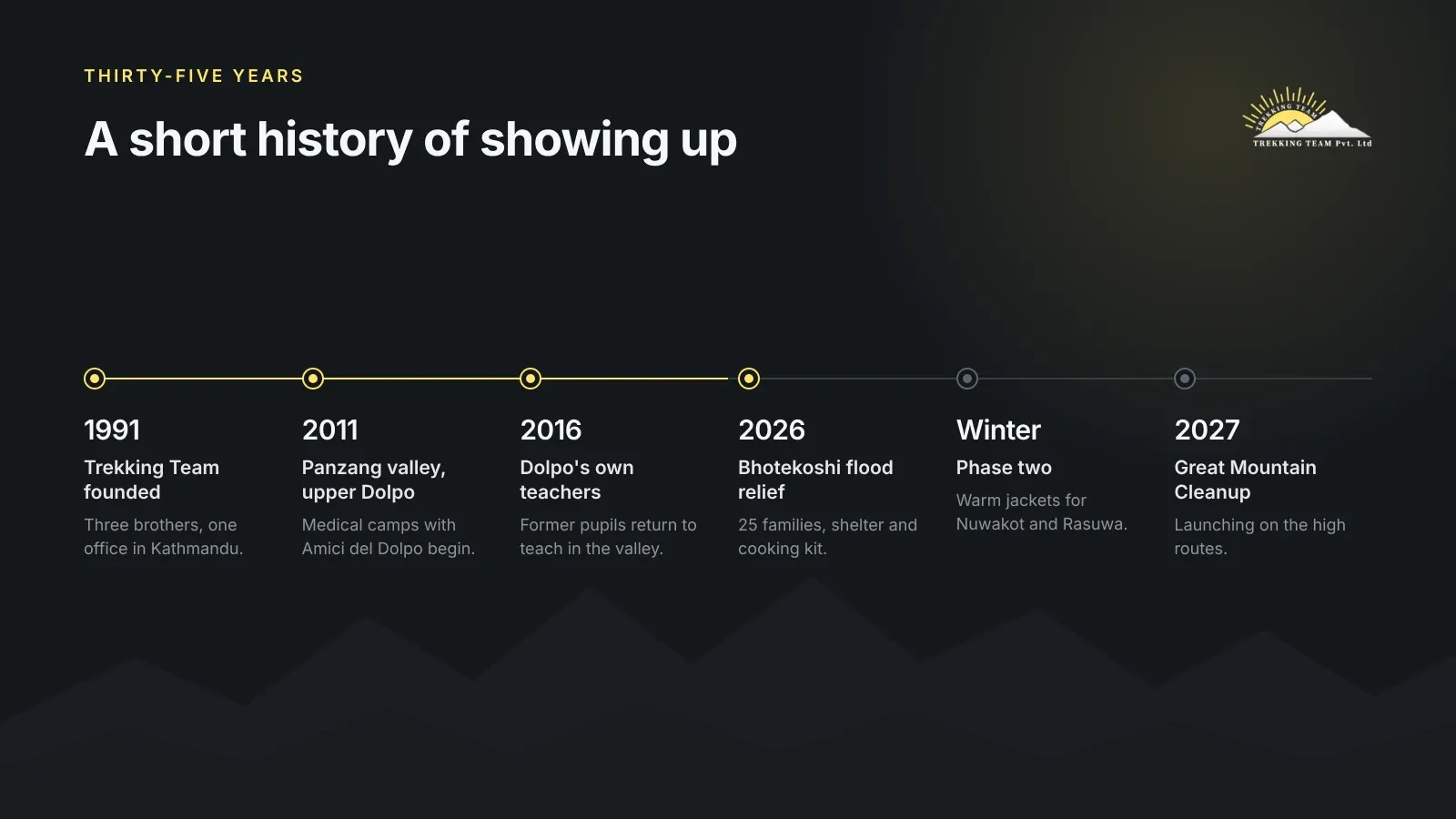
Trekking Team is a family run trekking and expedition company in Kathmandu, registered in 1991 and still owned by the same family. Thirty-five years, roughly ten thousand trekkers, one office in Gongabu. We run flood relief and village projects because the hill economy that pays our wages is the same one that gets wrecked when a river moves.
There is a longer answer too.
Somewhere in the mid-2000s, trekking in Nepal turned into a volume business. Agencies started selling Everest Base Camp the way an airline sells a seat. Forty people to a group, fixed departures, a guide whose name you will have forgotten by the time you get home. It works. Several companies we know got rich doing it.
We did not follow, and the reason is less noble than it sounds. We did not believe we could scale without the quality falling apart, and the quality was all we had. A guide walking with eight people knows who went quiet at Dingboche. A guide walking with forty finds out when somebody has to be carried down.
So we stayed small on purpose. We cap group sizes, we turn work away in October rather than put a weaker team on it, and we have watched competitors overtake us in revenue for twenty years without changing our minds. Staying small also means that when we decide to spend twelve thousand dollars on tents and stoves, there is no board to ask. Three brothers talk about it over tea and then it happens.
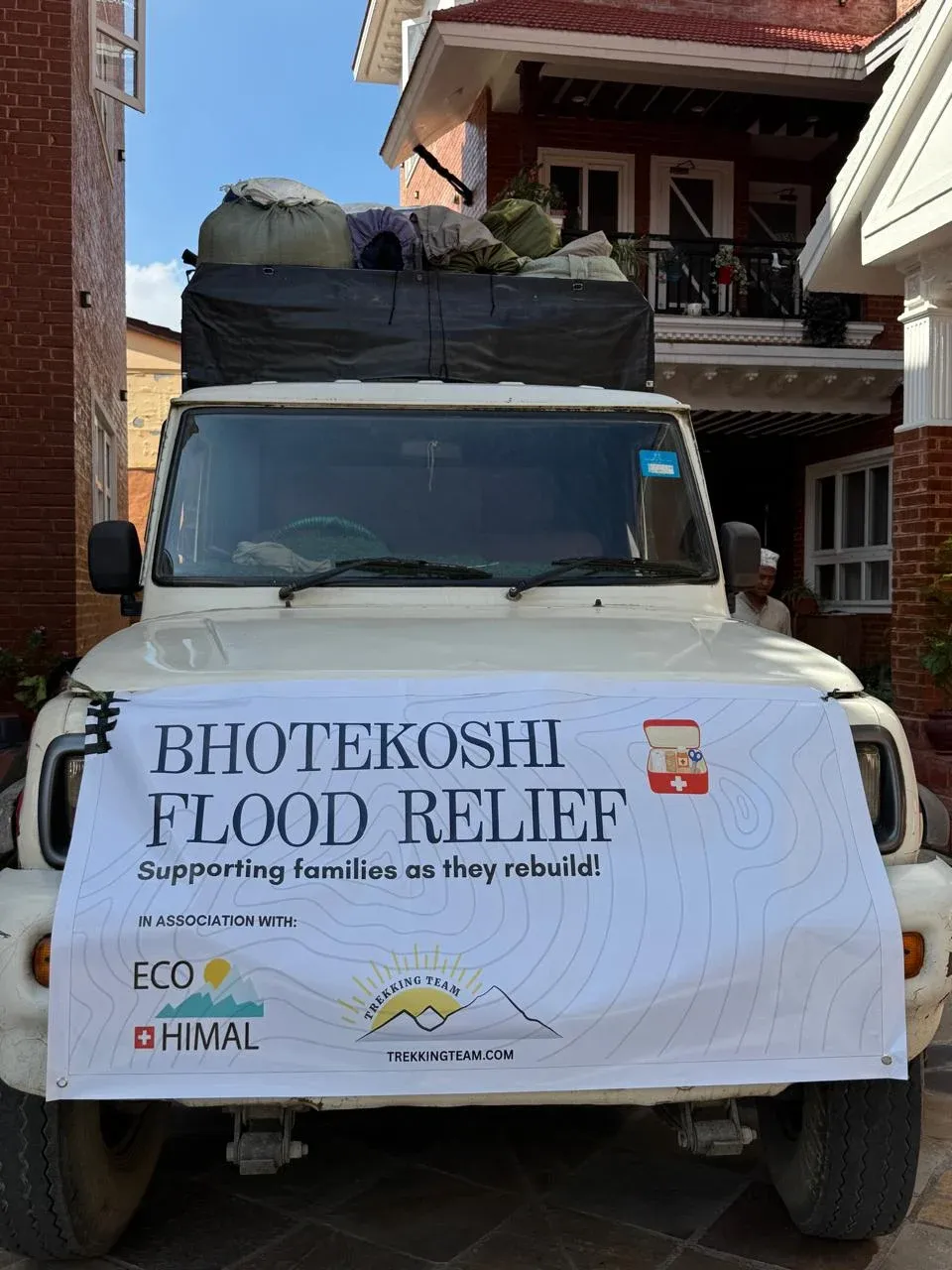
Loaded and roped in the courtyard in Gongabu, the morning we drove down to Betrawati.
What happened in the Bhotekoshi flood of August 2026?
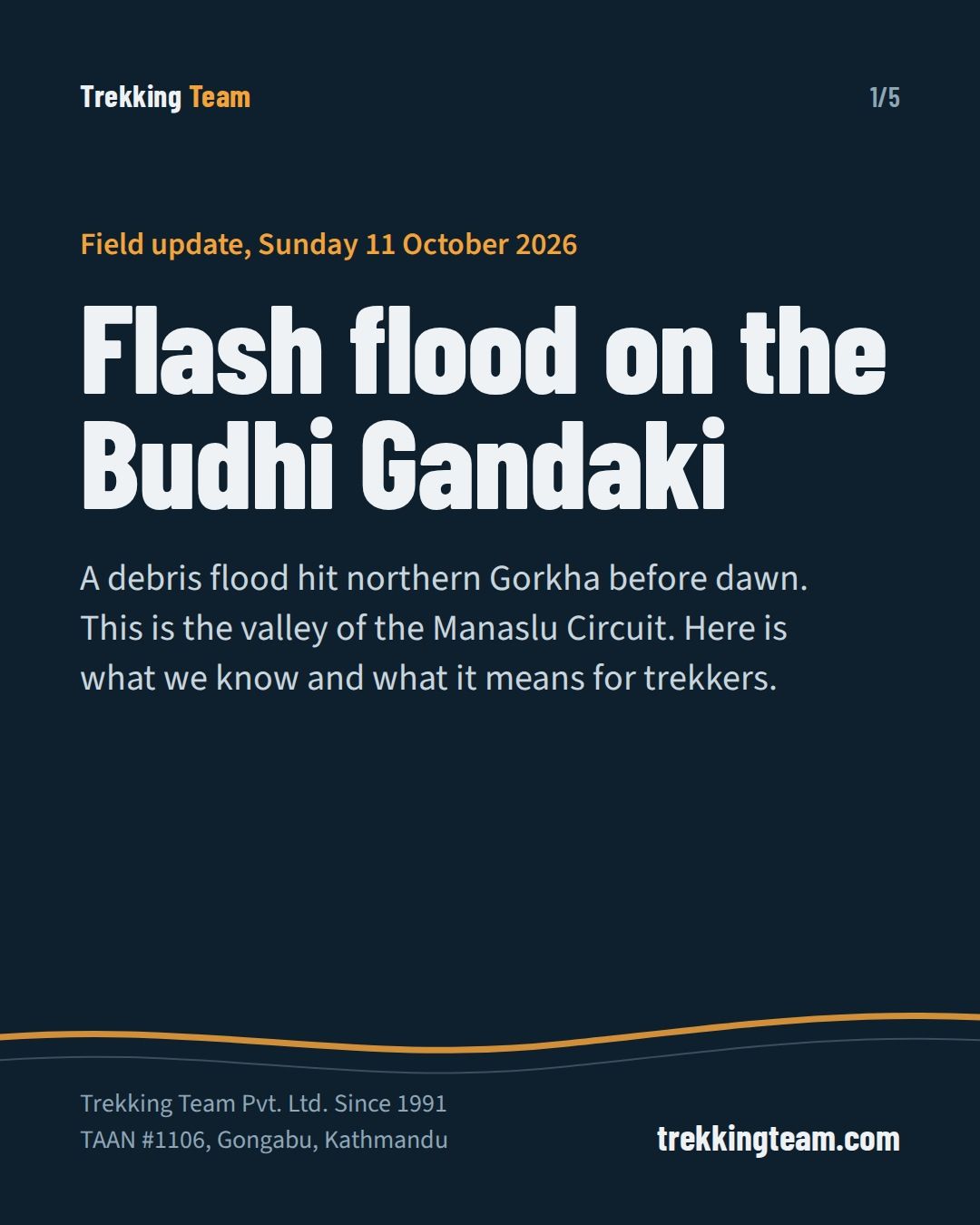
On 26 August 2026 a flash flood tore down the Bhotekoshi and the Trishuli, through the Rasuwa, Nuwakot and Dhading corridor. Houses went into the water. Bridges went with them. The road north closed and stayed closed, which also killed the overland route to Kerung and Kailash for the season.
Here is the number most coverage abroad never carried. Nepal Police put the toll at 1,457 dead and 4,720 still missing as of 10 October, with 589 foreign nationals among the missing. It is the deadliest flood Nepal has recorded in decades, and it is why the roads through that corridor are still held together by temporary arrangements rather than repaired.
Twenty-five tents do not answer a number like that. Nothing we could have done would have. What follows is only what we were able to carry.
We know that corridor the way you know a road you have driven two hundred times. Our vehicles run it. A lot of our staff come from villages strung along it. For us it was never an abstract news item, and that is probably why we moved faster on it than on anything else we have ever done.
What did Trekking Team actually give the flood-hit families?
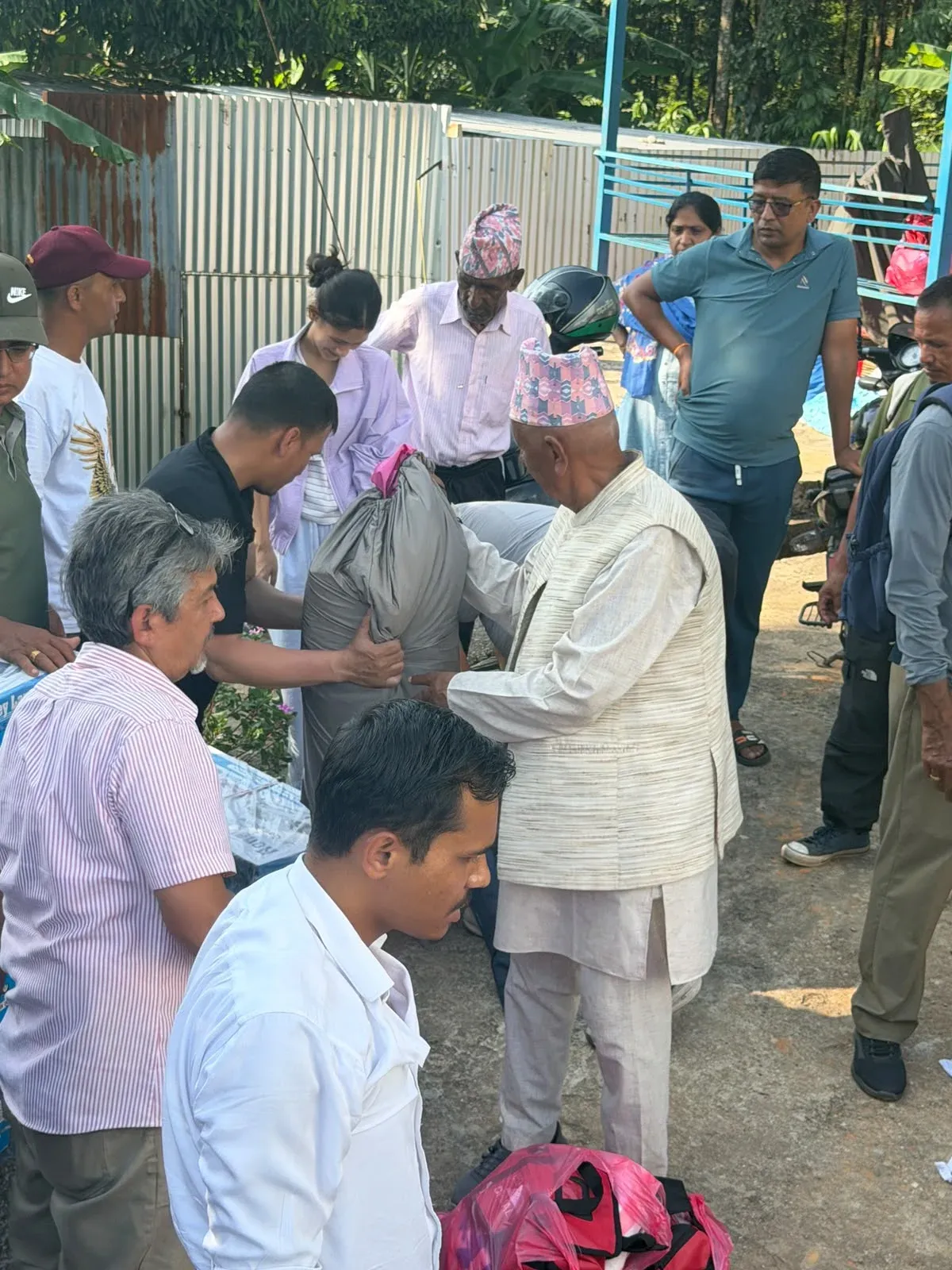
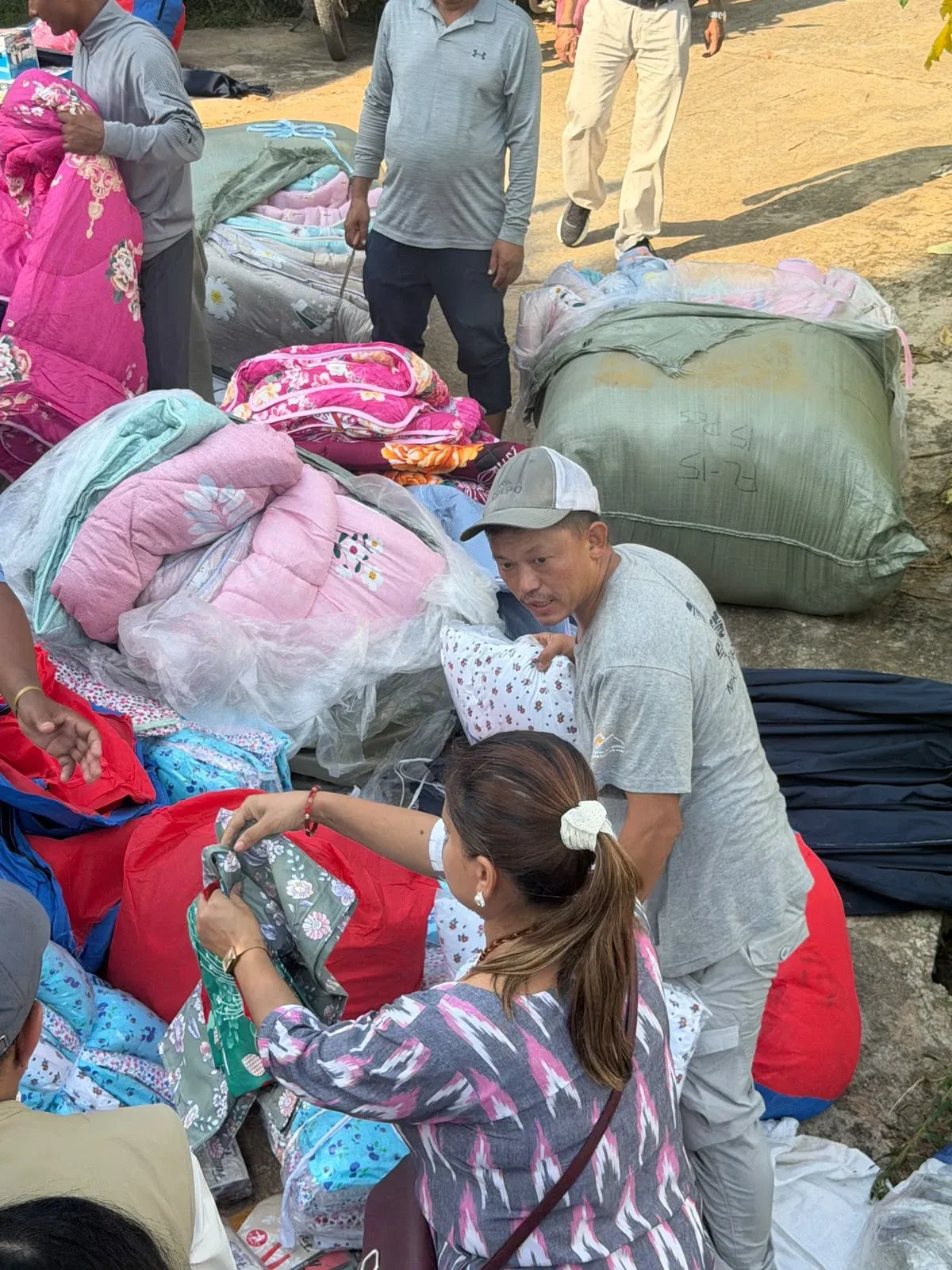
Twenty-five households in Betrawati, Nuwakot, received roughly USD 12,000 worth of shelter and household goods, delivered by hand in association with Eco Himal, Switzerland. Each family got a temporary shelter tent, a two burner LP gas stove, a full set of cooking utensils, bedding, mattresses and blankets, basic household equipment, and medicines.
We bought in Kathmandu, loaded the jeep, and handed everything over in person with the ward representatives standing there. No distribution agency in the middle.
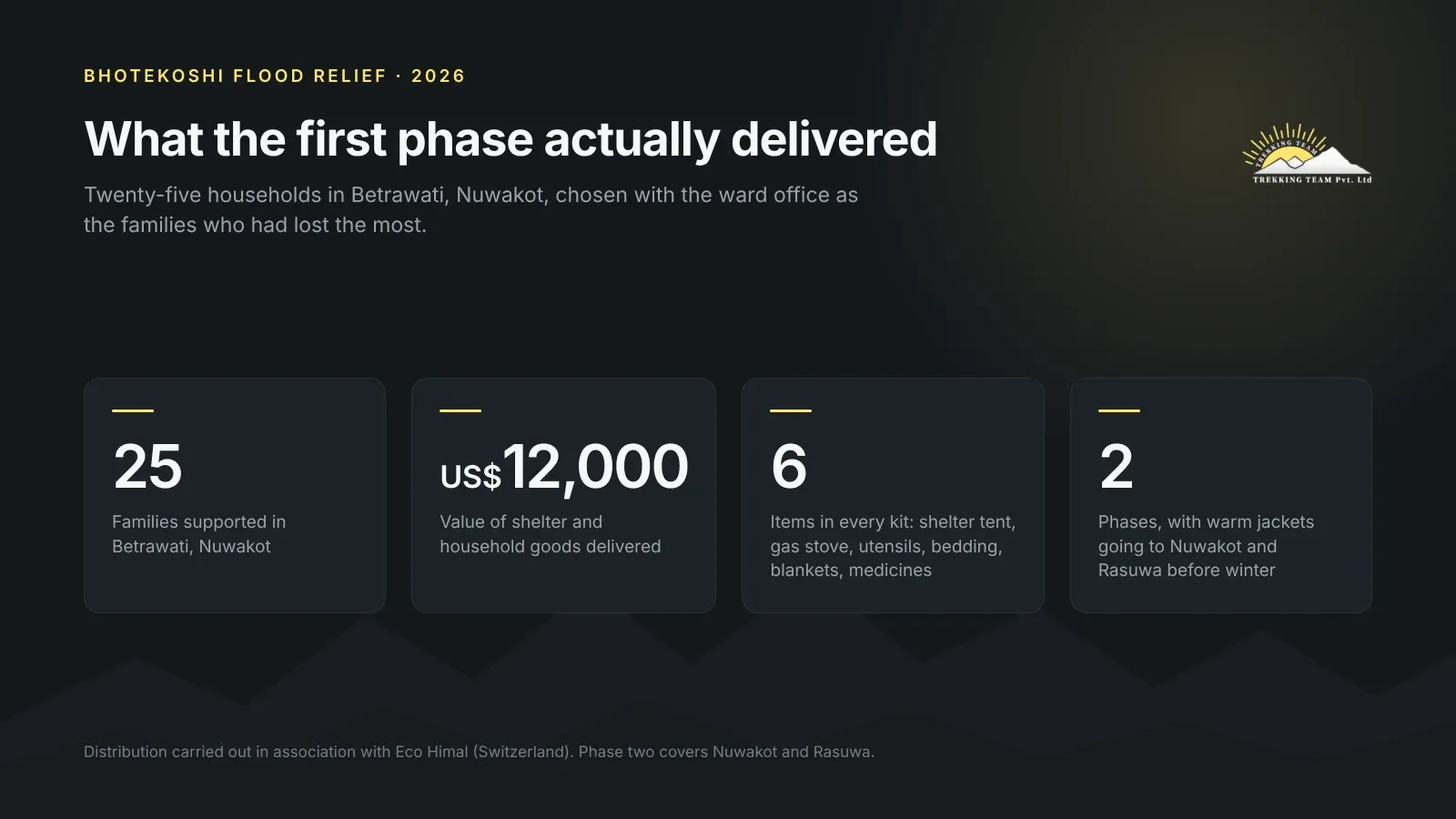
Picking twenty-five families out of a flooded district is the part nobody enjoys. We sat with the ward office and went through it household by household, and the line we drew was between families who had lost a lot and families who had lost everything. People on the second list got a tent. People on the first did not. Both lists were full of people we would have liked to help.
Twenty-five is a small number and we know it. We are a small company. We would rather do one ward properly than scatter a token across five districts for the photographs.
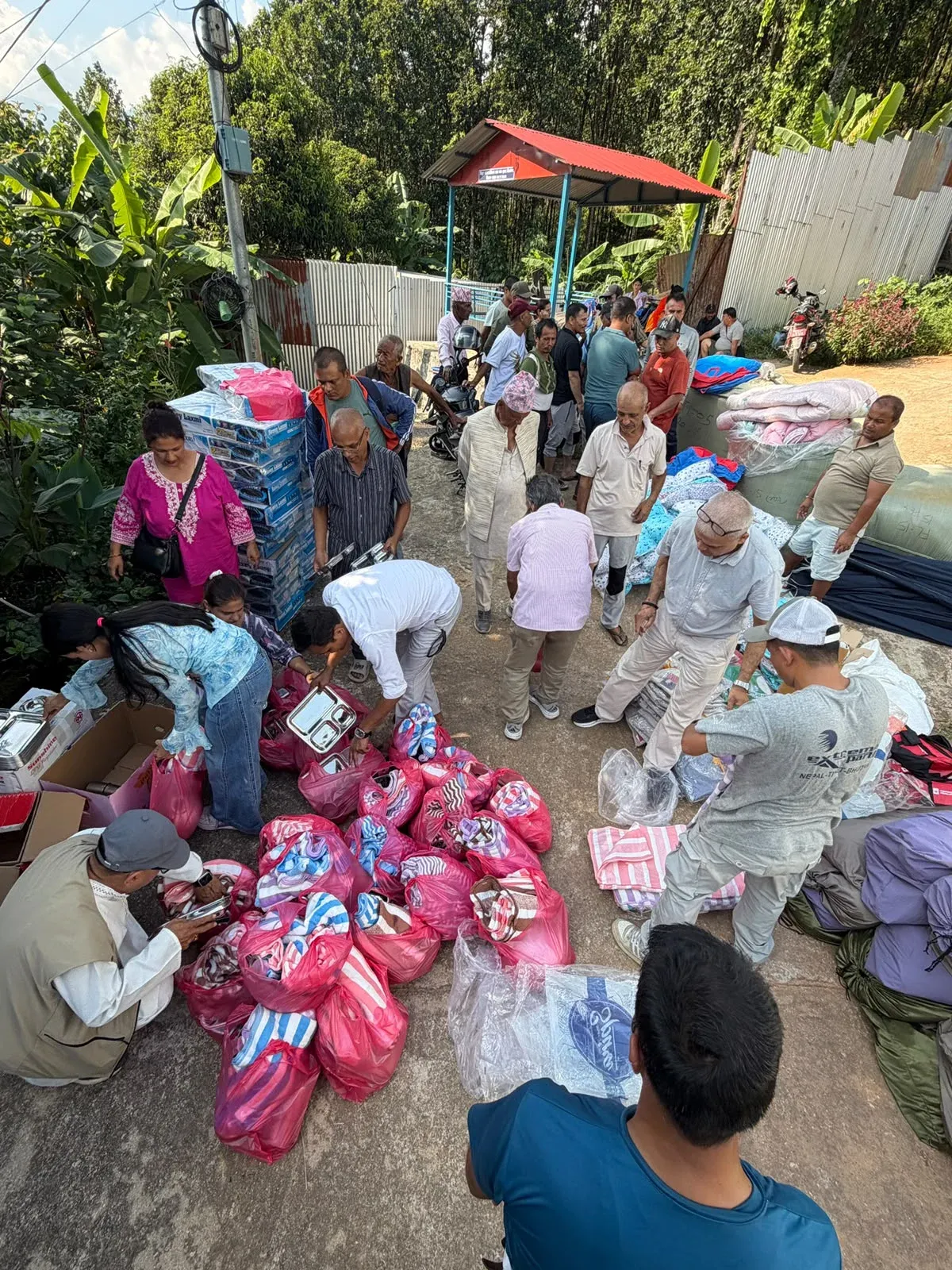
Betrawati, Nuwakot. Everything laid out and counted before anyone picked anything up.
Why a gas stove and not just food?
Because after a flood the firewood is soaked and the kitchen is gone, and a family with no way to cook stops eating properly inside a week. A sack of rice is useless to someone with nowhere to boil it.
That was not our insight. We asked, and that is what people said they needed. The same conversation is why bedding went on the list ahead of several things that would have looked better in a photograph.
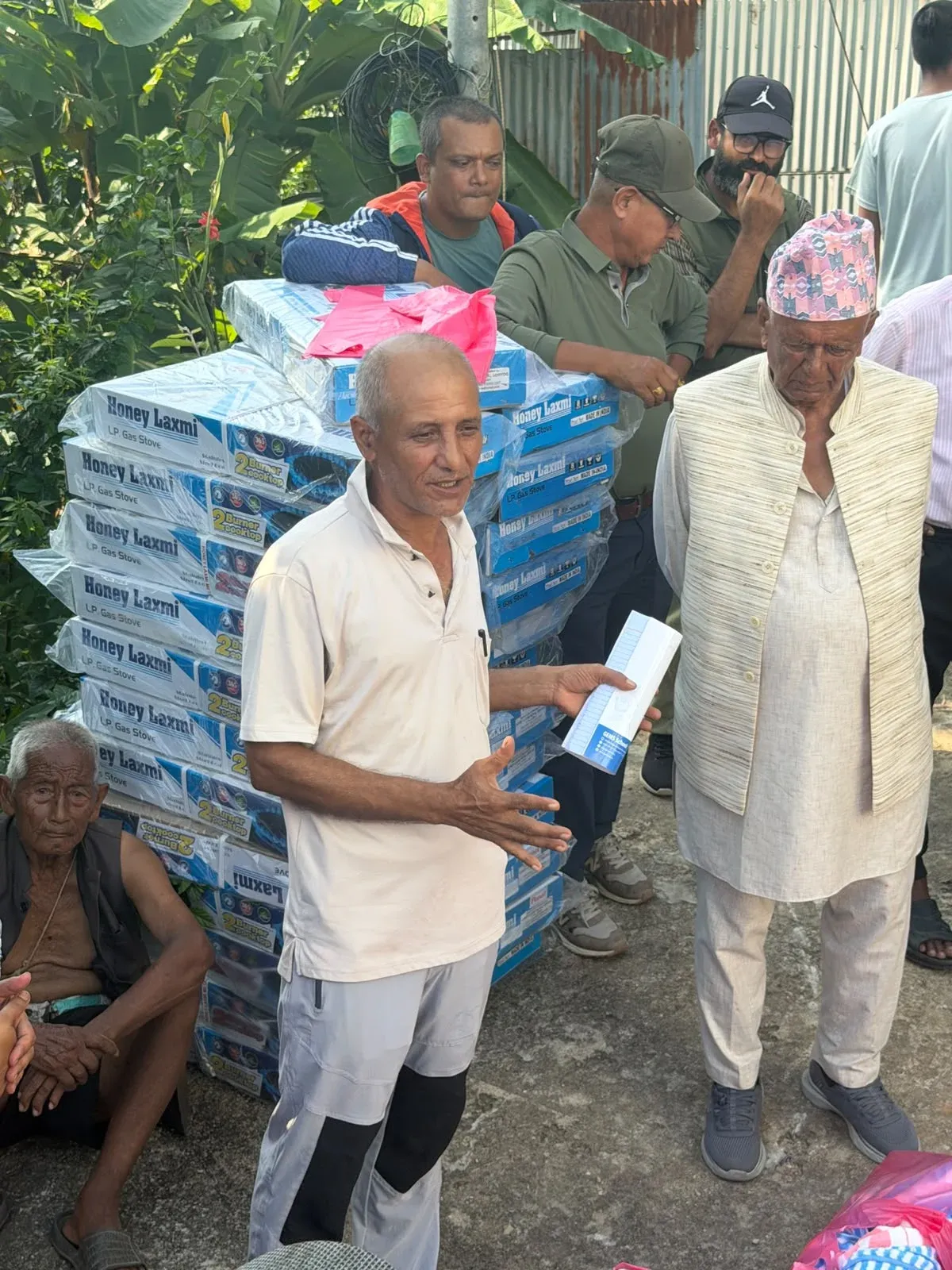
One moment from that afternoon has stayed with most of us. The ward secretary read names off a slip, and an old man in a dhaka topi came forward, took his bundle, and then stood holding it instead of leaving. He did not say thank you. He looked at the pile of things and then at the river, and after a while somebody led him over to sit down.
There is no clean way to write about that. We are not going to try.
What is phase two of the relief programme?
Phase two is warm clothing, mainly warm jackets, going to families across Nuwakot and Rasuwa who lost everything in the flood. It runs before winter, with the same partners.
Phase one solved shelter and cooking. It did not solve the thing that is coming next. Winter at the altitude of upper Nuwakot and Rasuwa is not survivable in whatever you happened to be wearing when the river took your house in August. Families are living under tarpaulin and corrugated tin. By December they will need clothing more than they need almost anything.
The attention has already moved on. The cold has not.
What does Trekking Team do in upper Dolpo?
Our longest running commitment is in the Panzang valley in upper Dolpo, with a Swiss association called Amici del Dolpo. We have helped run the logistics for their medical camps since 2011.
Dolpo is the hardest place in Nepal to reach and close to the hardest to live in. Villages sit above 4,000 metres. Winter hits minus thirty. Until recently the only schooling in those villages happened inside monasteries, which in practice meant most children and nearly all girls got none.
The association has built two primary schools there. Kula Mountain school at Thing-Khyu opened in 2001 and nearly shut in 2004 when the money ran out. A new building went up between 2006 and 2009, and it now has six classrooms, a library, a kitchen, teacher housing and a greenhouse, with around 110 pupils. Tsering Dolma school at Shimen was built between 2008 and 2012 after the villagers asked for it. The monastery gave the land for nothing. The village itself built the retaining wall and the riverbank reinforcement. About fifty children, seven teachers, one cook.
Two details from those schools say more than any mission statement.
The teachers come up from Kathmandu for the school year, April to October, and live on the school grounds because there is nowhere else in the village to stay. The schools close in winter because minus thirty is not a temperature you teach in.
And since 2016, some of the teachers are former pupils. Children who went through Kula Mountain or Tsering Dolma, finished their training down in the cities, and came back to teach for a year or two before getting on with their own lives. That is the entire point of building a village school, and it took fifteen years to show up.
On the health side: medical care in the Panzang valley came from one young Amchi, a practitioner of Tibetan medicine, who could not possibly treat everyone and could not operate. In 2010 an epidemic killed nine people. The regular medical camps started after that, and getting doctors, medicine and equipment into one of the most remote inhabited valleys on earth is the one thing a trekking company is genuinely qualified to do.
The work on the ground belongs to the Dolpo Local Help Association, founded by three people from Dolpo: the painter Tenzin Norbu Lama, the monk Kunga Lama, and Urgen Dorje Budha, who studied in Pokhara and now runs the schools. We are not in charge of anything up there. Dolpo people run it. We help carry it.
What is the Great Mountain Cleanup, and when does it start?
The Great Mountain Cleanup starts in 2027. We are partnering with a local recycling organisation to bring waste down off the high routes, recycle it, and turn it into souvenirs that are then sold by people from underprivileged communities, who keep the income.
Cleanups on Nepali peaks usually end at the same place. A team hauls a few tonnes off the mountain, there is a press photo with the sacks, and the sacks go to a landfill in the valley. The mountain is cleaner and nothing else has changed.
We wanted the rubbish to be worth something to somebody at the end of the chain. So the plan runs the other way round: the waste comes down, the recycler processes it, and what comes out the far side is a product. A trekker buys a souvenir in Kathmandu that used to be a gas canister or a tent pole at 5,000 metres, and the person selling it is someone who needed the work.
It is a loop rather than a cleanup, and that is the only version of this we were interested in running.
Routes, dates and the recycling partner are being finalised. We would rather publish them once than publish them twice, so this section will be updated when it is settled rather than filled with intentions.
How can trekkers help Nepal after the 2026 floods?
Come to Nepal and spend money in the hills. That is not a line. Tourism is a large share of how the Nepali hill economy actually functions, and an empty teahouse in October does more damage to a village than most visitors realise.
The flood made international news. The reopening did not. So, plainly: the Everest region is running normally, with flights and access as usual. Annapurna is running normally. Langtang runs on an alternative approach through Dhunche. The mountains of Nepal are open.
We are not going to ask you for a donation. You are a client, not a donor, and mixing the two is how trekking companies end up with a charity page that exists to sell treks. If you want to give directly to flood relief, the Prime Minister Disaster Relief Fund takes international donations at pmdrf.nchl.com.np and the money does not pass through us.
Common questions
Is Nepal safe to trek after the 2026 floods?
Yes, in the main trekking regions. The Everest region is unaffected and running on normal flights and access. Annapurna is running normally. Langtang is open on an alternative approach via Dhunche. The damage is concentrated in the Rasuwa, Nuwakot and Dhading road corridor, and the overland route to Kerung and Tibet remains closed, so Kailash trips are currently sold as fly in and fly out.
How many families did Trekking Team support after the flood?
Twenty-five households in Betrawati, Nuwakot, in phase one, with around USD 12,000 of shelter and household goods. Phase two covers warm clothing for families across Nuwakot and Rasuwa before winter.
Who did Trekking Team partner with for the flood relief?
Eco Himal, Switzerland. The distribution itself was carried out with the local ward office in Betrawati, which identified the households.
Does Trekking Team support schools in Nepal?
We support two primary schools in the Panzang valley in upper Dolpo through the Swiss association Amici del Dolpo and the Dolpo Local Help Association: Kula Mountain school at Thing-Khyu and Tsering Dolma school at Shimen. We have run logistics for the valley's medical camps since 2011.
What is the Great Mountain Cleanup 2027?
A waste removal programme on Nepal's high routes starting in 2027, run with a local recycling organisation. Waste collected on the mountains is recycled and made into souvenirs, which are then sold by people from underprivileged communities who keep the income.
Why does Trekking Team keep its groups small?
Because a guide can genuinely look after eight people and cannot genuinely look after forty. Small groups are the reason we can spot altitude problems early, and they are also why we have stayed roughly the same size since the 1990s instead of scaling into a volume operator.
Where this leaves us
Thirty-five years, still family run, still deliberately small. Two schools and a yearly clinic in a valley most people will never see. Twenty-five families in Betrawati with tents, stoves and bedding. Jackets going north before the cold. A cleanup starting in 2027 that we hope turns into something more useful than a photograph of full sacks.
None of it is large. It is what a company our size can actually carry, and we would rather carry a small thing every year than announce a big one once.
If you want to talk about any of it, or you are coming to Nepal and want to walk somewhere that needs the visitors, get in touch. We answer our own emails.