Nepal Travel Advisory 2026: Flood Updates, Roads, Flights and Trekking Access
Trekking Team travel desk | Kathmandu, Nepal
Last updated: 14 October 2026. First researched edition: 11 October 2026. All local times are Nepal time (UTC+5:45).
Coverage: autumn 2026, with planning notes for the transition into winter.
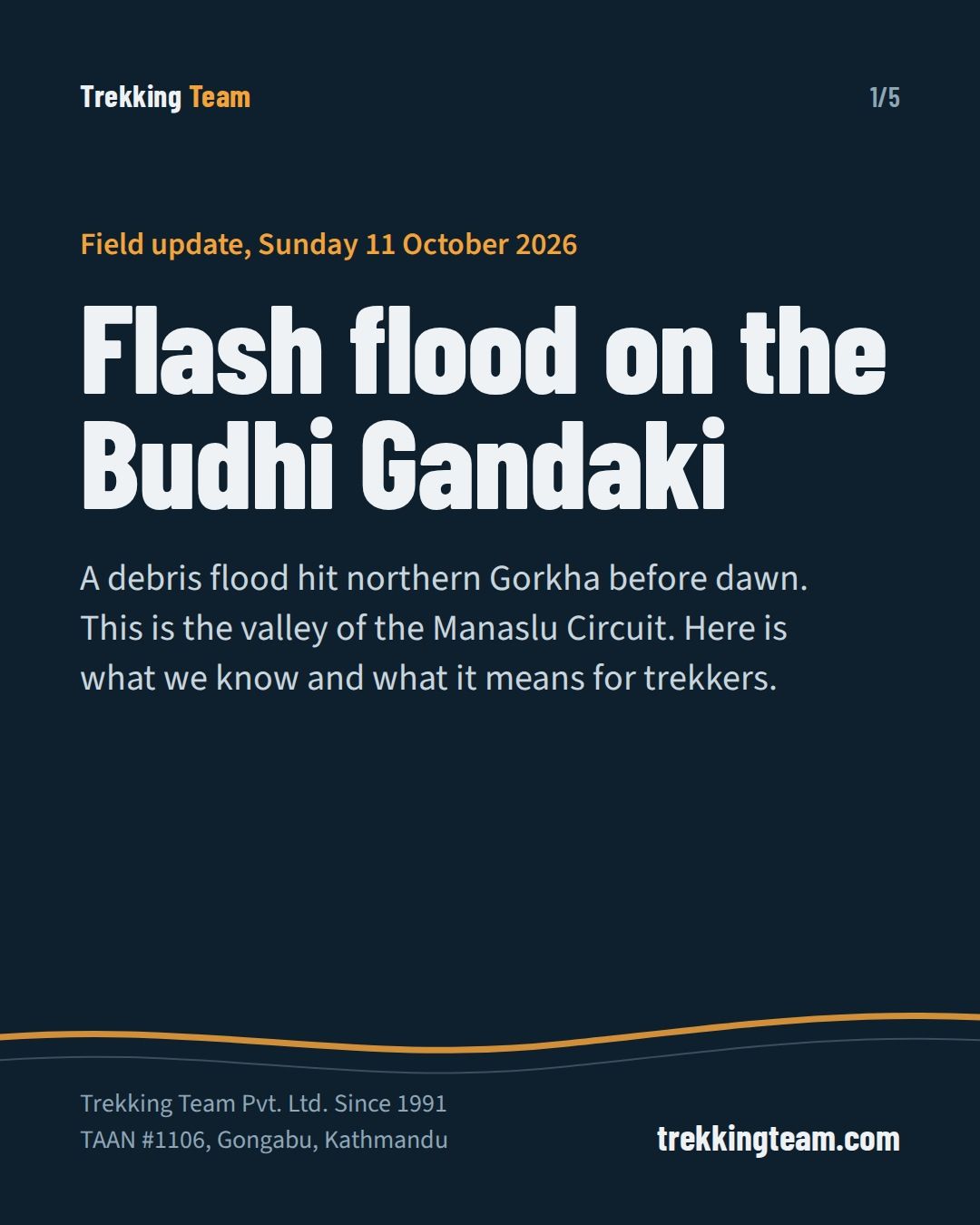
Nepal travel plans this autumn need to be checked journey by journey. The most urgent development is the 11 October Budhi Gandaki flood in Gorkha, which has cut off northern Gorkha and stopped the Manaslu and Tsum Valley season there. Behind it sits the far larger August Bhotekoshi disaster, which killed 1,457 people and left 4,720 missing, and which is the reason so much of the road network in Rasuwa, Nuwakot and Dhading is still provisional. Elsewhere, road repairs are restoring connections, but a bridge reopening or a flight schedule does not establish that an entire itinerary is ready to operate.
Our advice is to postpone departures into the affected Budhi Gandaki corridor, reconfirm road transfers immediately before travelling, and consider flights where they bypass disrupted highways. For other regions, assess the road to the trailhead, the walking route and the return journey separately.
This advisory brings together dated official information, reporting that quotes responsible authorities, airline notices and practical trip-planning guidance. It is a researched travel-desk update, not a claim that our guides have personally inspected every location. Where current access has not been independently established, we say so. Any evacuation instruction or local closure takes priority over this page.
The latest changes that matter to travellers
| Area | Latest evidence reviewed | What we recommend |
|---|---|---|
| Manaslu and Tsum Valley access | 14 October: northern Gorkha cut off. Five bridges lost in Dharche, the Sardibhir cantilever bridge out of Chum Valley swept away, and no trail at all between Filim and Jagat. More than 100 foreign trekkers were stranded and many left by helicopter. MCAP says there is little prospect of an immediate reopening. | Postpone departures through this corridor. If you are on the route, arrange a helicopter lift rather than walking the damaged sections. |
| Prithvi Highway at Galaundi, Dhading | 11 October: reported reopened to all traffic after a 160-metre section was cut into the hillside. The minister urged extra caution at night. | Confirm the position on your travel date. Treat night driving on the repaired section as the higher risk. |
| Betrawati, Rasuwa access | 11 October: a replacement bridge over the Falakhu Khola reportedly began carrying vehicles. | Recheck the entire route to your intended trailhead; this is a local reopening. |
| Beni–Jomsom road | 11 October reporting says traffic resumed on the evening of 9 October. | Obtain a fresh check for the onward Mustang journey and the return route. |
| Trishuli and Narayani riversides | 11 October: very high flood risk warned along the Trishuli corridor as far downstream as Benighat, with alerts around Mugling, Chitwan and Nawalparasi. | Avoid riverbank activities in warned areas and follow local instructions. |
| Lukla flights | Tara Air publishes a Ramechhap operating period of 25 September – 15 December 2026. | Check your actual airline and ticket; arrange a verified transfer to the correct airport. |
How to read this page. “Reported open” means a named source reported passage at a particular time. It is not an assurance of unrestricted passage today. “Not verified” means we do not have sufficient current evidence; it does not automatically mean closed. Recommendations to defer travel are our assessment unless an official order is explicitly identified.
The Budhi Gandaki flood and the Manaslu season: where it stands on 14 October
Short answer: northern Gorkha is cut off, the Manaslu and Tsum Valley trekking season there has effectively stopped, more than a hundred foreign trekkers were stranded, and helicopter evacuation has been the way out for many of them. No deaths have been reported in this flood. Five villagers were out of contact as of 12 October.
What is cut
The Kathmandu Post reported on 14 October that the flood has severed northern Gorkha's lifeline. In Dharche Rural Municipality five bridges were swept away, four footbridges and one motorable bridge, leaving around 1,000 people cut off on either side of the river, with road damage at four separate points. In Chumnubri Rural Municipality the road is damaged around Sirdibas, Jagat, Salleri-Paiyun, Yaru, Khorlabesi and Kalubhir, and the Sardibhir cantilever bridge, the key way out of Chum Valley, has gone. At Arughat the damaged bridge is being rebuilt and residents are crossing on a suspension bridge.
There is no trail at all between Filim and Jagat.
Trekkers on the route
Of 97 tourists registered at Jagat, 12 turned back and the rest were stuck for three days, according to Bhuwan Ojha of the Manaslu Conservation Area Project. Seventeen returned from Lokpa and 19 foreign tourists were lifted out by helicopter. Chum Valley was holding 107 foreign and 80 Nepali visitors, and some groups have been chartering helicopters to get out. Trekkers who had already crossed into Nubri were still planning to go over Larkya La.
Reuters reported on 12 October that more than 100 foreign trekkers were stranded along the Manaslu trail. Rescuers brought out 321 people that day, including 12 foreigners, and the army continued the operation on 13 October as the river level dropped.
Ojha said there is little prospect of the routes reopening immediately. No official timeline has been given for rebuilding the bridges or the trail.
What caused it
A predawn landslide on Sunday 11 October blocked the Budhi Gandaki about 100 km west of Kathmandu. When the blockage gave way the resulting surge of mud and debris destroyed more than 200 homes and damaged three hydroelectric plants, according to national disaster authorities. It was a dry landslide rather than a glacial lake outburst.
The damage in the villages
In Dharche ward 1 more than two dozen hotels were destroyed, with losses the ward chair Ram Singh Gurung put at around Rs 100 million. Between Yarukhola and Dobhan, 24 houses were destroyed and 15 damaged, displacing 76 people with 70 more at risk. In Chumnubri ward 3, 23 families lost their homes and around 200 people need assistance, and hotels at Tallo Bagar in Jagat were swept away. In Arughat wards 3 and 5, 64 families were displaced, 40 of them housed at Bhumithan. Nineteen people were displaced in Tripurasundari ward 2 in Dhading.
The National Disaster Risk Reduction and Management Authority says relief has gone to Gorkha and Dhading, including 11,216 kg of rice to Gorkha against an estimated need of 6,960 kg. Local representatives say it has still not been enough in some wards, and that roads have to be rebuilt before the remote villages can be reached properly.
Our recommendation, unchanged and now firmer
Postpone Manaslu Circuit and Tsum Valley departures that use this corridor. This is our assessment as an operator rather than an official ban, but with the Filim to Jagat trail gone and no repair timeline, we would not send a group in. If you are already on the route and want out, talk to your operator about a helicopter lift rather than trying to walk the damaged sections.
The emergency reported on 11 October concerns the Budhi Gandaki River in Gorkha, with the heaviest damage in Chumnubri and Dharche rural municipalities. It should not be confused with the 26 August Bhotekoshi–Trishuli flood in the Rasuwa corridor. The distinction matters because the two events affect different approaches to trekking areas.
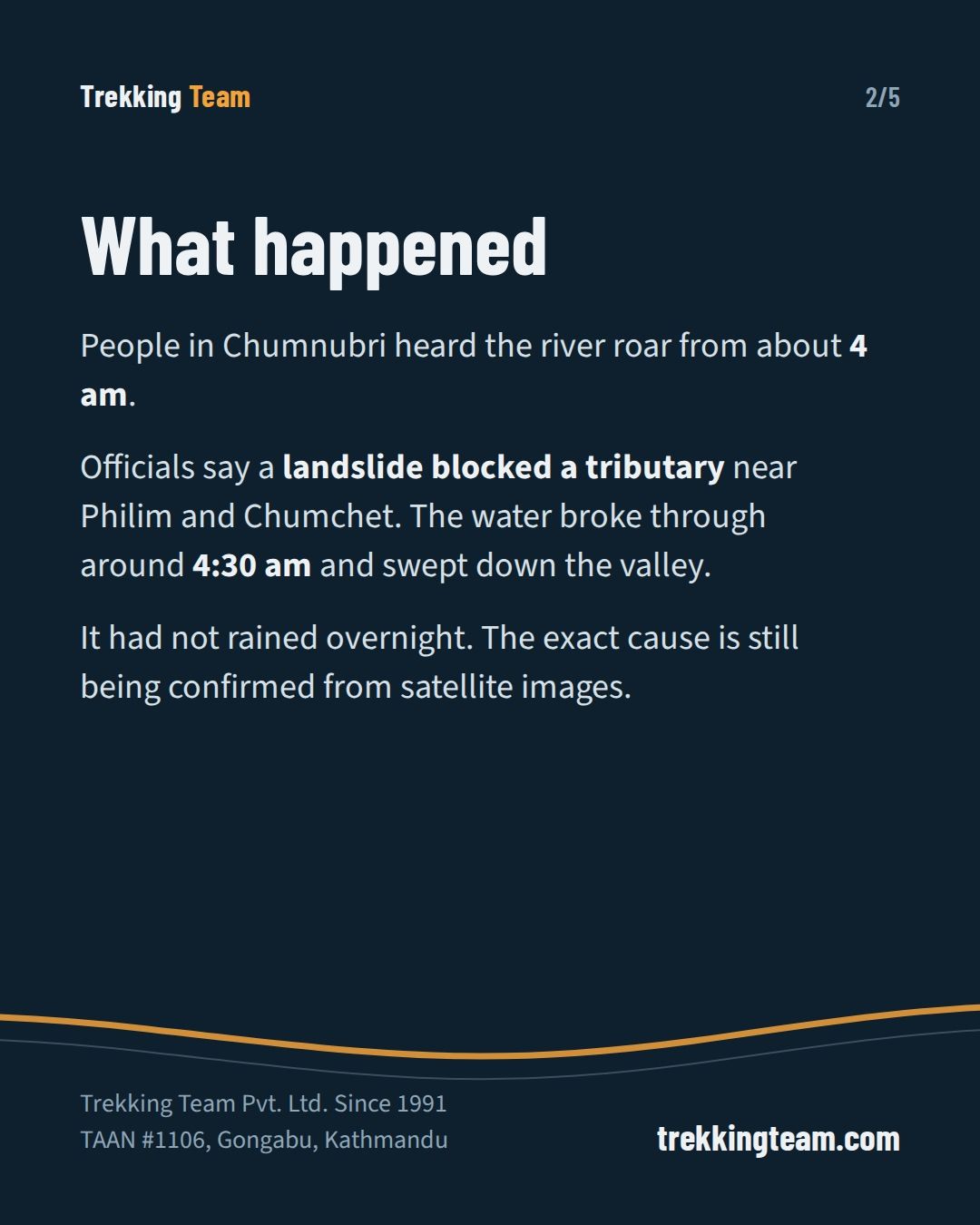
The Department of Hydrology and Meteorology has said a landslide near Chumchet may have blocked a tributary, with the sudden release of water triggering the flood. Satellite imagery shows a large landslide in the area. This is a preliminary account, not a final technical determination, and we are not calling it a confirmed glacial-lake outburst.
Four bridges are reported destroyed:
- The suspension footbridge connecting Nyakchet and Sirdibas
- The suspension footbridge connecting Machhakhola and Kerauja
- The motorable iron bridge at Soti, linking wards 2 and 3 of Aarughat Rural Municipality
- The Aarughat bridge connecting Gorkha and Dhading districts
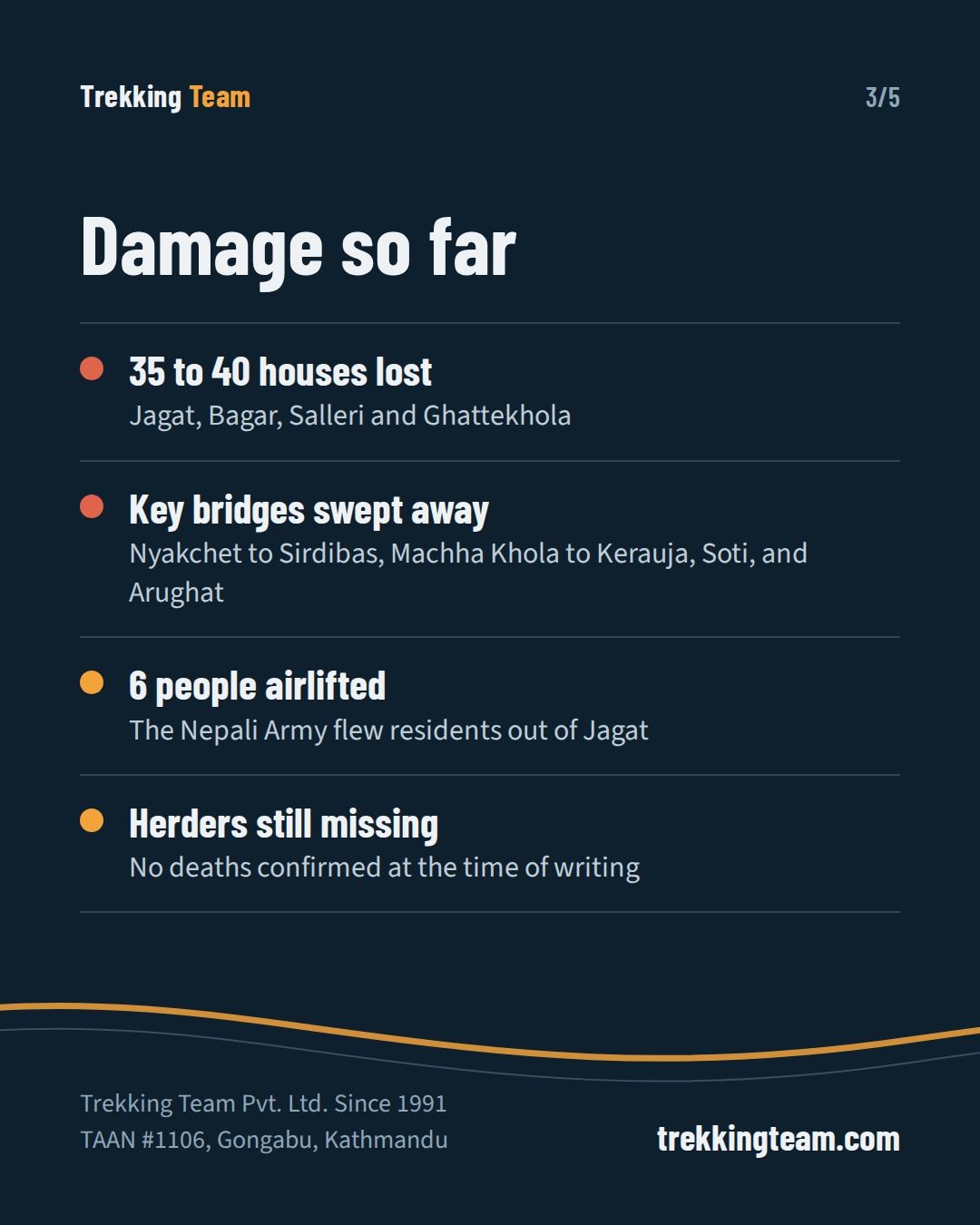
A fifth bridge, linking Nyakchet and Philim Bazar, is reported damaged. The first two are footbridges on the Manaslu trekking route itself, not road bridges — which is why a different vehicle approach cannot solve this.
An estimated 35 to 40 houses were swept away at Jagat Bagar, Salleri and Ghattikhola, with further houses inundated at Machhakhola and around 20 to 22 at risk at Salleri in Dharche-3. The Nepali Army rescued six people by helicopter from Jagat. Preliminary reports confirmed no deaths, but four people sheltering on the banks of the Ungilung river at Chumchet are missing, and four to five herders travelling from Sirdibas towards Chumling are out of contact.
Our recommendation for Manaslu and Tsum Valley
Postpone new Manaslu Circuit and Tsum Valley departures that require this corridor. A different jeep approach cannot replace a missing walking connection farther upstream. An itinerary should resume only after the relevant authorities and local teams establish a continuous, usable route, including its bridges, overnight stops and emergency options.
For trekkers already in the region, do not assume that descending towards the original pickup point is possible. Stay in contact with your guide and local authorities, remain at a suitable safe location, and obtain instructions for your precise position. Do not attempt to cross a damaged bridge or improvise a riverside bypass to meet a flight home.
The August Bhotekoshi–Trishuli disaster remains relevant
The scale of the 26 August flood should be stated plainly, because most coverage abroad has moved on. Nepal Police headquarters put the toll at 1,457 dead and 4,720 still missing as of 10 October. Deaths by district: Chitwan 369, Rasuwa 236, Nawalparasi East 232, Nawalparasi West 222, Nuwakot 205, Gorkha 80, Dhading 73, Tanahun 38. Of the bodies recovered, 1,438 remain unidentified and DNA samples have been taken. Some 1,231 people are still living in holding centres.
Earlier figures from the National Disaster Risk Reduction and Management Authority, dated 6 September, recorded 589 foreign nationals among the missing, 13,104 people rescued and 6,075 injured treated.
We say this here because it changes how you should read every road and bridge item further down this page. The infrastructure in the Rasuwa, Nuwakot and Dhading corridor is not being repaired after an ordinary monsoon. It is being rebuilt in the middle of the deadliest flood event Nepal has recorded in decades, with search operations still running and thousands of families displaced. A road described as reopened is a working arrangement, not a restored highway.
The World Health Organization identifies 26 August as the date of severe flooding along the Bhote Koshi and Trishuli corridors, affecting several districts in central Nepal. Recovery from that event is still part of the transport picture.
UK Foreign Office advice continues to describe damaged infrastructure in the Rasuwa and Nepal–China border area and warns that affected slopes can remain unstable. A dry day does not establish that an eroded road foundation or a damaged slope is secure.
Place names need care. Do not assume that every reference to “Bhotekoshi”, “Tatopani” or a “border road” identifies the same destination. Confirm the district, river crossing and exact road section before changing a journey.
Nepal road conditions and alternatives
Kathmandu to Pokhara and the Prithvi Highway
The picture has changed repeatedly. A 1 October report described renewed movement on major highways. On 9 October a gas-tanker incident near Galchhi and road subsidence at Galaundi brought a fresh closure. As of midday on 11 October, the highway at Galaundi is reported reopened to all traffic, with a 160-metre section cut into the hillside to restore passage, and the Infrastructure Development Minister urging extra caution for night travel.
A repaired section is not the same as a repaired highway. For a departure today, ask the transport operator to establish whether your vehicle type is permitted, whether a closure window is expected for further works, whether the complete Kathmandu–Pokhara journey is passable beyond the repaired section, and where the vehicle can wait safely if movement stops.
A Kathmandu–Pokhara flight is a practical alternative to investigate. Confirm the actual flight, seat availability and baggage allowance before replacing a road booking. Arrival in Pokhara still leaves the local transfer and walking route to be checked.
Kathmandu to Chitwan and the Narayanghat–Mugling corridor
This journey needs checks on both the approach from Kathmandu and the onward section towards Narayanghat. Today's warnings also concern the Trishuli and Narayani riverbanks as far downstream as Benighat, with alerts around Mugling, Chitwan and Nawalparasi. A hotel operating inland does not establish that canoeing, riverbank visits or every park activity is appropriate.
Consider a Kathmandu–Bharatpur flight followed by a separately verified hotel transfer. Ask the accommodation provider which activities are actually available and whether local flood restrictions affect its access road.
BP Highway and travel to Ramechhap
Two-way BP Highway traffic was reported restored on 29 September, including temporary arrangements after flood damage. That provides a dated baseline, not a clearance for today.
For Lukla departures the road transfer to Manthali is part of the flight plan. Reconfirm the road, pickup arrangement and departure airport with your airline or operator. Where practical, travelling in daylight and staying near the airport reduces dependence on a rushed overnight transfer. UK travel advice warns against night bus travel. Do not treat a standard drive time as a promise; a queue or repair window may matter more than distance.
Rasuwa, Dhunche and Syabrubesi
There is a positive update at Betrawati: reporting on 11 October, quoting the Nepali Army, says vehicles have begun using the replacement Falakhu Khola bridge.
Do not translate that into “Kathmandu–Syabrubesi fully restored”. Earlier reporting identified separate works and missing connections along the corridor. Ask where a vehicle can actually reach, whether a vehicle change or a walking section is required, and which crossing connects to the intended Langtang approach.
Besisahar to Chame and the Annapurna Circuit approach
The road was reported reopened as far as Chame on 7 October using temporary tracks. Reaching Chame does not establish unrestricted vehicle access beyond it, or a clear high pass.
Agree the actual walking start before departure. Do not remove acclimatisation nights to recover time lost on the road. A shortened approach by jeep changes how quickly your sleeping altitude increases.
Beni, Jomsom and Mustang
Reporting on 11 October says the Beni–Jomsom road reopened on the evening of 9 October, with vehicles leaving Mustang afterwards. This supersedes earlier reports that the road was cut off.
Check the local transfer through to your intended overnight stop, especially if travelling further towards Muktinath, Kagbeni or Upper Mustang. The reopening of this road is not confirmation that tourists can cross the international border at Korala. Tara Air also lists Pokhara–Jomsom flights from 13 September to 15 December 2026; a scheduled flight still depends on operational and weather conditions.
Trekking regions across Nepal
The broadest recent regional summary we reviewed was a 9 October report of a Trekking Agencies' Association of Nepal advisory dated 8 October. It described Everest, Kanchenjunga, Makalu, Rolwaling and Helambu as open, listed operating Annapurna foothill treks, and reported reopened Thorong La, Tilicho and Nar Phu access. It also covered Upper Mustang and the western regions. This is a dated association assessment reported by a news outlet, not our independent inspection. Its favourable Manaslu and Tsum assessment predates the 11 October flood and must not guide a new departure.
Everest Base Camp, Gokyo and the high passes
Start by confirming the operating airport, airline and transfer. Tara Air's notice specifies Ramechhap for its seasonal Lukla services; do not assume every other carrier has identical arrangements.
Gokyo, Cho La and the Three Passes require route-specific checks. An accessible main valley or an operating Lukla flight does not establish that a pass is clear. Ask about the planned crossing day, local snow conditions and the option of a lower route or an extra overnight stop.
Allow spare days before an international flight. We recommend discussing at least two contingency days for a mountain-flight itinerary, and more where the onward ticket is difficult to change. This is a planning allowance, not a guarantee against a longer disruption.
Annapurna Base Camp, Mardi Himal, Poon Hill and Khopra
Consider these individually when replacing a disrupted trip. A shorter trek can absorb transport delays without rushing a high-altitude itinerary. For Annapurna Base Camp, check the intended approach, bridges, lodges and conditions in the upper valley. For Mardi Himal, check the ridge and the turnaround point. For Poon Hill or Khopra, check the village sequence and the vehicle pickup location. Do not substitute “Annapurna is open” for those questions.
Annapurna Circuit, Tilicho Lake and Nar Phu
Treat each high route as its own decision. A pass crossed by another group several days ago may present different conditions on your arrival. Nar Phu's reported reopening involved a temporary bridge; confirm the crossing rather than relying on the earlier report. For any route involving Thorong La, Tilicho or Kang La, retain a weather contingency and an option to turn back.
Langtang, Gosaikunda and Helambu
The question is the complete approach, not only the state of a valley trail. Betrawati's reopening is useful progress, but the vehicle endpoint and onward connections must be checked separately. An approach through Helambu changes the walking programme and may introduce a high crossing; it is not a like-for-like substitute for a road transfer to Syabrubesi. Review total days, sleeping elevations, supplies and exit options before accepting it.
Ganesh Himal and Ruby Valley
Do not reuse older advice to approach through Arughat. Today's bridge damage makes that assumption particularly unsuitable. Request an exact route description from the proposed vehicle endpoint to the first overnight stop, followed by confirmation of the later river crossings.
Kanchenjunga, Makalu and Rolwaling
These need their own access and weather assessment. For the Kanchenjunga Circuit, ask about both sides of the itinerary rather than a single gateway town. For Makalu and Rolwaling, request recent information for the intended approach, bridges and high sections. We have not independently verified every connecting trail or road.
Dolpo, Rara, Humla and far-western routes
A regional statement is useful context but is not a departure clearance. Obtain current flight or road information, confirmation that the planned camps or accommodation can support your group, and a realistic return plan. Remote routes are poor last-minute substitutes unless the logistics have been rebuilt for that destination.
Trekking peaks and expeditions
Mera, Island Peak, Lobuche East, Himlung and other climbing objectives need separate expedition assessments. A trekking advisory cannot establish the condition of glaciers, fixed ropes, camps or summit routes. Request an objective-specific briefing before committing.
Alternative ways to reach Nepal and move within the country
Kathmandu's Tribhuvan International Airport is Nepal's main international arrival point. A damaged northern border road does not establish an airport closure. Equally, an international ticket does not establish that an onward trek is accessible. Allow time between an international arrival and a separate domestic ticket.
| Journey under consideration | Air alternative to check | What still needs confirmation |
|---|---|---|
| Kathmandu–Pokhara by road | Kathmandu–Pokhara | Airport transfer, local trailhead road and trek conditions |
| Kathmandu–Chitwan by road | Kathmandu–Bharatpur | Hotel access, riverside warnings and available park activities |
| Kathmandu–Lumbini by road | Kathmandu–Bhairahawa | Ground transfer to Lumbini |
| Pokhara–Jomsom by road | Pokhara–Jomsom | Flight operation, onward road or trail and return option |
Published route information establishes options to check, not guaranteed seats or same-day operation.
Entering overland from India. Verify that the intended immigration post processes your nationality and travel document, that your Indian permission allows the intended journey, and that transport operates on both sides. An open border for local movement does not mean every foreign visitor can use every crossing.
Tibet, Rasuwagadhi and Kailash connections. Rasuwagadhi was still reported shut in the 7 October road update, and a 9 October Foreign Ministry briefing described coordination over alternative Chinese border crossings. Neither establishes a tourist crossing approval. Do not treat Tatopani or Korala as a confirmed workaround because trade discussions or cargo movements are reported. For any Tibet or Kailash itinerary, obtain written confirmation of the actual routing, permits, visa arrangements and operating dates before buying non-refundable connections.
Helicopters. A helicopter may be considered only when an operator confirms availability, permissions, weather and a suitable landing plan. It is not a guaranteed substitute for a cancelled mountain flight or a damaged trail. Rescue flights and commercial transport are different arrangements, and insurance does not automatically cover a discretionary itinerary change.
Seasonal precautions for autumn and early winter
Check the Department of Hydrology and Meteorology forecast and warnings for the relevant area, including the mountain portion of the journey. Clear weather in Kathmandu is not evidence of conditions at a high pass.
Retain warm and waterproof equipment, sufficient essential medication and contingency money. Keep passport, policy and emergency-contact copies available offline. Before departure, ask your insurer to confirm the activities and maximum altitude covered, evacuation arrangements, disruption cover and relevant exclusions. Follow your own government's travel advice as well as local instructions.
As the season moves towards December, reassess daylight, snow, accommodation availability and the suitability of high crossings.
Questions travellers are asking
Should I cancel my Nepal holiday?
Decide from the actual itinerary. A journey requiring the damaged Budhi Gandaki corridor needs postponement or redesign. A trip elsewhere may remain feasible after its flights, roads, accommodation and trails are checked. Avoid both a blanket cancellation and a blanket reassurance.
Can I start the Manaslu Circuit or Tsum Valley now?
Our recommendation for departures through the affected corridor is to postpone. Four destroyed bridges, two of them footbridges on the trekking route itself, are sufficient reason not to proceed on an older itinerary. This is our assessment and should not be described as a government-wide ban unless a specific official order is obtained.
Is the Kathmandu–Pokhara road open?
The Prithvi Highway at Galaundi was reported reopened to all traffic around midday on 11 October, after a 160-metre section was cut into the hillside. Night travel on the repaired section carries added risk. Obtain a same-day check before departure, and confirm the whole route rather than the repaired section alone.
Is Langtang accessible after the Betrawati bridge reopening?
The reopening improves one important connection. It does not establish every onward road, bridge or walking link. Confirm the vehicle endpoint and exact approach for your departure.
Can I fly to avoid the floods?
Flights can bypass particular road sections. They cannot establish that the destination's local roads, river crossings or trails are usable. Confirm the complete journey before switching transport.
Does “no new warning found” mean a trek is safe?
No. It may mean a recent report is unavailable. Ask for a dated local check, including the route's exit, rather than treating a gap in public reporting as reassurance.
What should I send Trekking Team for a route review?
Send your travel dates, group size, intended route, domestic and international flight details, and any part of the plan that cannot move. If you are already travelling, include your current location and your guide's contact details. Use our contact page or email info@trekkingteam.com.
Useful contacts and live information
Numbers below are short codes for use inside Nepal and depend on a working telephone connection. Check what each line is for before you call — several are routinely mislabelled online.
| Number | What it is | Use it for |
|---|---|---|
| 100 | Nepal Police | Rescue, missing persons, or when you are unsure who to call |
| 101 | Fire brigade | Fire, building collapse, rescue from a structure |
| 102 | Ambulance | Injury or illness needing hospital transport |
| 103 | Traffic Police | Blocked roads, accidents, checking whether a route is open |
| 1144 | Tourist Police | Foreign visitors and families of relatives in an affected area. This is not a flood hotline. |
| 1234 | Home Ministry line | Reported in use for the Gorkha flood response, alongside 100 |
| 1112 | Home Affairs control room (toll free) | Cross-district rescue coordination for cut-off settlements |
| 1115 | Health Emergency Operation Centre (toll free) | Health advice and hospital placement |
| 1149 | National Emergency Operation Centre | Disaster hotline |
| 1098 | Child Helpline Nepal (toll free) | Missing, unaccompanied or at-risk children |
| Department of Hydrology and Meteorology | Weather and flood notices | Forecasts and warnings, including the mountain section of a journey |
| Trekking Team | Trip-specific enquiry | Route review for your dates and group |
A note on 1144. Several circulating summaries describe 1144 as a hotline set up for the flood response. It is the Tourist Police line. It remains a sensible number for a foreign visitor, but it is not the disaster desk, and we would rather you knew the difference before you needed it.
Update record
14 October 2026, second edition. Rewrote the Budhi Gandaki section around the 14 October Kathmandu Post report on northern Gorkha: five bridges lost in Dharche, the Sardibhir cantilever bridge gone, no trail between Filim and Jagat, and the stranded trekker numbers at Jagat, Lokpa and Chum Valley. Added the Reuters figures of 12 October on the rescue of 321 people. Added the 10 October Nepal Police toll for the August Bhotekoshi flood, 1,457 dead and 4,720 missing, which the first edition had not stated. Confirmed the Prithvi Highway reopening at Galaundi still stands with repair work continuing at some points.
11 October 2026 — initial researched edition. Added the Budhi Gandaki emergency and the Manaslu and Tsum departure recommendation; distinguished it from the 26 August Bhotekoshi–Trishuli event; recorded four destroyed bridges from Department of Roads and Kathmandu Post reporting; recorded the Prithvi Highway reopening at Galaundi, the Betrawati bridge, the Beni–Jomsom reopening and Tara Air's seasonal notice.
We review this page weekly, and sooner when a verified flood warning, road or bridge failure, closure, reopening or flight change materially affects a journey. Read the date of each entry. This page is not a real-time emergency alert service.
Sources
All sources were researched on 11 October 2026. Dates refer to the report or notice where available.
- The Kathmandu Post — Budhi Gandaki flash flood: bridges destroyed, houses swept away, missing persons and DHM's preliminary account of the cause, 11 October.
- OnlineKhabar — Department of Roads preliminary bridge assessment, 11 October.
- OnlineKhabar — Jagat access damage, quoting Manaslu Conservation Area Project and municipal officials, 11 October.
- OnlineKhabar — Prithvi Highway reopens after road cutting at Galaundi, 11 October.
- Ujyaalo — Betrawati replacement bridge carrying vehicles, 11 October, Nepali.
- RSS via OnlineKhabar — Beni–Jomsom reopening on 9 October, reported 11 October.
- Tara Air — public Jomsom and Lukla seasonal operations notice, retrieved 11 October.
- World Health Organization Nepal — 2026 Rasuwa flash floods.
- UK Foreign, Commonwealth and Development Office — Nepal travel advice, current 11 October.
- The Kathmandu Post — highway restoration baseline, 1 October; Chame access and Rasuwa restoration, 7 October.
- The Tourism Times — report of TAAN's 8 October regional assessment, published 9 October; its Manaslu and Tsum element is overtaken by the 11 October flood.
- Department of Hydrology and Meteorology — forecasts, warnings and the 1155 information line.
- Nepal Tourism Board — Tourist Police and emergency contacts.
- Kathmandu Post, 14 October 2026, flood cuts off northern Gorkha and disrupts the Manaslu trekking season.
- Al Jazeera and Reuters, 12 to 13 October 2026, more than 100 foreign trekkers stranded in Gorkha; 321 people rescued.
- Nepal Police headquarters via Pardafas, 10 October 2026, Bhotekoshi flood toll of 1,457 dead and 4,720 missing, with the district breakdown.
- National Disaster Risk Reduction and Management Authority via RSS and Rising Nepal, 6 September 2026, 589 foreign nationals missing, 13,104 rescued, 6,075 injured treated.