Mount Kailash sits at 6,638 metres in far western Tibet, and getting there involves more paperwork, altitude and planning than almost any other journey in the Himalaya. We have been organising Tibet and Kailash trips from Kathmandu since 1991, and these are the questions travellers actually ask us, answered the way we answer them on the phone.
If you cannot find your question here, call us or send an inquiry. A real person in our Gongabu office replies, usually the same day.
The Basics
Where is Mount Kailash and why is it sacred?
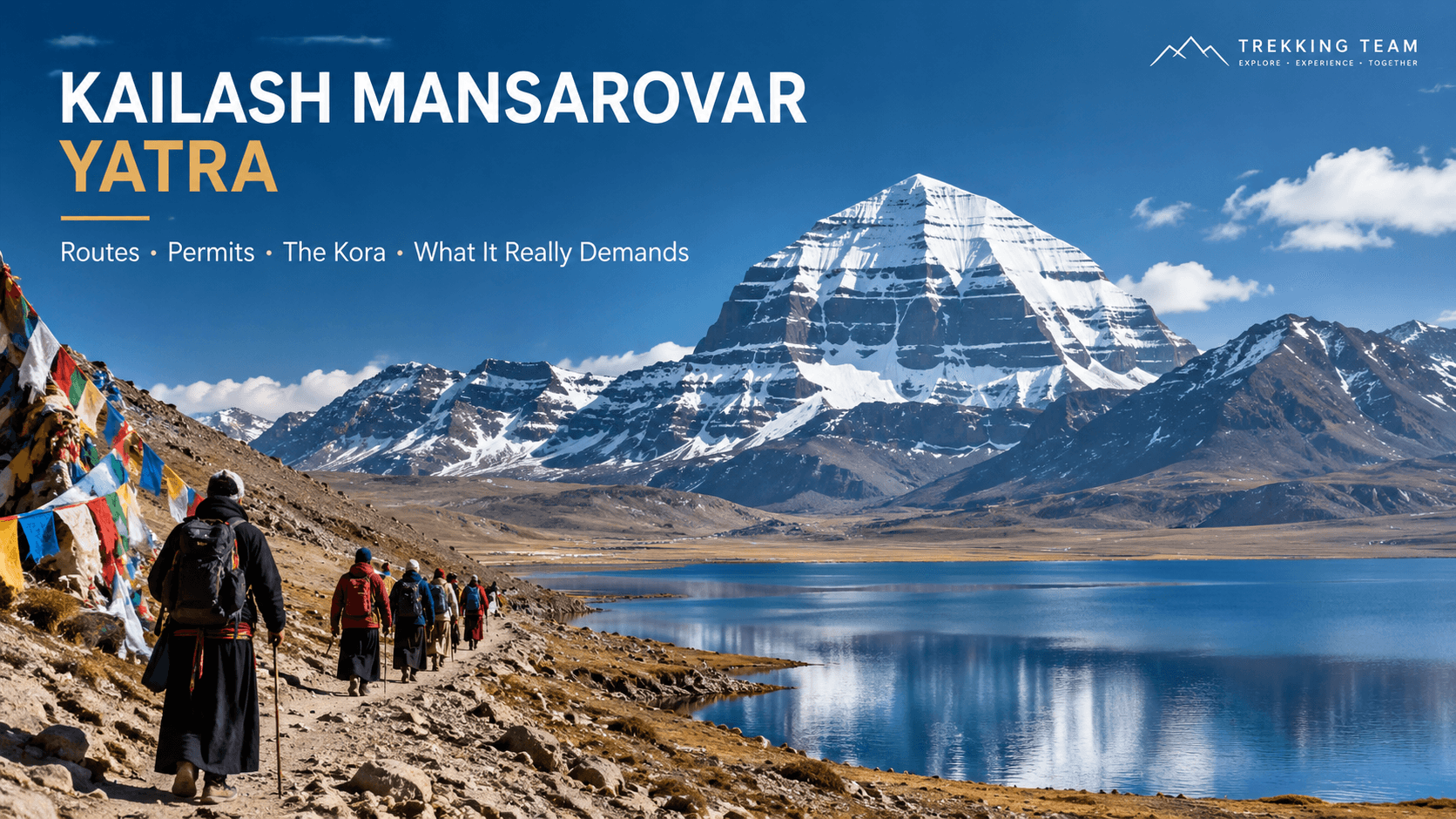
Mount Kailash stands in Ngari Prefecture, in the far west of the Tibet Autonomous Region of China, roughly 1,200 km overland from Kathmandu. Four religions hold it sacred. Hindus see it as the abode of Lord Shiva. Tibetan Buddhists know it as Kang Rinpoche, the precious jewel of snow, and the home of Demchok. Jains believe their first Tirthankara attained liberation on nearby Ashtapada. Followers of Bon, Tibet's pre-Buddhist faith, regard it as the seat of spiritual power. Nobody has ever climbed it, and no permit to climb has ever been issued. Pilgrims walk around it instead.
What is the kora (parikrama)?
The kora is the 52 km circuit around Mount Kailash, normally walked over three days. Hindus call it the parikrama and walk clockwise; Bon practitioners walk anticlockwise. Day one runs from Yamadwar (near Tarboche) to Dirapuk, about 12 km with the north face of Kailash directly ahead. Day two is the hard one: 22 km over the Dolma La pass at 5,630 metres, then down past Gauri Kund to Zuthulpuk. Day three is a short 8 km walk out to the road, then a drive back to Darchen. Tradition holds that one kora erases the sins of a lifetime, and 108 koras bring liberation.
What is Lake Mansarovar?
Lake Mansarovar lies about 20 km southeast of Kailash at 4,590 metres, making it one of the highest freshwater lakes on earth. Hindus believe it was created in the mind of Brahma and that bathing in it, or even sprinkling its water, washes away sin. Most itineraries include a night or two on its shore, a holy dip for those who want one, and a puja. On a clear morning you can see Kailash reflected in the water from the Chiu Gompa side. Its darker twin, Rakshas Tal, sits just to the west and pilgrims traditionally do not touch its water.
When did the Yatra reopen, and is it running normally now?
Yes. Tibet reopened to foreign travellers after the COVID closure, and China resumed the Kailash Mansarovar Yatra for Indian passport holders in June 2025 after a five year suspension. The 2025 season ran successfully and 2026 departures are operating as normal, though under stricter documentation rules than before (covered in the permits section below). 2026 is also the Year of the Fire Horse in the Tibetan calendar, when tradition holds that a single kora carries the merit of thirteen.
What is the best time of year to go?
Mid-May to mid-October. The season opens around Saga Dawa (the full moon festival of Buddha's enlightenment, usually late May or early June) and closes when snow shuts the Dolma La, normally by late October. June and September are our favourite months: stable weather, clear mountain views and moderate crowds. July and August work fine too. Western Tibet sits in the Himalayan rain shadow, so the Indian monsoon that soaks Nepal barely reaches Kailash, though the drive through Nepal can be slow in monsoon. Saga Dawa itself is spectacular, with the raising of the great flagpole at Tarboche, but it is also the busiest window of the year, so book early if you want it.
How many days does the trip take?
Depends on the route:
- Overland from Kathmandu via Kerung (Gyirong): 13 to 14 days
- Fly to Lhasa, drive west, exit via Kerung (or reverse): 14 to 16 days
- Helicopter route via Simikot and Hilsa: 9 to 11 days
- Helicopter route ex-Lucknow (for Indian pilgrims): about 10 days
- Lhasa to Ali flight combination: about 11 days
Shorter is not automatically better. The overland routes build acclimatisation into the drive, which is exactly what your body needs. The helicopter routes save days but gain altitude fast, so they suit travellers who are short on time and confident in their fitness.
Permits, Visa and Documents
What permits do I need for Kailash?
Four documents, all arranged by us, none of which you can apply for yourself:
- Tibet Travel Permit (TTP) - the base permit to enter Tibet
- Alien Travel Permit - for travel beyond Lhasa into restricted prefectures
- Military Permit - required for Ngari because Kailash sits near sensitive border areas
- China Group Visa - a paper visa issued to the whole group, not stamped in your passport
Individual travel in Tibet is not permitted for any nationality. Every traveller must be on an organised tour with a licensed Tibetan guide and registered vehicle. That is Chinese law, not an agency upsell.
How does the visa process work in 2026?
The rules tightened in 2026, so build in more lead time than the old guides suggest:
- Send us a clear passport scan at least 30 days before departure (60 days is safer) so we can apply for your Tibet Travel Permit.
- Visa processing in Kathmandu now takes 6 working days, up from the old 3 to 4.
- Applications now require both online and offline submission, and biometric registration (fingerprints) in person at the visa centre in Kathmandu for most foreign nationals.
- Your original passport is required in Kathmandu, which means arriving at least 3 to 4 working days before the Tibet entry date. Plan a week in Kathmandu before crossing if you can.
- Indian passport holders on the Nepal route have their group visa processed via the Chinese Embassy, with passports needed in advance; we confirm the exact handover schedule at booking because it shifts season to season.
One important quirk: if you already have an individual Chinese visa in your passport, it gets cancelled when the Tibet group visa is issued in Kathmandu. You cannot enter Tibet from Nepal on a regular China visa. If your trip continues into mainland China after Tibet, tell us before we apply so we can sequence it correctly.
Is there an age limit?
For Indian passport holders, yes. Under the current policy you must be born in 1955 or later, which in practice caps the physical Yatra at around 70 years of age. Pilgrims above the limit can still take an aerial darshan flight over the region. For other foreign passport holders there is no formal age limit, but everyone signs a health self-declaration, and we ask travellers over 60 to get a doctor's clearance for sustained time above 4,500 metres. It protects you, and it is the honest thing to do.
Do I need travel insurance?
Yes, and not the cheap kind. Your policy must cover trekking to 5,700 metres and emergency helicopter evacuation. Standard travel insurance usually stops at 3,000 or 4,000 metres, which is useless at Dolma La. Read the altitude clause before you buy. Medical costs and evacuation are never included in any operator's package price, ours included, and Chinese hospitals in Tibet require payment up front.
Can I travel to Kailash solo?
You cannot travel independently in Tibet at all. But you do not need to bring your own group either. We run fixed group departures through the season that solo travellers join, which also keeps the group visa requirement satisfied and the cost shared. If you want a fully private trip with your own vehicle and guide, we arrange that too at a private-trip price.
Routes: How to Get There
What is the overland route from Kathmandu like?
The classic. You drive from Kathmandu to the border at Rasuwagadhi, cross to Kerung (Gyirong) on the Tibet side, then head northwest across the plateau through Saga to Lake Mansarovar and Darchen, the small town at the foot of Kailash. It takes three to four driving days each way with acclimatisation stops built in. The roads on the Tibet side are excellent paved highways; the Nepal section to the border is rougher, especially in monsoon. This route gives your body the most gradual altitude exposure and it is the most economical way to reach Kailash.
How does the helicopter route work?
You fly Kathmandu to Nepalgunj, then Nepalgunj to Simikot in Humla (2,950 m), then take a short helicopter hop to Hilsa on the border, cross to Purang (Taklakot) on the Tibet side and drive to Mansarovar and Darchen. It compresses the journey to around 9 to 11 days. The trade-offs: weather delays in Simikot are common enough that we build buffer days in, and the altitude gain is faster, so we hold an extra acclimatisation night in Purang. This is the route for travellers with limited leave who are fit and healthy.
What about going via Lhasa?
The Lhasa route is the scenic long way round: fly into Lhasa (3,650 m) from Kathmandu or mainland China, spend two or three days acclimatising among the Potala Palace, Jokhang and Sera monastery, then drive west for four days through Gyantse, Shigatse and Saga to Kailash. It is the best route for acclimatisation because Lhasa itself does the early work, and you see central Tibet properly. It costs more and takes 14 to 16 days, but if you are coming this far and can spare the time, it is the trip we would choose ourselves. Many travellers combine it with Everest Base Camp on the Tibet side at Rongbuk.
Can I combine Kailash with other places?
Yes, and it is worth doing. Popular combinations we run:
- Lhasa, Everest Base Camp (Tibet side) and Kailash in one sweep
- Kailash with the ruins of the Guge Kingdom at Tsaparang, western Tibet's lost city
- Kailash with Muktinath in Nepal for a complete Hindu pilgrimage circuit
- Langtang or other Nepal treks before Tibet as acclimatisation that doubles as its own trip
Which route should I choose?
Short version: choose overland via Kerung if you want the best value and steady acclimatisation, helicopter via Simikot if time is tight and you are fit, and the Lhasa route if you want the full Tibet experience and the safest altitude profile. If you are undecided, tell us your available days and fitness level and we will tell you straight which one fits.
Altitude, Health and Difficulty
How hard is the Kailash kora really?
Honest answer: the walking itself is moderate, the altitude makes it hard. The trail is broad and non-technical, with no climbing or scrambling. A reasonably fit person who walks regularly can do it. What makes it serious is that the entire circuit sits above 4,600 metres and day two crosses 5,630 metres at Dolma La, where the air holds roughly half the oxygen of sea level. Cold, wind and the sheer length of the pass day (10 to 12 hours for many pilgrims) are the real tests. Thousands of pilgrims in their 50s and 60s complete it every year. The ones who struggle are usually the ones who skipped preparation, rushed acclimatisation, or ignored early symptoms.
What is altitude sickness and how do you manage it?
Acute Mountain Sickness (AMS) comes from ascending faster than your body can adapt. Early signs are headache, nausea, poor sleep and loss of appetite. Our itineraries are built around gradual ascent with proper acclimatisation nights, which prevents most cases before they start. Our guides are trained in altitude first aid, carry oximeters and check the group's oxygen saturation daily. The rules we follow are simple: never ignore a headache, never ascend with symptoms, and descend if symptoms worsen. Descent cures AMS; nothing else reliably does. Many travellers take Diamox (acetazolamide) preventively; talk to your doctor before the trip, not at Darchen.
Is supplementary oxygen available?
Yes, as an optional add-on. We carry emergency oxygen for medical situations on every departure at no charge; that is a safety backstop, not a comfort service. Personal supplementary oxygen cylinders for use during the kora can be arranged in advance as a paid extra. Oxygen is never included in the package price, so if you want a personal supply, ask us when booking and we will quote it.
Who should not attempt the kora?
Anyone with uncontrolled heart disease, severe respiratory conditions, uncontrolled blood pressure or a recent surgery should not attempt it without explicit clearance from a doctor who understands high altitude. Pregnancy and Kailash do not mix. And here is something most operators will not say plainly: you can travel to Mansarovar and Darchen, take darshan of the mountain, and skip the kora entirely. Plenty of pilgrims do exactly that, and the journey loses none of its meaning. The mountain does not check your step count.
What happens if someone gets sick during the trip?
The guide assesses immediately. Mild cases rest, hydrate and are monitored; the itinerary has enough flex for a slow day. If symptoms are moderate, the traveller stops ascending and a helper stays with them while the group continues. Serious cases are driven down to lower altitude and to hospital in Purang or beyond, and if needed, evacuated across the border toward Kathmandu by vehicle or helicopter. Two things you must know in advance: all medical and evacuation costs are on your insurance, not the package, and if you return early to Darchen without completing the kora, the extra nights of accommodation in Darchen are chargeable, since they fall outside the group arrangement.
Can I ride a horse on the kora?
Yes. Local pony service with a horseman can be hired at Yamadwar on the first morning of the kora, paid directly to the horse owners in Chinese Yuan. The going rate for a pony plus handler for the full three days has been in the region of CNY 3,600 per person in recent seasons, and porters can be hired separately for bags. Prices are set by the local Tibetan community, not by any agency, and they change season to season, so treat that number as a guide and carry enough Yuan. One caveat: even with a horse, you walk the steepest sections of the Dolma La descent on your own feet, because the terrain is unsafe to ride.
Food, Accommodation and Daily Life
What is the accommodation like?
Be realistic about western Tibet: this is one of the remotest inhabited regions on earth, and the accommodation reflects that. In Kathmandu you stay in a proper hotel on a bed and breakfast basis, with 3, 4 and 5 star options depending on your package. On the Tibet side, towns like Kerung, Saga and Darchen have simple guesthouses and basic hotels, usually twin or group sharing, often with shared bathrooms. During the three days of the kora, accommodation is basic teahouse dormitory style at Dirapuk and Zuthulpuk: a bed, blankets and four walls at 5,000 metres. No showers, no attached bathrooms, and electricity that comes and goes. Nobody travels to Kailash for the hotels. Pack a sleeping bag liner, a headlamp and low expectations for plumbing, and you will be fine.
What meals are included?
Our packages run on a bed and breakfast basis. In Kathmandu, breakfast is included at your hotel. On the Tibet side, lunches and dinners are not included in the package price; you pay for them directly at guesthouses and restaurants along the route, which keeps the package honest and lets you eat what you actually want. During the three day kora, breakfast and basic teahouse accommodation are included. Budget roughly USD 15 to 25 per day for your other meals on the plateau. If you prefer everything sorted in advance, we can arrange a prepaid meal plan as an optional add-on; ask when booking.
What food is available in Tibet?
Simpler than you might hope, better than you might fear. Guesthouse kitchens along the route serve Tibetan and Chinese staples: thukpa (noodle soup), fried rice, chow mein, momos, eggs, pancakes and endless tea. Vegetarian food is easy to find everywhere, since most pilgrim traffic is vegetarian. Genuinely strict dietary requirements (Jain, vegan, gluten free) are manageable with notice, but bring supplementary snacks from Kathmandu: dry fruits, protein bars, instant meals you trust. Appetite drops at altitude, so pack food you will actually want to eat when nothing sounds good.
Is drinking water available?
Boiled water is available at every guesthouse and teahouse, usually free or for a small fee, and bottled water is sold along the driving route. Carry a one litre thermos flask; warm water at altitude is worth more than almost anything else in your bag. Aim for 3 to 4 litres a day. Dehydration mimics and worsens altitude sickness, so drinking enough is a safety habit, not a comfort tip.
Is there phone signal and internet?
More than you would expect, less than you would like. Chinese SIM cards work in the towns along the route, and most guesthouses in Saga and Darchen have some form of WiFi, though it crawls. On the kora itself, expect nothing and be pleasantly surprised at Dirapuk. Note that Google, WhatsApp, Facebook and most Western apps are blocked in China; a VPN installed on your phone before you enter Tibet is the standard workaround, since you cannot download one once inside. Tell your family to expect silence during the kora days.
What about money? What currency do I need?
Chinese Yuan (CNY) is the only currency accepted on the Tibet side. Cards and foreign cash are effectively useless outside Lhasa, and even Lhasa is patchy for foreign cards. Exchange money in Kathmandu before departure; we can point you to reliable exchange counters, or handle it for you. How much depends on your habits, but a workable budget is CNY 2,500 to 4,000 to cover meals, pony service if you want it, drinks, souvenirs and tips. Mobile payment (WeChat Pay, Alipay) dominates in Tibet and both now accept foreign cards, so setting one up before the trip is genuinely useful.
Cost and Booking
How much does the Kailash Yatra cost?
Depends on route, group size and season, but honest 2026 ranges look like this: overland group departures from Kathmandu typically run USD 2,200 to 3,200 per person; helicopter route packages via Simikot run roughly USD 3,500 to 4,800; Lhasa route trips with EBC extensions run USD 3,800 to 5,500. Fuel surcharges pushed Tibet transport costs up in 2026, so quotes from two years ago are no longer realistic. We publish current fixed departure prices on our trip pages and quote private trips individually. Beware of quotes dramatically below market: in Tibet, an unusually cheap package usually means a crowded vehicle, rushed acclimatisation, or costs that reappear later as surprises.
What is included and what is not?
Included: all Tibet permits and the group visa fee, licensed English speaking Tibetan guide, private transport on the Tibet side, accommodation throughout, breakfasts (bed and breakfast basis), kora arrangements with breakfast and basic teahouse lodging on the three kora days, and airport transfers in Kathmandu.
Not included: lunches and dinners in Tibet (paid directly, or via optional prepaid meal plan), personal supplementary oxygen, pony and porter service on the kora, travel insurance, international flights, tips, personal expenses, medical or evacuation costs, and any extra nights in Darchen if you return early from the kora. We list this in writing on every quote so there are no surprises at the border.
How far in advance should I book?
Sixty days minimum, ninety is better. The 2026 permit process takes longer than it used to, Saga Dawa departures fill months ahead, and passport logistics need breathing room. Last minute Kailash trips are occasionally possible for non-Indian passport holders, but permits under 30 days are a gamble we will be upfront about rather than promise.
How do I pay?
Bank transfer, wire transfer, or card payment for the deposit, with the balance payable before departure. We are a registered Nepali company (TAAN #1106, operating since 1991), and we provide proper invoices and a written contract for every booking. We recommend carrying part of your personal budget as cash Yuan, since that is what works on the plateau.
Culture, Preparation and Everything Else
What should I pack?
The plateau swings from harsh sun to below freezing in the same day, so layers rule everything. Essentials: a warm down jacket, thermal base layers, fleece, windproof shell, warm hat, sun hat, gloves, broken-in walking shoes or boots, a 4-season sleeping bag or liner (guesthouse blankets exist but you will want your own layer on the kora), sunglasses with real UV protection, SPF 50 sunscreen, lip balm, headlamp, power bank, water flask, personal medicines and a basic first aid kit. Trekking poles help enormously on the Dolma La descent. Keep your kora bag small; whatever you carry, you carry at 5,600 metres.
How should I train before the trip?
Start eight to twelve weeks out. The single best preparation is walking: long walks of 3 to 5 hours with a light pack, hills or stairs whenever possible, building to back to back walking days on weekends. Add general cardio (cycling, swimming, jogging) three or four times a week. You cannot train for altitude at sea level, but you can arrive with legs and lungs that do not waste energy, which leaves your body free to handle the acclimatisation. If you smoke, the months before Kailash are an excellent reason to stop.
Can I do a puja or religious ceremony at Mansarovar?
Yes. A havan or puja on the shore of Mansarovar is part of most Hindu group departures, and we arrange materials in advance if you tell us at booking. Holy dips at Mansarovar are permitted (technically bathing rules fluctuate, so we brief you on the current practice each season). You can collect Mansarovar water to carry home; bring a solid, leakproof bottle for it. At Kailash itself, prostration, mantra and circumambulation are the practice; there is no touching or approaching the mountain face itself.
What is Saga Dawa and should I plan around it?
Saga Dawa is the festival of Buddha's birth, enlightenment and parinirvana, held on the full moon of the fourth Tibetan month, falling in late May or early June. At Tarboche, at the start of the kora route, thousands gather to watch the great prayer flagpole lowered, redressed in fresh flags and raised again; how straight it stands is read as an omen for the year. Walking the kora during Saga Dawa is considered especially meritorious, and doing so in the Fire Horse year of 2026 compounds it further by tradition. It is the most powerful time to be at Kailash, and also the busiest, so decide which matters more to you and book accordingly.
Are drones, and what else, prohibited in Tibet?
Drones are strictly prohibited; do not bring one even in checked luggage. Also avoid carrying: any printed or digital material about Tibetan politics, images of the Dalai Lama, Bhutanese or Taiwanese flags, and religious literature in bulk. Border checks at Kerung include phone and luggage inspection, and this is one area where the rules are enforced without humour. Photography of military installations, bridges and checkpoints is forbidden. Everywhere else, photograph freely; western Tibet is one of the most photogenic landscapes on the planet.
Is Kailash safe for women travelling alone?
Yes. Tibet has very low crime, groups travel together with a licensed guide throughout, and solo women join our fixed departures every season. Accommodation on the kora is dormitory style, so a sleeping bag liner and earplugs matter more than any safety concern. If you would prefer to share rooms only with other women in the group, tell us at booking and we arrange it.
Why book with Trekking Team?
We have been running Himalayan journeys from Kathmandu since 1991: three decades, more than ten thousand travellers, and long standing partnerships in Switzerland, Poland and Italy that keep us accountable to international standards. Our Kailash operation runs on the same principle as everything else we do: honest pricing with meals and extras stated plainly, itineraries built around acclimatisation rather than speed, and guides who treat pilgrims as people rather than cargo. We are registered with TAAN (#1106), NTB, NMA and KEEP, and our office is in Gongabu, Pragatinagar, Kathmandu, where you are welcome to walk in and meet us before you decide anything.
Have a question we have not covered? Send us an inquiry or browse our Kailash Mansarovar itineraries. Trekking Team Pvt. Ltd., Gongabu, Pragatinagar, Kathmandu, Nepal.