Trekking Peaks in Nepal: Island Peak, Mera, Lobuche East and Ama Dablam Compared
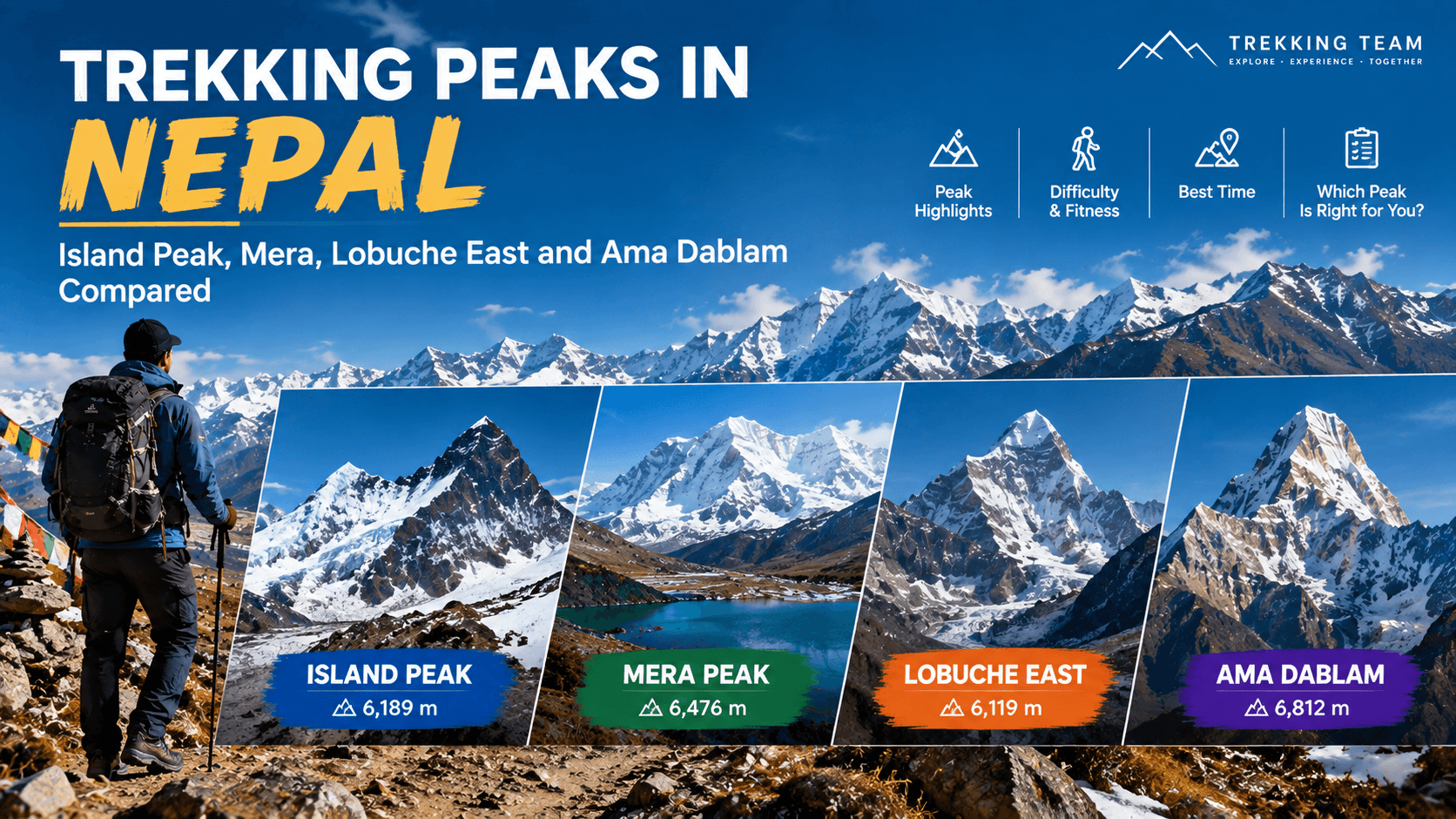
There is a step between trekking to Everest Base Camp and climbing an 8,000 m peak, and most people do not know it exists. Nepal calls them trekking peaks: mountains between roughly 5,600 m and 6,500 m that are permitted by the Nepal Mountaineering Association rather than the Ministry, and that a fit trekker can climb with a fortnight of preparation and a good guide.
They are not easy. Standing on the summit of Island Peak at 6,189 m at seven in the morning, having left camp at two, is the hardest thing most people who do it have ever done. But they are attainable, and they are the honest answer for anyone who has finished a Himalayan trek and found themselves looking up rather than back down the valley.
This is a guide to which peak to pick, what each one actually demands, and what the whole thing costs.
The four peaks worth considering
Island Peak, 6,189 m
Best for: a first Himalayan summit, and by some distance the most popular choice.
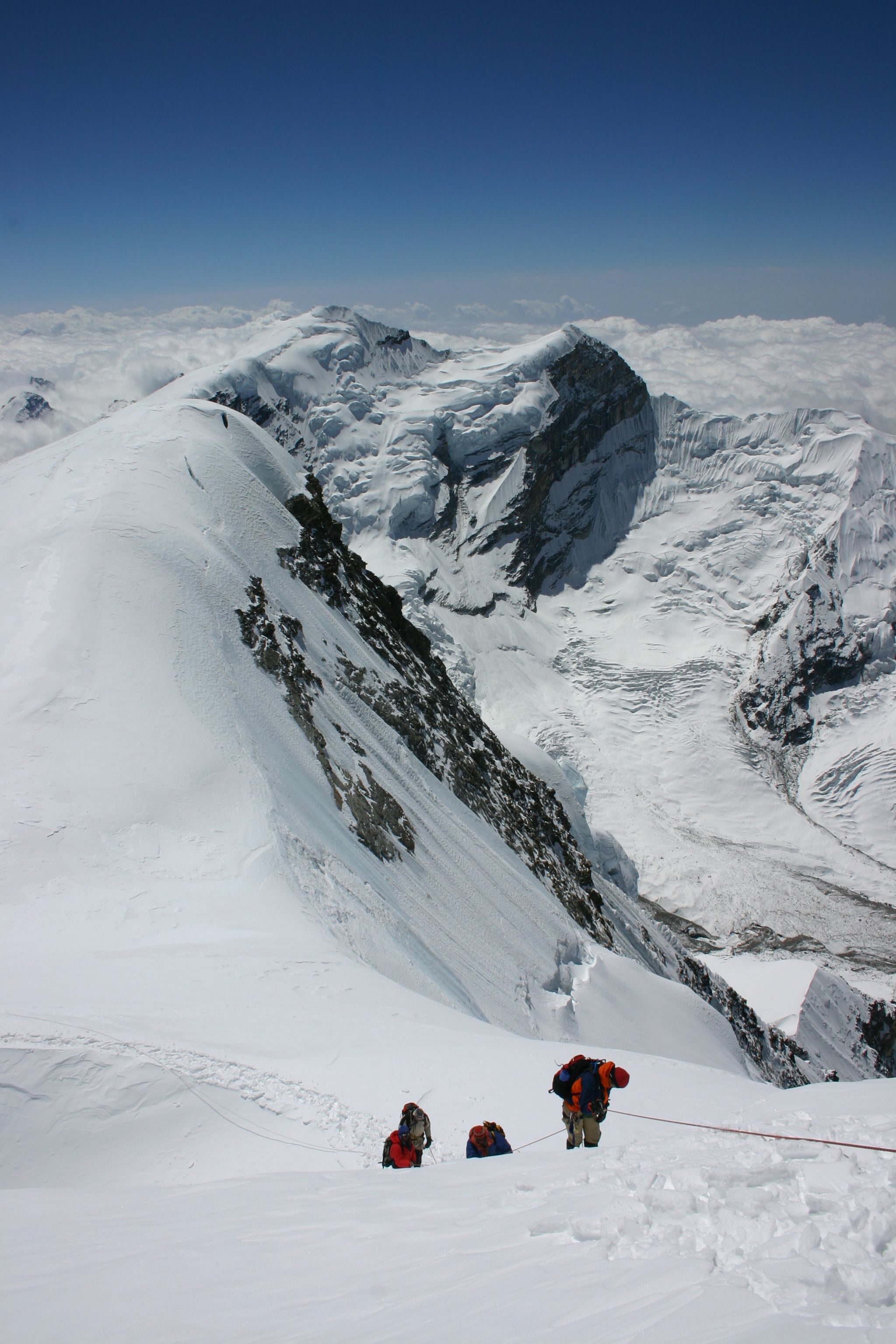
Imja Tse, to use its Nepali name, sits at the head of the Chhukhung valley in the Khumbu, and its summit day is the classic introduction to Himalayan climbing: a pre-dawn start, a rock and scree approach, crampons on at the glacier, a fixed-rope section up the headwall, and a spectacular corniced ridge to the top with Lhotse's south face filling the sky in front of you.
The technical demand is real but contained. You need to jumar a fixed line, walk in crampons, and be steady on an exposed ridge. None of that requires prior mountaineering; all of it requires a training day, which we run at base camp.
Most people climb it as an extension to an Everest Base Camp trek, which solves the acclimatisation problem elegantly. Allow 18 to 20 days for the combination.
Mera Peak, 6,476 m
Best for: the highest summit with the least technical difficulty.
Mera is the highest of Nepal's trekking peaks and, counter-intuitively, the least technical. The summit route is essentially a long glacier walk at a punishing altitude, with a short steep section right at the top. If you can walk uphill in crampons for six hours while breathing thin air, you can climb Mera.
The catch is exactly that altitude. At 6,476 m the summit is higher than Everest Base Camp by a kilometre, and the approach through the Hinku valley is remote with far less lodge infrastructure than the Khumbu. The panorama from the top is the best available from any trekking peak: five 8,000 m mountains at once, Everest, Lhotse, Makalu, Cho Oyu and Kangchenjunga.
Allow 18 to 21 days.
Lobuche East, 6,119 m
Best for: more actual climbing than Island Peak, on a shorter trip.
Lobuche East is steeper and more sustained than Island Peak, with a proper snow and ice ridge to the true summit that a lot of parties skip in favour of the lower false summit. If you want a mountaineering day rather than a fixed-rope queue, this is the better mountain, and it is markedly less crowded.
It sits directly on the Everest Base Camp trail, so it combines with EBC even more easily than Island Peak does.
Ama Dablam, 6,812 m
Best for: experienced climbers only.
Ama Dablam is in a different category and we want to be clear about that. It is an expedition peak, not a trekking peak. The southwest ridge is sustained rock and mixed climbing with serious exposure, camps hung on the ridge, and a commitment level that is closer to an 8,000 m peak than to Island Peak.
You need previous experience on technical alpine terrain, competence on rock at moderate grades in boots, and a genuine tolerance for exposure. If you are asking whether you are ready for Ama Dablam, you are not, and that is not a judgement, just how it works. Climb Island Peak or Lobuche East first.
How to choose
The short version:
- First summit, want the classic: Island Peak, combined with Everest Base Camp.
- Want to go as high as possible without technical climbing: Mera Peak.
- Want real climbing, fewer people: Lobuche East.
- Already an alpinist: Ama Dablam, or talk to us about a 7,000 m objective like Himlung or Baruntse.
- Want two summits in one trip: Lobuche East and Island Peak combine well and share the acclimatisation.
What you actually need to be able to do
Fitness first, because it is the part people underestimate. You need to be able to walk six to eight hours a day for two weeks straight and then, on summit day, move continuously for ten to fourteen hours starting at two in the morning at temperatures around minus 20 C. Aerobic base matters more than leg strength. Six months of hill walking, running or cycling, three or four sessions a week, is the right preparation.
Technically, you need four skills, and we teach all four on a dedicated day before the climb:
- Walking in crampons on flat and angled ice, including the awkward business of traversing
- Ascending a fixed rope with a jumar, and descending with a figure of eight or belay device
- Basic self-arrest with an ice axe
- Moving as a roped team on a glacier
Previous experience above 5,000 m is close to essential for Mera and strongly advisable for the others. Altitude is not a skill you can train at home, and knowing how your own body handles 5,500 m is worth more than any amount of gym work.
Permits, costs and what a trip includes
Trekking peak permits are issued by the Nepal Mountaineering Association and priced by season, with spring the most expensive and winter the cheapest. On top of that sit the national park and municipality permits for the approach trek, a garbage deposit, and the climbing guide's own permit and insurance.
A realistic all-in figure for a guided Island Peak with Everest Base Camp, from Kathmandu, is in the region of USD 2,800 to 3,800 depending on group size and lodge standard. Mera sits in a similar band. Ama Dablam is substantially more because of the fixed rope, the camps and the ratio of guides to climbers.
What a properly priced trip includes, and what you should check for in any quote:
- A qualified climbing guide, not just a trekking guide with a rope. Ask for the certification.
- A guide to climber ratio of 1:2 or better on summit day. This is the number that most affects both your safety and your chance of summiting, and it is the first thing a cheap operator cuts.
- All group climbing equipment: ropes, ice screws, snow bars, fixed line.
- Personal climbing gear hire if you do not own it: harness, helmet, crampons, ice axe, jumar, carabiners.
- All permits, park fees and the garbage deposit.
- Insurance and equipment for every member of the climbing and portering crew, which is not a given and which you should ask about explicitly.
The honest bit about summit success
Summit rates on Island Peak with a good operator run around 80 to 90 per cent. Mera is similar. The people who do not make it are almost never stopped by the climbing; they are stopped by altitude, by arriving underprepared aerobically, or by weather that closes the window.
What we will not do is push a client who is deteriorating, and you should be suspicious of any operator whose marketing implies a guaranteed summit. The mountain decides, and a guide who cannot say no on summit morning is a liability rather than an asset.
Frequently asked questions
Do I need climbing experience to climb Island Peak?
No previous mountaineering is required, but you do need to arrive fit and willing to learn. We run a full skills day at base camp covering crampons, fixed rope, ice axe and roped glacier travel. What you cannot substitute for is aerobic fitness and, ideally, some prior experience above 5,000 m.
Which is harder, Island Peak or Mera Peak?
Island Peak is more technical: a fixed-rope headwall and an exposed summit ridge. Mera is higher by nearly 300 m and the summit day is a long glacier plod at extreme altitude with only a short steep section. Most people find Island Peak more intimidating and Mera more exhausting.
How high is too high for a first Himalayan climb?
Both Island Peak and Mera are around 6,100 to 6,500 m and are appropriate first objectives with a proper acclimatisation schedule. What matters more than the altitude number is the profile you get there on. A trip that reaches 6,000 m over eighteen days is a different proposition from one that does it in ten.
When is the best season for peak climbing in Nepal?
April and May, and late September through November. Spring gives longer days and warmer summit mornings. Autumn gives more stable weather and better visibility. Winter climbs are possible on Island Peak and Lobuche East for experienced parties but the cold is severe and success rates drop.
What insurance do I need for a trekking peak?
A policy that specifically names mountaineering to 6,500 m with ropes and fixed lines, and that includes helicopter evacuation and repatriation. Standard travel insurance almost always excludes this. Check the wording rather than the marketing, and send us the policy details before you fly.
Can I combine a trekking peak with Everest Base Camp?
Yes, and for Island Peak and Lobuche East it is the sensible way to do it. The Everest Base Camp trek provides exactly the acclimatisation profile the climb needs, so you are not adding as many days as you might think. Typical combined trips run 18 to 22 days.
Talk to us about which peak
We have been running climbing trips out of Kathmandu since 1991, and our climbing guides are the people who have been doing this for us for decades rather than freelancers hired for the season.
Tell us what you have climbed or trekked before, how much time you have and what you want out of it, and we will tell you honestly which peak fits and whether you should do something else first. We have talked plenty of people out of Ama Dablam and onto Lobuche East, and every one of them came back and thanked us.