Which Everest Trek Should You Do? Base Camp, Gokyo, Cho La and Three Passes Compared
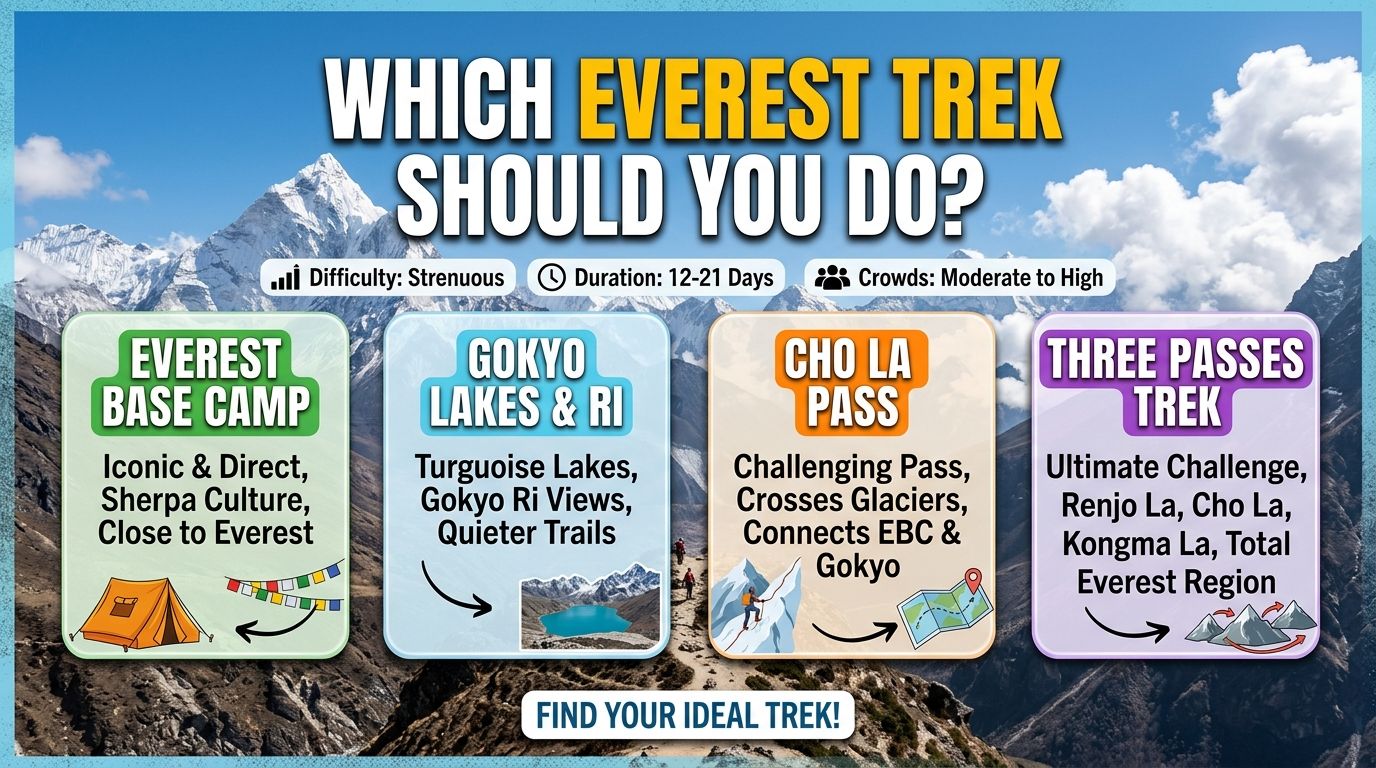
Everest Base Camp is the trek everyone has heard of, and for a lot of people it is the right one. But the Khumbu holds at least five distinct trekking routes, and a fair proportion of the people who book EBC would have had a better trip on one of the others.
The base camp itself is, to be honest about it, a moraine field. The view of Everest from it is poor, because you are too close and under the wrong face. What people actually remember from that trip is Namche, Tengboche, the Khumbu icefall seen from Kala Patthar at dawn, and the walking in between.
Knowing that changes how you choose. Here are the options, ranked by what you get rather than by what is famous.
Everest View Trek, 8 to 12 days, max 3,880 m
Lukla to Phakding, Namche, Khumjung and the Everest View Hotel, Tengboche, and back. You see Everest, Lhotse, Nuptse and Ama Dablam. You walk through the Sherpa villages that give the region its character. You visit the largest monastery in the Khumbu. And you never go above 3,900 m, which means altitude sickness is a marginal risk rather than the defining one.
Choose this if: you have under two weeks, you are travelling with children or older parents, you have never been to altitude and would rather not find out the hard way, or you simply want the Khumbu without the endurance test.
It is also the best winter option in the region, because everything on the route stays open and staffed.
Everest Base Camp, 14 to 16 days, max 5,545 m
The classic. Lukla, Namche, Tengboche, Dingboche, Lobuche, Gorak Shep, base camp and Kala Patthar.
Choose this if: standing at base camp matters to you specifically, or you want the Kala Patthar sunrise, which genuinely is one of the great mountain views on earth and is the real high point of the trip.
Be aware: it is the busiest trail in Nepal in October. The upper lodges at Lobuche and Gorak Shep are cold, crowded and basic. And the altitude is serious: 5,545 m at Kala Patthar is where the air holds roughly half the oxygen of sea level.
Gokyo Lakes and Gokyo Ri, 12 to 14 days, max 5,357 m
This is the one we most often recommend to people who came asking about EBC.
The route branches at Namche and heads up the Dudh Koshi to a chain of six turquoise glacial lakes, the highest freshwater lake system in the world, sitting beside the Ngozumpa glacier. Gokyo Ri at 5,357 m gives a panorama that includes four 8,000 m peaks in a single sweep: Everest, Lhotse, Makalu and Cho Oyu.
It is quieter than the base camp trail, the lakes are extraordinary, and the view from Gokyo Ri is, in the opinion of most guides who have done both, better than the one from Kala Patthar. Slightly lower, slightly shorter, considerably fewer people.
Choose this if: you want the big Everest view and the mountain scenery without the queues, or if you have done EBC before and want something different in the same region.
EBC via Gokyo and the Cho La, 16 to 18 days, max 5,545 m
The combination: up to Gokyo, across the Cho La at 5,420 m, then down into the Khumbu valley for base camp and Kala Patthar. You get both, plus a genuine pass crossing.
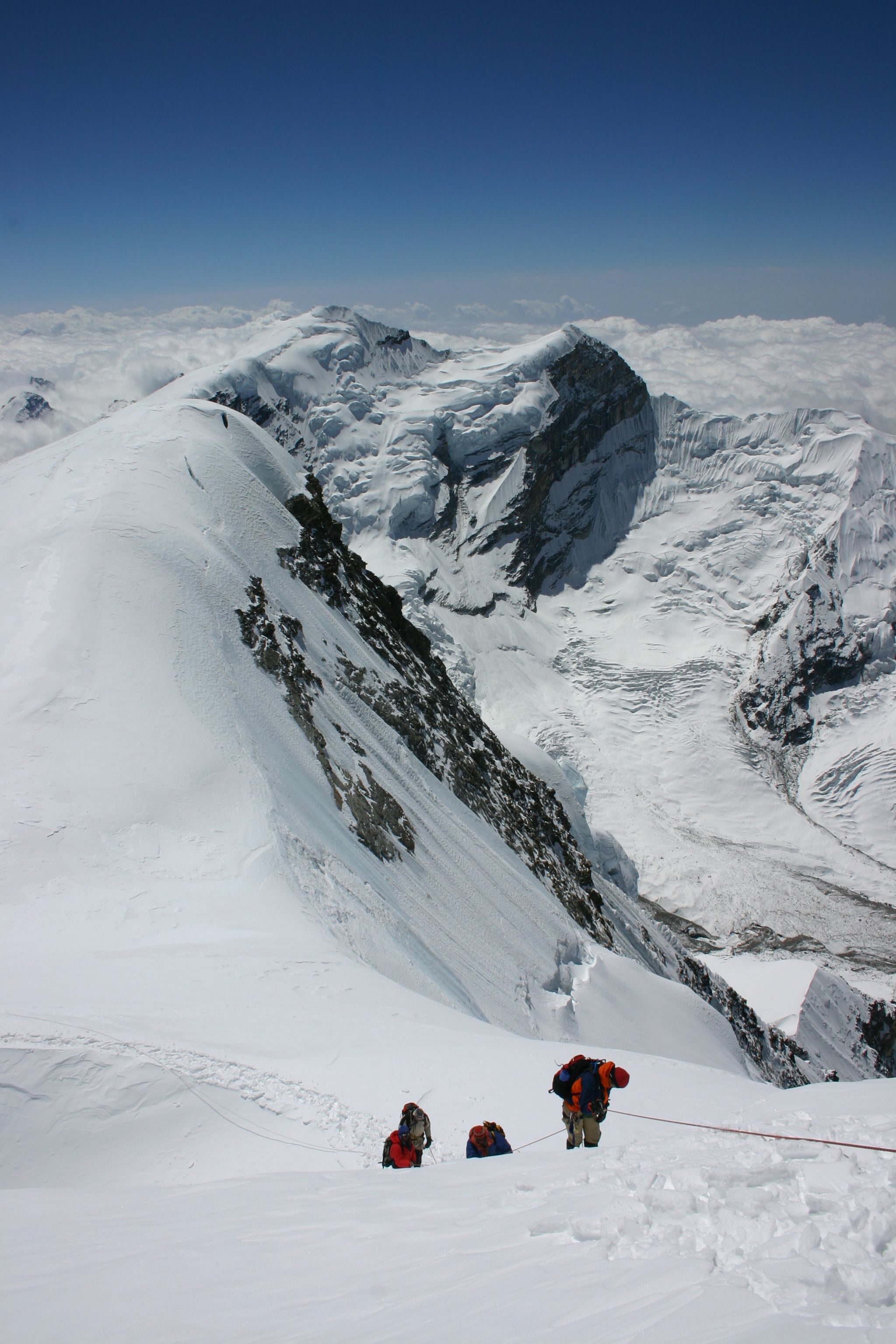
The Cho La involves a short glacier section and a rocky descent that needs care, and after fresh snow it needs microspikes and a guide who has been across it recently. It is not technical, but it is not a walk either.
Choose this if: you have eighteen days, you are fit, and you want the fullest version of the Khumbu short of the Three Passes.
Everest Three Passes, 18 to 21 days, max 5,545 m
Renjo La, Cho La and Kongma La, plus Gokyo, base camp and Kala Patthar. This is the complete circuit of the Khumbu and it is the best trek in the region by a wide margin.
It is also hard. Three passes over 5,300 m, sustained days at altitude, and Kongma La in particular is a long, unrelenting boulder field. You need previous multi-day trekking experience and genuine fitness.
Choose this if: you are an experienced trekker and you want the Khumbu properly rather than as a checklist item. Autumn or spring only.
The comparison, in short
- Least altitude risk, shortest: Everest View trek.
- Best single viewpoint: Gokyo Ri, closely followed by Kala Patthar.
- Most famous destination: Everest Base Camp.
- Quietest of the high routes: Gokyo.
- Best overall trek: Three Passes, if you have the time and the legs.
- Best compromise: EBC via Gokyo and Cho La.
Things that apply to all of them
Getting there
Everything starts with the flight to Lukla, 35 minutes from Kathmandu or, in the peak October and April weeks, from Manthali in Ramechhap after a four to five hour pre-dawn drive. Lukla flies visual, so cloud stops it. Keep two spare days between the end of your trek and your international flight.
Permits
Sagarmatha National Park entry and the Khumbu Pasang Lhamu Rural Municipality permit. No TIMS card is issued for Khumbu, which is also why Everest is the one mainstream Nepali trek where independent walking remains legal. We include both permits and we send a guide anyway.
Acclimatisation
The rule that matters: above 3,000 m, gain no more than 400 to 500 m of sleeping altitude per day and take a rest day roughly every 1,000 m. Every good Khumbu itinerary has acclimatisation days at Namche and Dingboche, and an itinerary that skips them is selling you a cheaper trip by making it a worse one. Look for those two days in any quote you compare.
Cost
Longer routes cost more, mostly in extra lodge nights and guide days rather than in permits. Gokyo runs slightly cheaper than EBC. Three Passes runs meaningfully more. None of the differences are large enough to be the reason you pick a route, so pick on what you want to see.
Frequently asked questions
Is Gokyo better than Everest Base Camp?
For scenery and quiet, most guides say yes. Gokyo Ri at 5,357 m gives Everest, Lhotse, Makalu and Cho Oyu in one view, plus the lakes and the Ngozumpa glacier, on a much less crowded trail. Everest Base Camp wins if standing on the base camp moraine is the thing you want. They are different trips, not better and worse versions of the same one.
Can you see Everest from Everest Base Camp?
Barely. The summit is hidden behind the west shoulder from base camp itself. The reason everyone climbs Kala Patthar at dawn is that it is the first place on that route with a clear view of the mountain. Gokyo Ri and even the Everest View Hotel at 3,880 m both give better Everest views than base camp does.
Which Everest trek is easiest?
The Everest View trek. Maximum altitude 3,880 m, eight to twelve days, lodges open all year, and no serious altitude exposure. It is the right first Himalayan trek for most people and it is far more rewarding than its modest profile suggests.
How hard is the Cho La pass?
Not technical, but a long day with a short glacier crossing and a steep rocky descent. After fresh snow it needs microspikes and a guide who has crossed it recently. Most fit trekkers manage it; nobody enjoys the descent.
How many days do I need for the Everest region?
Minimum eight for the Everest View trek. Fourteen to sixteen for base camp. Twelve to fourteen for Gokyo. Eighteen to twenty-one for the Three Passes. To all of those add two spare days at the end for Lukla weather, which is not optional advice.
What is the best time to trek in the Everest region?
Late September to early December, and March to mid-May. October has the clearest air and the most people. November is colder and much quieter. April brings rhododendron below 4,000 m. December works well on the lower routes and for experienced trekkers on the higher ones.
Not sure which one?
Tell us how many days you have, whether you have been to altitude before, and what you actually want to look at. We will tell you which of these five fits, and we are perfectly happy to talk you out of Everest Base Camp if Gokyo or the Everest View trek is the better trip for you. We have been doing this out of Kathmandu since 1991 and we would rather you came back than that you booked the famous one.