Nepal Lifts Solo Trekking Restrictions in 13 Restricted Districts: What It Means for Your 2026 Himalayan Adventure
Breaking News — March 2026
📅 March 23, 2026•✍️ Trekking Team Editorial•⏱️ 14 min read
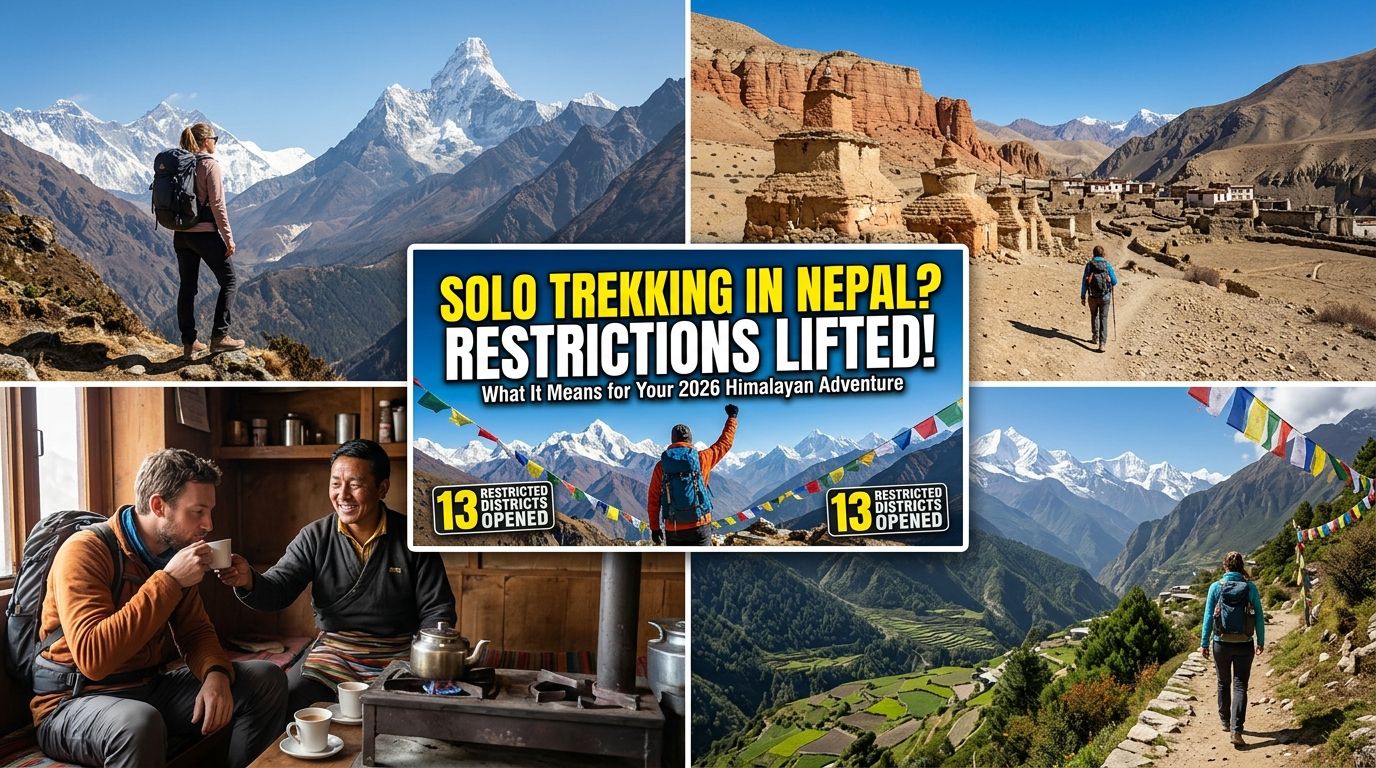
In a landmark decision that is set to reshape the Himalayan adventure tourism landscape, Nepal's Department of Immigration (DoI) has officially revised its trekking permit policy for restricted areas, removing the long-standing requirement that a minimum of two foreign trekkers must apply together. As of March 22, 2026, individual foreign travellers can now obtain Restricted Area Permits (RAPs) for some of the most coveted and remote trekking destinations in the Himalayas — from the ancient walled city of Lo Manthang in Upper Mustang to the crystal-clear waters of Phoksundo Lake in Dolpo.
The announcement, reported by the Kathmandu Post and confirmed by DoI spokesperson Tikaram Dhakal, comes after years of sustained lobbying by the Trekking Agencies' Association of Nepal (TAAN) and other tourism stakeholders who argued that the two-trekker minimum was stifling tourism potential and discouraging independent travellers from choosing Nepal over competing Himalayan destinations.
Key Takeaway
Solo foreign trekkers can now apply for restricted area permits across 13 districts in Nepal. You still need a licensed guide and must book through a registered trekking agency — but you no longer need to find a second trekker to join you.
 In This Article
- What Exactly Changed — The New Policy Explained
- Why This Matters for Trekkers Worldwide
- Safety Provisions and the New Guide-to-Trekker Ratio
- Digital Permit Application: A Modernised Process
- Complete Guide to Nepal's Restricted Trekking Routes
- Restricted Area Permit Fees for 2026
- How to Plan Your Solo Restricted Area Trek
- Frequently Asked Questions
1. What Exactly Changed — The New Policy Explained
Until this week, Nepal's restricted trekking areas — remote border-sensitive regions near Tibet and India — required a minimum of two foreign trekkers to apply for a Restricted Area Permit. This policy, enforced by the Department of Immigration, was originally designed for border security, environmental conservation, and trekker safety in some of the most isolated terrain on Earth.
However, the two-trekker minimum had an unintended consequence: it forced solo travellers to either find a companion on internet forums, pay inflated "single supplement" fees to agencies, or skip these extraordinary regions entirely. For many independent adventurers — especially those who travel alone by choice — the policy was a dealbreaker.
📋 What the New Policy States
- Solo travellers can now apply for Restricted Area Permits individually — no second trekker required
- A licensed trekking guide remains mandatory for all restricted area treks
- All treks must be arranged through a registered trekking agency — the agency bears full responsibility for emergency rescue and logistics
- A new guide-to-trekker ratio of 1:7 has been introduced for group safety oversight
- The policy covers restricted areas across 13 districts of Nepal
- A digitised permit application process has been launched alongside the policy change
It is important to understand what this policy does not change. The mandatory guide requirement — introduced in April 2023 and fully enforced since — remains firmly in place. Solo trekking without a guide is still prohibited throughout Nepal's national parks, conservation areas, and restricted zones. What has changed is the permit eligibility: you can now be one person (plus your guide), rather than two people (plus a guide), when entering restricted territory.
2. Why This Matters for Trekkers Worldwide
Nepal's restricted areas represent some of the last truly untouched frontiers in global adventure travel. These are not busy tourist trails; they are ancient trade routes, trans-Himalayan desert landscapes, and sacred valleys where Tibetan Buddhist culture has survived for centuries with minimal outside influence.
The previous two-trekker rule meant that tens of thousands of potential visitors — solo backpackers, professional photographers on assignment, writers researching long-form pieces, and experienced trekkers who simply prefer solitude — were effectively locked out of these regions unless they could coordinate schedules with a stranger. According to TAAN, this restriction was directly hindering Nepal's tourism potential at a time when the country is actively working to increase visitor numbers.
By opening restricted areas to individual permit holders, Nepal is signalling that it wants to compete more aggressively for the growing global market of independent, experience-driven travellers. Countries like Bhutan (which reformed its own tourism pricing model in 2023) and Pakistan (which has been steadily liberalising access to its northern areas) have been attracting solo adventurers who might previously have chosen Nepal — and the Nepali government is clearly paying attention.
3. Safety Provisions and the New Guide-to-Trekker Ratio
The Department of Immigration was clear in its announcement: while the two-trekker minimum is gone, safety remains the top priority. The revised policy maintains every existing safety provision and adds a new one.
Every trekker entering a restricted area must be accompanied by a licensed trekking guide employed through a TAAN-registered agency. The agency is legally and operationally responsible for the trekker's emergency rescue, evacuation coordination, and all logistical arrangements throughout the trek. This is not a formality — it is an enforceable legal obligation, and agencies that fail to meet this standard risk losing their operating licence.
The new addition is a guide-to-trekker ratio of 1:7 — meaning one guide can lead a maximum of seven trekkers. For solo travellers, this is largely irrelevant (you will have a 1:1 ratio with your personal guide), but for larger groups it establishes a safety floor that did not previously exist in formal policy.
At Trekking Team, we have always maintained a maximum 1:5 guide-to-trekker ratio on restricted area treks, and our guides carry satellite communication devices, pulse oximeters, and are trained in high-altitude emergency protocols. The new government ratio aligns with what responsible operators were already doing — and it ensures that all agencies meet a baseline standard.
4. Digital Permit Application: A Modernised Process
Alongside the solo trekking policy change, the Department of Immigration has launched a digitised permit application system — a long-overdue modernisation that will streamline access for both trekkers and agencies.
Foreign nationals already in Nepal can now apply for restricted area permits using their valid Nepali visa number as an identifier. Those applying from abroad — planning ahead before arriving in Kathmandu — can use an Application Submission ID to pay permit fees in advance, reducing the processing time needed on arrival.
For trekkers booking through Trekking Team, this means we can initiate your permit application earlier in the process, reducing the number of days you need to spend in Kathmandu waiting for paperwork. Our operations team handles the entire application process, from document submission to payment processing to permit collection, so you can focus on preparing for your trek rather than navigating bureaucracy.
5. Complete Guide to Nepal's Restricted Trekking Routes
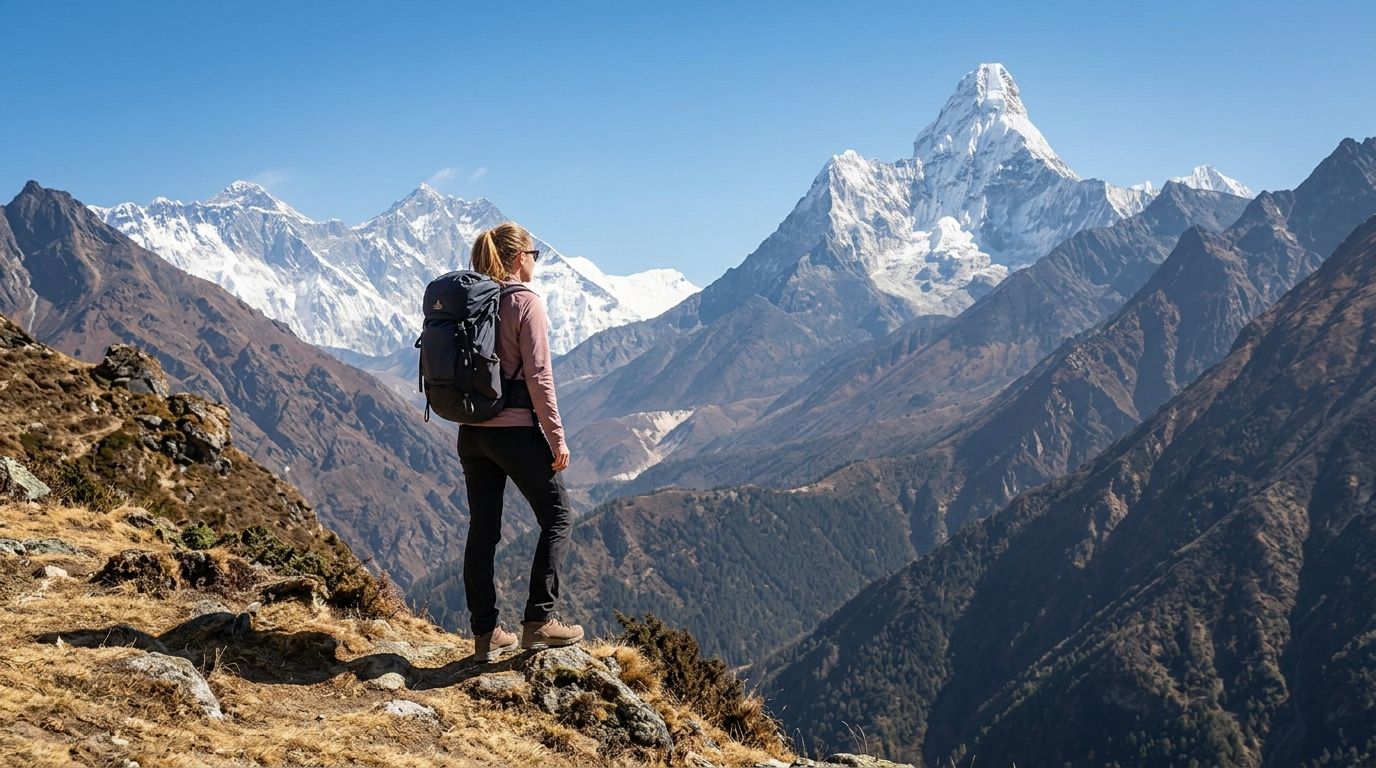
The revised policy opens 13 districts to individual permit applications. Here is a detailed guide to the most significant restricted trekking routes now accessible to solo travellers — each one offering a profoundly different Himalayan experience.
Upper Mustang Trek — The Forbidden Kingdom
📍 Mustang District📏 160 km⏱️ 12–16 Days⛰️ Max 3,810 m📅 Mar–Nov
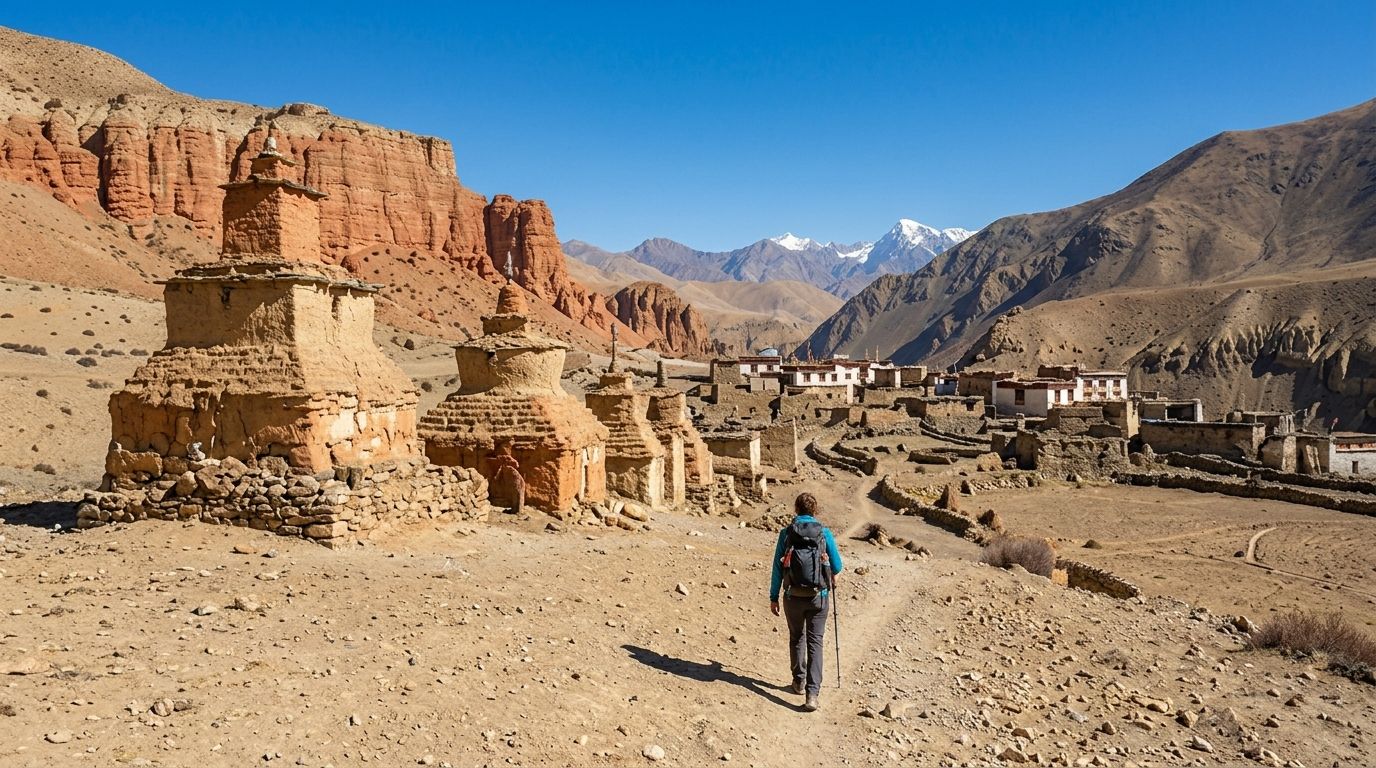
Upper Mustang is Nepal's crown jewel of restricted area trekking. Often called the "Last Forbidden Kingdom," this trans-Himalayan desert region was closed to foreigners until 1992 and remained accessible only to paired trekkers until this week. The landscape is otherworldly — wind-carved sandstone cliffs in ochre and crimson, vast arid plateaus, and the walled medieval city of Lo Manthang, where a living Tibetan Buddhist culture has thrived for over 600 years.
The trek follows the ancient salt-trading route along the Kali Gandaki gorge — the deepest gorge in the world — before climbing into the rain shadow of the Annapurna and Dhaulagiri massifs. You will pass through cave monasteries with centuries-old murals, visit sky burial sites, and walk through villages where prayer flags outnumber people. The isolation is absolute: in Upper Mustang, you can walk for hours without seeing another trekker.
Permit: USD 500 for the first 10 days, USD 50/day thereafter | Also required: ACAP permit (NPR 3,000) + TIMS card | Best season: May–October (monsoon does not reach this rain-shadow region)
Manaslu Circuit Trek — The New Classic
📍 Gorkha District📏 177 km⏱️ 14–18 Days⛰️ Max 5,160 m (Larkya La)📅 Sep–Nov, Mar–May
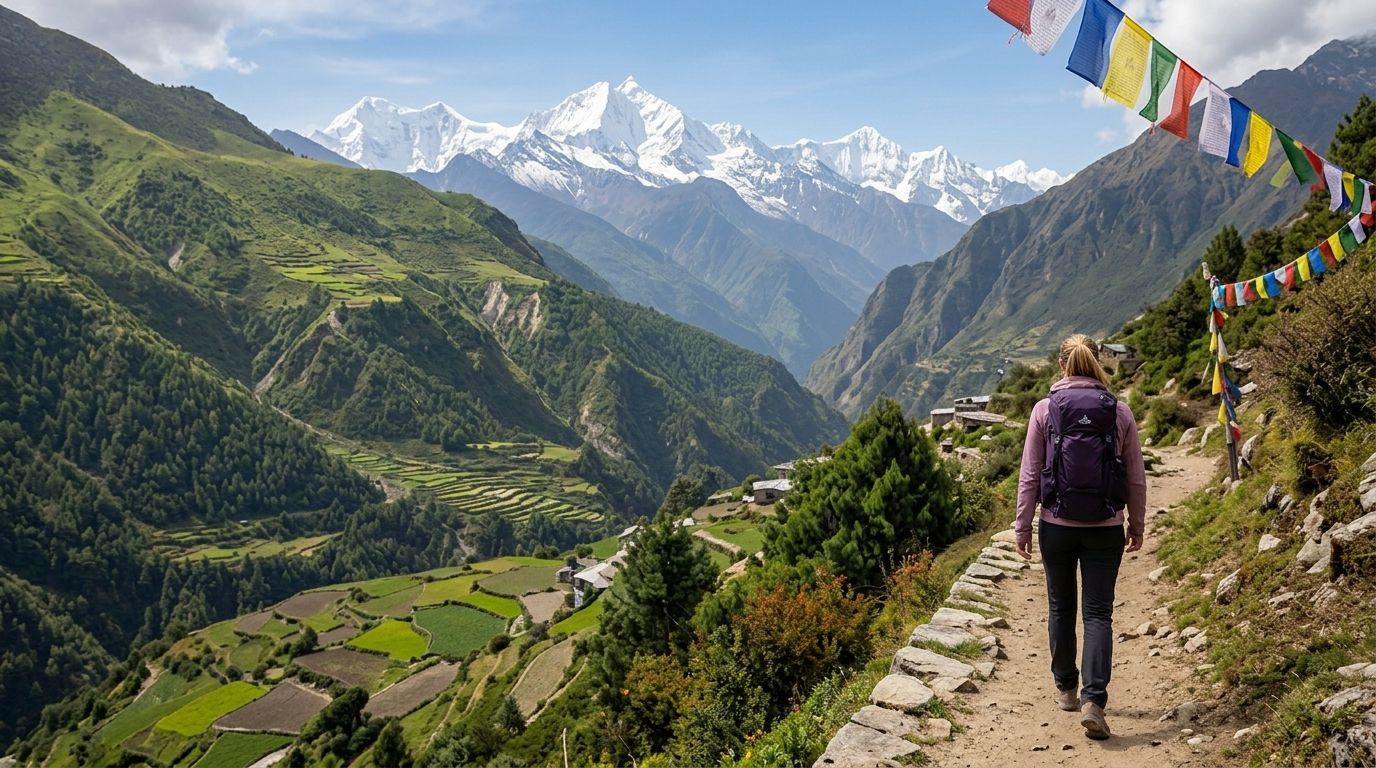
The Manaslu Circuit is widely regarded as the best alternative to the Annapurna Circuit, offering comparable diversity with a fraction of the trekker traffic. The route encircles Mount Manaslu (8,163 m) — the eighth-highest mountain on Earth — passing through lush subtropical forests, Tibetan-influenced Nubri and Tsum villages, and high-altitude yak pastures before crossing the dramatic Larkya La pass at 5,160 metres.
What makes Manaslu special is the cultural richness. The Nubri people of this valley are of Tibetan origin, and their villages feature ancient gompas, chortens, and mani walls that have remained virtually unchanged for centuries. The teahouse infrastructure has improved dramatically in recent years, making this a comfortable trek despite its remote classification.
Permit: USD 100/week (peak season: Sep–Nov) or USD 75/week (off-season) | Also required: MCAP permit (NPR 3,000) + TIMS card | Note: Larkya La is snow-covered Dec–Feb; local conditions should be checked
Tsum Valley Trek — The Hidden Sacred Valley
📍 Gorkha District📏 Variable⏱️ 10–14 Days⛰️ Max 3,700 m📅 Mar–May, Sep–Nov
Tsum Valley is Nepal's hidden gem — a remote, sacred Himalayan valley that was opened to trekkers only in 2008. The valley's name comes from the Tibetan word "tsombo," meaning vivid, and it lives up to that name. Enclosed by towering peaks including Ganesh Himal, Sringi Himal, and Boudha Himal, Tsum Valley is a land of ancient Buddhist monasteries, sacred caves where Milarepa meditated, and villages that practise a pure, unbroken form of Tibetan Buddhism.
Unlike most restricted treks, Tsum Valley does not require crossing any high passes, making it accessible to trekkers of moderate fitness. The trail follows the Budhi Gandaki river valley, branching off from the Manaslu Circuit route and ascending gently into a landscape of terraced barley fields, stone-walled villages, and panoramic mountain views. Many trekkers combine Tsum Valley with the Manaslu Circuit for a comprehensive 20-day itinerary.
Permit: USD 100/week (peak) or USD 75/week (off-season) | Also required: MCAP permit (NPR 3,000) + TIMS card | Highlight: Can be combined with the Manaslu Circuit
Upper Dolpo Trek — Beyond the Mountains of the Moon
📍 Dolpa District📏 Variable⏱️ 20–28 Days⛰️ Max 5,190 m📅 Jun–Oct
Upper Dolpo is the most remote, most expensive, and most profoundly rewarding restricted trek in Nepal. Immortalised in Peter Matthiessen's classic "The Snow Leopard," this region lies beyond the Dhaulagiri range in a high-altitude desert landscape that feels more like the Tibetan Plateau than South Asia. Very few trekkers make it here — in most years, fewer than 200 permits are issued — and the landscapes are utterly unlike anything else in Nepal.
The route passes through the legendary Shey Gompa — the Crystal Monastery that Matthiessen spent weeks searching for — and skirts the shores of Phoksundo Lake, Nepal's deepest lake, whose turquoise waters are so vivid they seem digitally enhanced. The Dolpo-pa people maintain a way of life that has barely changed in a thousand years, including annual yak caravans that trade salt from Tibet for grain from the lowlands.
Permit: USD 500 for the first 10 days, USD 50/day thereafter | Also required: Shey Phoksundo National Park permit (NPR 3,000) | Access: Very limited infrastructure; fully camping-based trek
Lower Dolpo Trek — Gateway to the Trans-Himalaya
📍 Dolpa District📏 Variable⏱️ 12–16 Days⛰️ Max 3,660 m📅 Mar–May, Sep–Nov
Lower Dolpo offers the magical landscapes of the Dolpo region without the extreme remoteness and extended timeline of the upper route. The centrepiece is Phoksundo Lake — an intensely turquoise alpine lake set in a canyon of silver birch and conifer forests. The trek passes through Magar and Thakuri villages, crosses dramatic river gorges, and offers outstanding mountain views of Dhaulagiri, Kanjiroba Himal, and the Dolpo peaks.
This route is an excellent introduction to restricted area trekking for solo travellers who want an off-the-beaten-path experience without committing to a three-week expedition. The teahouse infrastructure in Lower Dolpo has improved in recent years, though trekkers should still carry supplementary camping gear for certain sections.
Permit: USD 500 for the first 10 days | Also required: Shey Phoksundo National Park permit (NPR 3,000) | Access: Flights to Juphal from Nepalgunj; limited road access
Nar Phu Valley Trek — The Secret Side of Annapurna
📍 Manang District📏 Variable⏱️ 10–14 Days⛰️ Max 5,320 m (Kang La)📅 Sep–Nov, Mar–May
Hidden in the northern shadow of the Annapurna range, the Nar and Phu valleys are two of the most dramatic and least-visited trekking destinations in Nepal. The route branches off from the main Annapurna Circuit near Koto and climbs into a high, arid landscape of Tibetan-style villages, ancient monasteries, and towering peaks. Phu village (4,080 m) sits at the end of a deep gorge and feels genuinely like stepping back in time — prayer wheels turn in the wind, yaks graze on sparse pastures, and the silence is total.
The crossing of Kang La pass (5,320 m) to rejoin the Annapurna Circuit near Manang is one of Nepal's great high-altitude crossings — technical enough to be challenging but accessible to experienced trekkers with proper acclimatisation. Many trekkers combine Nar Phu with the full Annapurna Circuit for a 20-day itinerary that offers the best of both open and restricted trekking.
Permit: USD 100/week (peak season) or USD 75/week (off-season) | Also required: ACAP permit (NPR 3,000) + TIMS card | Highlight: Can be combined with the Annapurna Circuit
Kanchenjunga Base Camp Trek — The Far East Frontier
📍 Taplejung District📏 Variable⏱️ 18–24 Days⛰️ Max 5,143 m📅 Mar–May, Oct–Nov
Kanchenjunga (8,586 m) is the world's third-highest mountain and the easternmost of Nepal's great peaks. The trek to its base camps — both north and south — traverses one of the most biodiverse regions in the Himalayas, from subtropical forests teeming with orchids and rhododendrons to high alpine meadows where snow leopards and red pandas still roam. The Kanchenjunga Conservation Area covers over 2,000 square kilometres of pristine wilderness.
This is a remote, demanding trek with limited teahouse infrastructure. The reward is an almost complete absence of other trekkers and some of the most spectacular mountain scenery in Nepal — including close-up views of five of the world's fourteen 8,000-metre peaks. The Limbu and Rai communities of this region have a rich cultural heritage that is distinctly different from western Nepal.
Permit: USD 100/week (peak) or USD 50/week (off-season) | Also required: KCAP permit (NPR 3,000) + TIMS card | Access: Flights to Suketar or Bhadrapur, followed by road transport
6. Restricted Area Permit Fees for 2026 — Quick Reference
Below is a consolidated fee table for the most popular restricted area treks now accessible to solo trekkers. All RAP fees are quoted in USD and must be paid in Nepali Rupees at the prevailing exchange rate. Additional conservation area permits and TIMS cards are required on top of these fees.
| Restricted Area | Permit Fee (USD) | Season Notes |
|---|---|---|
| Upper Mustang | $50/day | Best May–Oct; rain shadow region |
| Manaslu Circuit | $100/week (peak); $75/week (off-season) | Peak: Sep–Nov; Off-season: Dec–Aug |
| Tsum Valley | $100/week (peak); $75/week (off-season) | Often combined with Manaslu |
| Upper Dolpo | $500 / first 10 days; $50/day after | Best Jun–Oct; very limited access |
| Lower Dolpo | $500 / first 10 days | Best Sep–Nov, Mar–May |
| Nar Phu Valley | $100/week (peak); $75/week (off-season) | Combine with Annapurna Circuit |
| Kanchenjunga | $100/week (peak); $50/week (off-season) | Remote; limited infrastructure |
Note: Fees are subject to change by the Government of Nepal. Always confirm current rates with your trekking agency before booking. In addition to RAP fees, trekkers need conservation area or national park permits (typically NPR 3,000) and a TIMS card (NPR 2,000 for group trekkers).
7. How to Plan Your Solo Restricted Area Trek with Trekking Team
Step 1: Choose Your Route and Season
Each restricted area offers a different experience — from the arid trans-Himalayan desert of Upper Mustang to the lush biodiversity of Kanchenjunga. Consider your fitness level, available time, budget, and what kind of landscape and cultural experience speaks to you. Our team can provide personalised recommendations based on a brief consultation.
Step 2: Contact Us and Confirm Your Booking
Reach out to Trekking Team via email at info@trekkingteam.com, WhatsApp at +977 9869400739, or through our website enquiry form. We will build a customised itinerary, assign an experienced licensed guide, and provide a detailed cost breakdown. A 20% deposit confirms your booking.
Step 3: We Handle All Permits and Logistics
Our operations team processes your Restricted Area Permit through the Department of Immigration, arranges your TIMS card and conservation area permits, coordinates domestic flights (where applicable), organises accommodation and meals, and prepares all emergency and communication equipment. With the new digitised permit system, we can now initiate your application earlier and with less paperwork on your end.
Step 4: Arrive in Kathmandu — Your Trek Awaits
We meet you at Tribhuvan International Airport, transfer you to your hotel, and host a detailed pre-trek briefing where you meet your guide, review the itinerary, and complete final gear checks. All permits are prepared and ready — you simply focus on the adventure ahead.
Ready to Explore Nepal's Restricted Areas Solo?
With 30+ years of Himalayan expertise and a team that has guided thousands through Nepal's most remote regions, Trekking Team is your trusted partner for restricted area adventures.
8. Frequently Asked Questions
Can I trek completely solo without a guide in Nepal's restricted areas?
No. The new policy removes the two-trekker minimum but does not remove the guide requirement. You must be accompanied by a licensed trekking guide and your trip must be booked through a registered agency. This applies to all restricted areas across Nepal.
Which 13 districts are covered by the new policy?
The revised rules apply to restricted areas across 13 districts. The most significant trekking regions include Upper Mustang (Mustang), Upper and Lower Dolpo (Dolpa), Manaslu and Tsum Valley (Gorkha), Nar and Phu valleys (Manang), and Kanchenjunga (Taplejung), among other border-region zones.
Do I still need a guide for non-restricted treks like Everest Base Camp or Annapurna?
Yes. Since April 2023, all foreign trekkers in Nepal's national parks and conservation areas must be accompanied by a licensed guide from a registered agency. This rule is separate from the restricted area policy and applies to all major trekking routes.
How far in advance should I apply for a restricted area permit?
We recommend booking your trek at least four to six weeks before your intended departure date. For peak season treks (September–November) in popular restricted areas like Upper Mustang and Manaslu, earlier booking is advisable to secure availability. Our team can process permits within two to four weeks under normal circumstances.
Is travel insurance mandatory for restricted area treks?
Yes. Comprehensive travel insurance covering medical treatment, helicopter evacuation, high-altitude trekking, and trip cancellation is mandatory. Proof of valid insurance must be provided before departure. Given the remoteness of restricted areas, helicopter evacuation coverage is especially important.
Can I combine a restricted area trek with an open-area trek?
Absolutely. Many of our most popular itineraries combine restricted and open areas — for example, Manaslu Circuit with Tsum Valley, or Nar Phu Valley with the Annapurna Circuit. Our team can design a custom itinerary that maximises your time and experience.
Trekking Team Editorial
Written by the Trekking Team editorial team in Kathmandu, Nepal. With over 30 years of experience operating treks across the Himalayas, we provide first-hand, expert insight into Nepal's trekking landscape.