Nepal Visa 2026: Complete Guide to Visa on Arrival, Fees, Extensions & Requirements
Published by Trekking Team Nepal | Est. 1991 | TAAN Member #1106
📅 April 2026 • ✍️ Trekking Team Editorial • ⏱️ 25 min read
Last Updated: April 24, 2026 | This guide is reviewed and updated monthly. See change log at the bottom.
Sources: All visa fees, rules, and requirements in this guide are sourced directly from the Nepal Department of Immigration, the Nepal Tourism Board, and the U.S. Department of State. Visa fees were last changed on July 17, 2019. Where this guide references specific processes, it reflects what our booking team and airport staff observe daily at Tribhuvan International Airport as of April 2026.
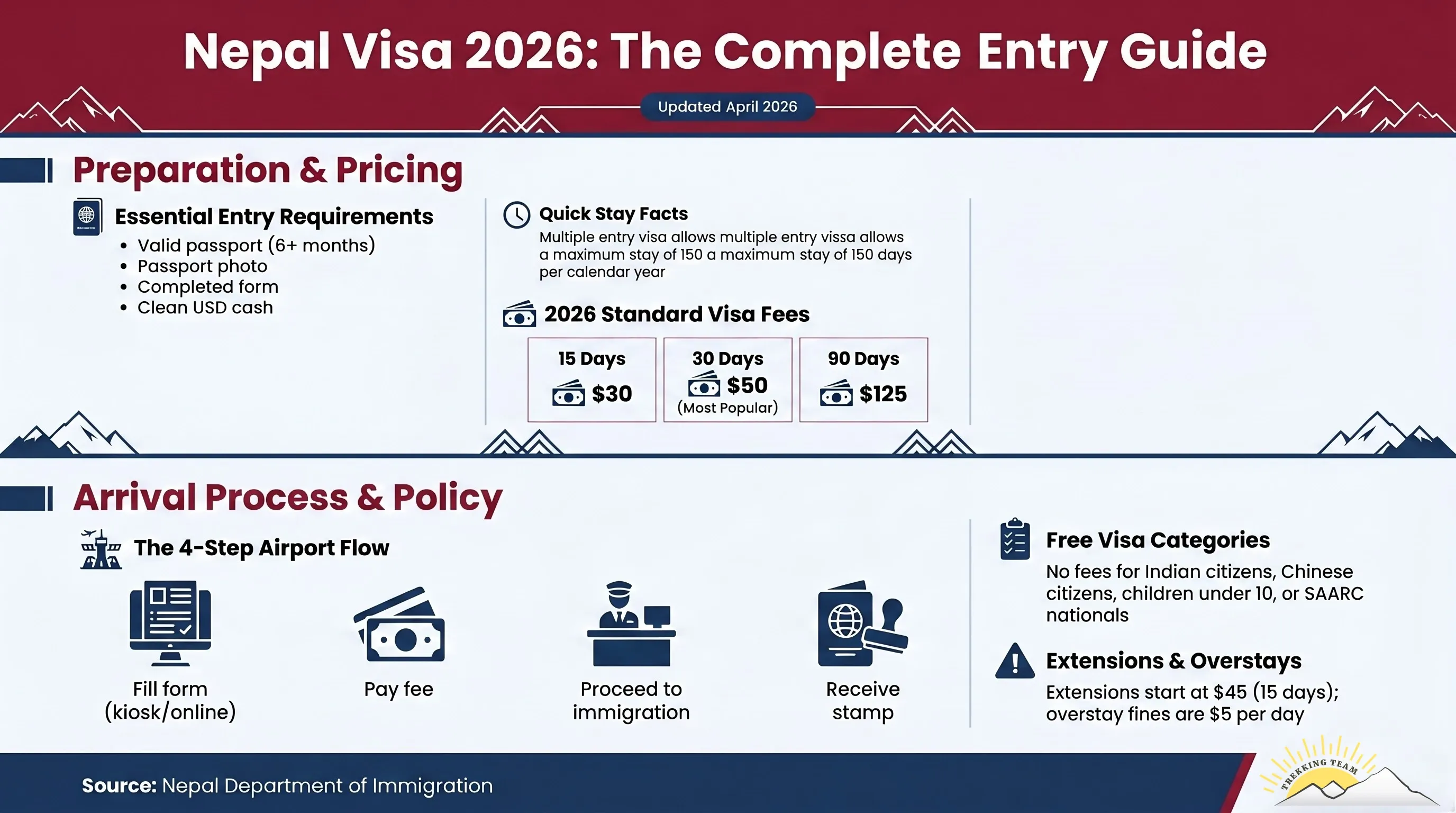
Understanding Nepal visa requirements in 2026 is straightforward. Nepal offers one of the easiest visa processes in Asia: citizens of most countries can get a multiple-entry tourist visa on arrival at Kathmandu's Tribhuvan International Airport or at land border crossings. The Nepal visa fee in 2026 is USD 30 for 15 days, USD 50 for 30 days, or USD 125 for 90 days. No appointment, no interview, no invitation letter. You land, you pay, you enter.
This guide covers every aspect of the Nepal visa for 2026: visa on arrival process, online pre-registration, fees, free visa categories, the 12 restricted countries, step-by-step airport instructions, land border crossings, extensions, the 150-day annual limit, overstay penalties, and how the visa connects to trekking permits. Every fact is sourced to an official government website.
How do I get a Nepal visa in 2026? Three ways: (1) Visa on arrival at Tribhuvan International Airport or land borders (most common), (2) Electronic Travel Authorization (ETA) through nepaliport.immigration.gov.np - apply and pay online with international credit cards before departure (fastest at the airport), or (3) in advance from a Nepali embassy or consulate. Visa fees: USD 30 (15 days), USD 50 (30 days), USD 125 (90 days). Source: Nepal Department of Immigration.
Nepal Visa 2026: Quick Reference
| Question | Answer | Source |
|---|---|---|
| Do I need a visa for Nepal? | Yes, all foreign nationals except Indian citizens | DoI |
| Can I get a visa on arrival? | Yes, at Kathmandu airport and land borders (most nationalities) | DoI |
| Can I apply and pay online? | Yes, through the ETA system with international credit cards (Visa, MC, AmEx) since Sept 2025 | NepYork |
| How much does it cost? | USD 30 (15 days), USD 50 (30 days), USD 125 (90 days) | DoI |
| What currency can I pay in? | USD preferred. EUR, GBP, and other major currencies accepted. Indian and Nepali rupees NOT accepted for visa fees | DoI |
| Is the visa multiple entry? | Yes, all tourist visas are multiple entry | DoI |
| What do I need? | Passport (6+ months validity), one passport photo, cash for fee | DoI |
| How long can I stay? | Maximum 150 days per calendar year on a tourist visa | DoI |
| Can I extend my visa? | Yes, at Immigration offices in Kathmandu or Pokhara | DoI |
| Do Indian citizens need a visa? | No. Free entry under the 1950 Indo-Nepal Treaty | Wikipedia |
| Are there countries that CANNOT get visa on arrival? | Yes. 12 countries must apply at a Nepali embassy in advance | DoI |
Part 1: Three Ways to Get a Nepal Visa
Option 1: Visa on Arrival (Most Common)
This is how the vast majority of travellers enter Nepal. You get your visa when you land at Tribhuvan International Airport (TIA) in Kathmandu or when you cross a land border.
Who is eligible: Citizens of most countries. If your nationality is not on the restricted list below, you are eligible.
What you need:
- Passport valid for at least 6 months from date of entry
- Machine-readable passport (handwritten passports are not accepted, per DoI arrival/departure rules)
- One recent passport-sized photograph (35 x 45 mm, white background)
- Cash for the visa fee in USD or another major currency (exact change recommended)
What our booking team tells every client: "Bring clean, undamaged US dollar bills. Creased, torn, or old-series notes are sometimes rejected at the visa counter. Bring exact change if possible. ATMs and currency exchange counters are available in the arrival hall, but they have queues during peak hours."
Option 2: Electronic Travel Authorization (ETA) - Apply and Pay Online Before You Fly
This is the newest and fastest option. Nepal launched the Electronic Travel Authorization (ETA) system in February 2024, and as of September 2025, the NepaliPort portal accepts international credit and debit cards including Visa, Mastercard, American Express, UnionPay, and Alipay. Source: NepYork.
What the ETA is: A digital pre-approval for your Nepal tourist visa. You apply online, upload documents, pay the visa fee by card, and receive an authorization with a barcode. When you land in Kathmandu, you skip the kiosks and the fee counter queue and go directly to the immigration desk. The officer scans your barcode, stamps the visa into your passport, and you are through. On a peak-season day when the regular queue takes 60-90 minutes, ETA holders can be through in 10-15 minutes.
What the ETA is NOT: It is not a visa by itself. You still need the physical stamp in your passport at the airport. The ETA transforms into a visa upon arrival when scanned at immigration. Do not assume you can enter Nepal on just the ETA printout without going through immigration.
How to apply:
- Visit nepaliport.immigration.gov.np
- Select "Electronic Travel Authorization"
- Fill in your passport details, travel dates, and local address in Nepal (hotel or trekking agency)
- Upload a passport-sized photo and passport bio page scan
- Pay the visa fee online by international credit/debit card (Visa, Mastercard, AmEx, UnionPay, Alipay)
- Receive your ETA confirmation with barcode via email
- Print the confirmation (or save to your phone, though printed is more reliable)
- At Kathmandu airport, go directly to the immigration desk with your passport and ETA printout. Skip the kiosk and fee counter queues.
Important notes:
- The ETA confirmation expires after 15 days. Apply no more than 15 days before your arrival. Source: DoI.
- The ETA is optional, not mandatory. Visa on arrival (Option 1) is still available for all eligible nationalities. The ETA simply speeds up the process.
- The portal has been reported as occasionally glitchy (timeouts, image upload failures). Allow 30 minutes to complete, not 5.
- Embassies abroad now use the ETA system too. If you apply at a Nepali embassy, they issue an ETA rather than a physical visa sticker. The stamp happens at the airport.
- The system processed over $42,000 in transactions during its initial trial period, confirming it is operational. Source: NepYork.
Our booking team's advice: "During peak trekking season (October and April), the ETA is genuinely worth the 15 minutes it takes to apply online. The regular kiosk and fee counter queues at the airport can take over an hour when three flights land at once. ETA holders walk past the entire queue. During off-peak months, the regular visa on arrival is fine. The queues are short."
Option 3: Visa from a Nepali Embassy or Consulate
You can apply for a tourist visa at a Nepali embassy or consulate in your home country before departure. The visa fee is the same. The advantage is that you skip the entire on-arrival process at the airport. The visa is valid for entry within 6 months of issue, and your stay is counted from the date you enter Nepal. Source: DoI tourist visa page.
When this makes sense: If you are a citizen of one of the 12 restricted countries that cannot get visa on arrival, you MUST use this option. It is also useful if you want zero hassle at the airport, or if you are arriving on a tight connection and cannot afford a 60-minute visa queue.
Part 2: Nepal Visa Fees 2026
Visa fees have not changed since July 17, 2019. They are the same whether you apply on arrival, online, or at an embassy. Source: DoI visa fee page.
| Duration | Fee (USD) | Best For |
|---|---|---|
| 15 days | $30 | Short cultural trips, Kathmandu and Pokhara only |
| 30 days | $50 | Most trekkers (EBC, ABC, Langtang, short circuit treks) |
| 90 days | $125 | Long treks (Upper Mustang, Dolpo, multiple treks, extended stays) |
Which duration should trekkers choose? Our booking team recommends the 30-day visa for most trekkers. The standard Everest Base Camp trek takes 14-18 days including Kathmandu time and buffer days. The Annapurna Base Camp trek takes 10-14 days. Both fit comfortably within 30 days. If your trek is 15 days or shorter and you have no delays, the 15-day visa works, but we always recommend the 30-day for safety. Flight delays, weather cancellations, and itinerary changes happen. Paying an extra $20 for a 30-day visa instead of a 15-day is cheap insurance.
Accepted currencies: USD is the standard and most reliable. EUR, GBP, AUD, CAD, CHF, JPY, CNY, and other major convertible currencies are accepted at the airport visa counter at the DoI's posted exchange rate. Indian rupees and Nepali rupees are NOT accepted for visa payment. Source: DoI visa on arrival page.
Can I pay by card? Some airport counters accept credit cards, but this is inconsistent. Card machines go offline, especially during power fluctuations. Carry cash as your primary payment method.
Part 3: Who Gets a Free Visa (Gratis Visa)
Several categories of travellers receive free (gratis) tourist visas. Source: DoI visa fee page and Nepal Tourism Board.
| Category | Free Visa Details | Conditions |
|---|---|---|
| Indian citizens | Completely visa-free | No visa required. Entry with Indian passport or government-issued photo ID (Voter ID accepted). Under the 1950 Indo-Nepal Treaty of Peace and Friendship. No time limit on stay. |
| SAARC citizens (Bangladesh, Bhutan, Maldives, Pakistan, Sri Lanka) | Free 30-day visa on arrival | Once per calendar year (January to December). Second visit in the same year requires paid visa. Same documents as regular visa on arrival, but USD 0 payment. |
| Chinese nationals | Free tourist visa (all durations) | 15, 30, or 90 days, all free. Same application process, USD 0 payment. Up to 150 days total per calendar year. |
| Children under 10 | Free visa (all nationalities) | All nationalities. Still need to complete forms and have a passport photo. |
| NRN cardholders | Free visa | Non-Residential Nepalese Identity Card holders (issued by Ministry of Foreign Affairs or Nepali diplomatic missions). |
Afghan citizens: Eligible for gratis visa on arrival ONLY upon recommendation of the Department of Immigration. Afghan travellers must request the inviting institution in Nepal to arrange paperwork with the DoI before arrival. Source: DoI tourist visa page.
Important for SAARC travellers: The free 30-day visa is available once per calendar year. If you visit Nepal in October 2026 and again in December 2026, the second visit requires a paid visa. If you visit in December 2026 and again in January 2027, both are free because they fall in different calendar years. Extensions beyond 30 days require standard extension fees regardless of initial free status.
Part 4: Countries That CANNOT Get Visa on Arrival
Citizens of the following 12 countries must obtain a tourist visa from a Nepali embassy or consulate before travelling to Nepal. They will NOT receive visa on arrival at the airport or land borders. Source: DoI official restricted list.
- Nigeria
- Ghana
- Zimbabwe
- Eswatini (Swaziland)
- Cameroon
- Somalia
- Liberia
- Ethiopia
- Iraq
- Afghanistan (gratis visa possible with DoI recommendation only)
- Syria
Note on Palestine: Some official summaries list 12 countries including Palestine; others list 11 without it. The DoI's published restricted list should be checked directly for the current version. If you hold a Palestinian travel document, contact the nearest Nepali embassy before travel to confirm your eligibility.
Exception: Holders of diplomatic and official passports from these countries may be exempt. Check with the nearest Nepali embassy.
Recent update: The Department of Immigration published a notice regarding revision of visa-on-arrival facility for Iranian nationals (posted March 2026). If you hold an Iranian passport, verify your current eligibility directly with the DoI or the nearest Nepali embassy before travel.
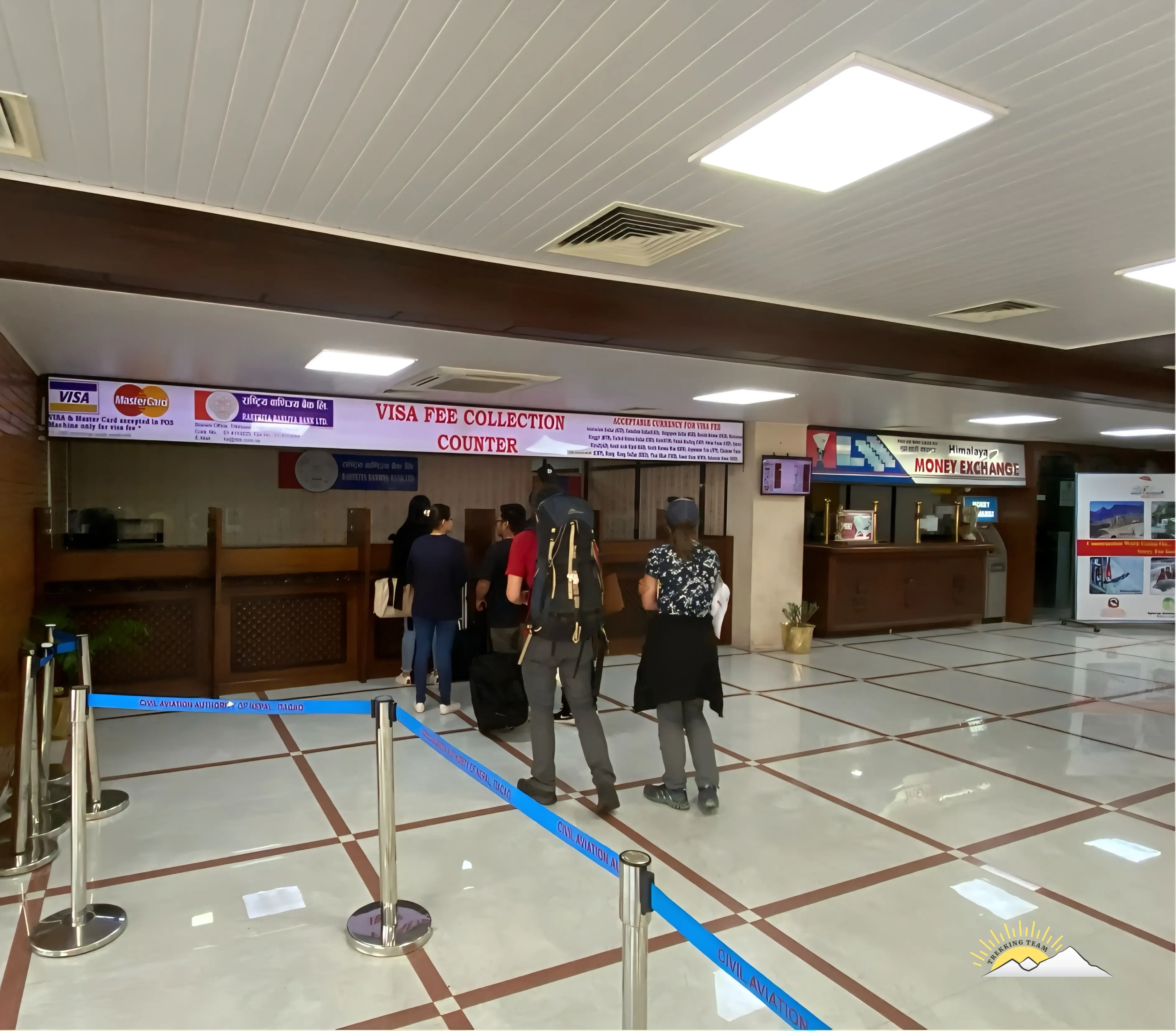
Part 5: Step-by-Step Visa on Arrival at Kathmandu Airport
Tribhuvan International Airport (TIA) is Nepal's only international airport handling regular commercial flights. Here is exactly what happens when you land, based on what our team observes daily:
Step 1: Deplane and follow signs to Immigration. After exiting the aircraft, follow the signs to the international arrivals hall. The visa section is to your left.
Step 2: Fill in the visa form. Two options:
- If you pre-registered online: Go directly to the fee counter with your printed barcoded receipt. Skip the kiosks.
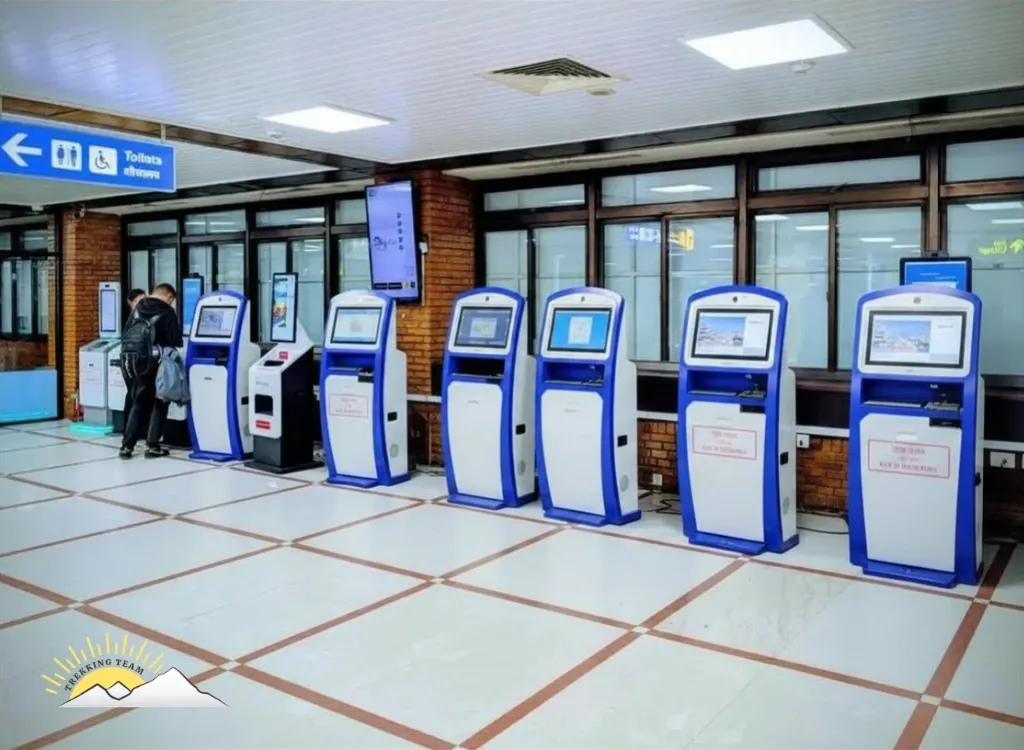
- If you did not pre-register: Use the electronic kiosk machines in the arrivals hall. They are touchscreen terminals where you enter your passport details, travel information, and take a digital photo. The kiosk prints a receipt. During peak hours (multiple simultaneous arrivals), kiosk queues can take 15 to 30 minutes.
Step 3: Pay the visa fee. Take your receipt (from kiosk or online pre-registration) to the visa fee counter. Pay in USD or another accepted currency. You receive a payment receipt.
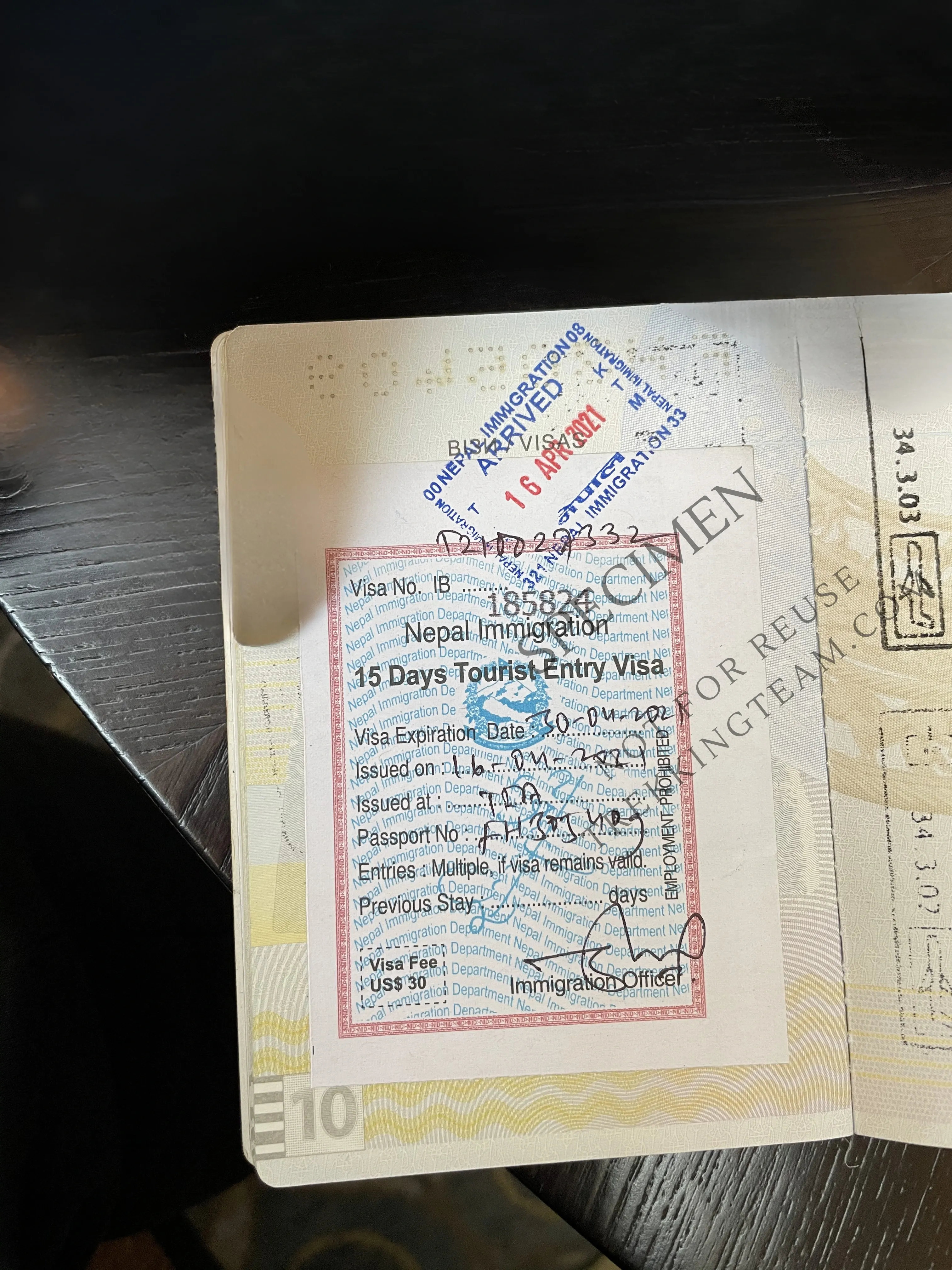
Step 4: Proceed to Immigration. Take both receipts (visa form + payment) to the immigration desk. Hand over your passport. The immigration officer stamps your visa. You are done.
Total time: 20 to 40 minutes during quiet periods. 45 to 90 minutes during peak arrivals (when multiple flights from Doha, Dubai, Delhi, or Kuala Lumpur land simultaneously). Source: U.S. Department of State notes that "getting a visa on arrival may take several hours."
Practical tips from our team:
- The kiosk cameras take your photo digitally, so you technically do not need a physical passport photo if using the kiosks. However, the kiosks sometimes malfunction. Carry one printed photo as backup.
- Some counters close during quiet hours. If you arrive on a late-night flight, expect fewer open counters and slightly longer processing.
- If you pre-filled the online form, bring a printed copy. Phone screenshots of the barcode work sometimes but not always. Print it.
- The fee counter and immigration desk are separate queues. Do not go to immigration without paying first.
Part 6: Visa on Arrival at Land Borders
Nepal shares land borders with India (south, east, west) and China/Tibet (north). Tourist visas on arrival are available at designated land border crossings with the same fees and requirements as the airport. Source: DoI visa on arrival page.
Major Land Border Crossings
| Border Point | Connects To | Notes |
|---|---|---|
| Sunauli / Belahiya | Uttar Pradesh, India | Most popular crossing for tourists coming from Delhi/Varanasi. Gateway to Lumbini and Pokhara. |
| Birgunj / Raxaul | Bihar, India | Busy commercial crossing. Less popular with tourists but functional. |
| Kakarbhitta | West Bengal, India | Eastern Nepal entry. Gateway to Ilam tea gardens and eastern Himalayas. |
| Nepalgunj | Uttar Pradesh, India | Gateway to Bardia National Park and far-western Nepal. |
| Gaddachauki / Mahendranagar | Uttarakhand, India | Western Nepal entry point. |
| Dhangadhi | Uttar Pradesh, India | Far-western entry. |
| Gyirong / Kerung | Tibet, China | Operational as of 2026. Requires China/Tibet permits arranged in advance. The only currently active Nepal-China land crossing for tourists. |
| Tatopani / Kodari | Tibet, China | Closed to tourist traffic since the 2015 earthquake. Check current status before planning. |
| Timure / Rasuwa | Northern border | Arrival and departure point. |
What to expect at land borders: The visa process is identical (same forms, same fees, same documents) but infrastructure is more basic than the airport. Queues may be less organised. English proficiency among border staff varies. Bring exact USD cash. Some smaller crossings may not have ATMs or currency exchange.
India to Nepal re-entry note: If you are crossing from Nepal to India and back to Nepal, Indian authorities may ask for proof of onward travel or accommodation. Always carry printed hotel bookings or an agency confirmation letter. Our team provides this for all clients.
Part 7: Nepal Visa Extension
If your trip runs longer than expected (weather delays, flight cancellations, or you simply do not want to leave), tourist visas can be extended within Nepal.
Where to extend:
- Department of Immigration, Kalikasthan, Kathmandu (main office)
- Immigration Office, Pokhara
Source: DoI tourist visa page.
Extension fees (verified from Pokhara Immigration Office):
| Fee Type | Amount | Source |
|---|---|---|
| Minimum extension (15 days) | USD 45 | DoI Pokhara |
| Each additional day beyond 15 | USD 3 per day | DoI Pokhara |
| Multiple entry retention (if needed) | Additional USD 25 | thelongestwayhome.com (unverified by DoI - confirm at office) |
| Overstay penalty (applied AFTER visa expires) | USD 5 per day | DoI |
Important distinction: The USD 3/day rate is for extending BEFORE your visa expires. The USD 5/day rate is the PENALTY for overstaying AFTER your visa expires. These are different things. Some guides confuse them. The Pokhara Immigration Office states clearly: "Tourist visa extension is done for minimum 15 days with USD 45 and USD 3 per day for additional days. In the case of delay less than 150 days additional USD 5 per day as late fine."
Note: Some travellers report an additional ~USD 10 processing fee charged at the immigration office counter that is not listed in the official fee schedule. Carry extra cash. Source: thelongestwayhome.com field report.
Maximum stay: 150 days per calendar year on a tourist visa. This includes your initial visa plus all extensions. After 150 days, you must leave Nepal and cannot re-enter on a tourist visa until the next calendar year (January 1). Leaving and re-entering Nepal does NOT reset this count. Source: DoI, U.S. State Department.
Extension process:
- Apply online through the DoI website before your current visa expires
- Visit the Immigration office in person with your passport, one passport photo, and the online application receipt
- Pay the extension fee
- Receive your extended visa (usually same day or next business day)
Critical warnings:
- Apply BEFORE your visa expires. Not after.
- The Immigration office closes for national holidays including Dashain (October) and Tihar. Plan accordingly.
- Overstaying results in a USD 5/day fine AND can complicate future entries to Nepal and departures at the airport. Serious overstays (beyond 150 days) can result in re-entry bans of one to several years. Source: U.S. State Department.
- Budget half a day for the extension process including travel time to the office and queues.
For trekkers: If your trek runs over schedule due to weather (this happens regularly on Everest Base Camp treks when Lukla flights cancel, or on monsoon treks when roads close), your guide will advise on extension options. This is one of the reasons we always recommend the 30-day visa over the 15-day, even for treks that technically fit within 15 days. A 30-day visa gives you buffer.
Part 8: Nepal Visa vs. Trekking Permits (They Are Different Things)
This is the point that confuses the most people. Your Nepal tourist visa gives you permission to enter and stay in Nepal. It does NOT give you permission to trek in specific regions. Trekking permits are separate documents with separate fees, issued by different authorities.
| Document | What It Covers | Where to Get It | Cost |
|---|---|---|---|
| Tourist visa | Entry and stay in Nepal | Airport / land border / embassy | $30-125 |
| National Park / Conservation Area permit | Entry to protected areas (Sagarmatha NP, ACAP, Manaslu, etc.) | Kathmandu or at park entrance | NPR 2,000-3,000 (~$15-22) |
| Restricted Area Permit | Entry to controlled regions (Upper Mustang, Dolpo, Nar Phu, Tsum) | Through a registered trekking agency only | Varies ($50/day for Upper Mustang) |
| Local municipality permit | Replaced the old TIMS card in 2025/2026 | Kathmandu or at checkpoints | Varies by region |
The TIMS card has been abolished. Many visa guides still list it as required. It is not. Local municipality permits have replaced it. Source: Our complete 2026 trekking permit guide.
Since April 2023, all foreign trekkers must hire a licensed guide from a TAAN-registered agency. Solo trekking without a guide is not permitted. Source: Our solo trekking update.
When you book with Trekking Team, all trekking permits are included and processed by our team. You do not visit any government office for permits. Your visa on arrival is the only document you handle yourself.
Part 9: The 7 Mistakes That Cause Problems at Nepal Immigration
These are real problems our team sees clients encounter. Not hypothetical. Real.
1. Passport with less than 6 months validity. You will be denied entry. Check your passport expiry date before booking flights. If it expires within 6 months of your planned arrival in Nepal, renew it first.
2. Handwritten passport. Nepal does not accept handwritten passports. You must have a machine-readable passport (MRP). Source: DoI arrival/departure page.
3. No cash for visa fee. The ATMs at the airport sometimes run out of cash during peak arrival hours. Card machines at the visa counter are unreliable. If you land without USD cash and the ATM is empty, you will be stuck in the arrivals hall until you can get money. Bring cash.
4. Choosing the wrong visa duration. A 15-day visa seems cheaper, but if your trek runs one day over and you need an extension, you lose half a day visiting the Immigration office in Kathmandu, paying USD 45 for a minimum 15-day extension. The extra USD 20 for a 30-day visa upfront is always worth it for trekkers.
5. Confusing visa and trekking permits. Your visa lets you into Nepal. Your trekking permits let you onto the trails. They are separate. If you arrive at a national park checkpoint without the correct trekking permit, you will be turned back regardless of your visa status.
6. Overstaying the visa. The USD 5/day penalty adds up fast, and the airport immigration desk will not let you depart until you settle the fine at the Department of Immigration office in Kathmandu. This has caused travellers to miss international flights. Set a calendar reminder for your visa expiry date.
7. Assuming the visa is single entry. It is not. All Nepal tourist visas are multiple entry. You CAN leave Nepal (to India or Tibet) and return without a new visa, as long as your original visa has not expired. Your 150-day annual limit still counts.
Part 10: Special Cases
US Citizens
Visa on arrival available. USD 30/50/125. The U.S. Department of State notes: "Either apply for a tourist visa at a Nepali embassy or consulate before traveling, or purchase a tourist visa upon arrival." US citizens of Nepali descent may be eligible for a Non-Residential Nepali (NRN) Identity Card through the Embassy of Nepal in Washington, D.C.
UK Citizens
Visa on arrival available. Standard fees apply.
EU Citizens
Visa on arrival available for all EU nationalities. Standard fees apply.
Australian and New Zealand Citizens
Visa on arrival available. Standard fees apply.
Canadian Citizens
Visa on arrival available. Standard fees apply.
Chinese Citizens
Free tourist visa for all durations (15/30/90 days). Same process as visa on arrival, but USD 0 payment at fee counter.
Indian Citizens
No visa required. Enter Nepal with Indian passport or government-issued photo ID (Voter ID with photo accepted). Under the 1950 Indo-Nepal Treaty.
Travelling Nepal to Tibet
If you are entering Tibet from Nepal (via the Gyirong/Kerung crossing), you need a China visa AND a Tibet Travel Permit, which must be arranged through a registered travel agency in advance. Your Nepal visa has no bearing on Tibet entry. These are completely separate processes.
Travelling Nepal to India
Indian border crossings are open for transit. If you are a foreign national entering India from Nepal, you need a valid Indian visa. Nepal-side exit requires presenting your passport at the Nepali immigration counter. Indian-side entry requires your passport and Indian visa at the Indian immigration counter.
Part 11: What Trekkers Should Know About Visa vs. Agency Paperwork
If you are coming to Nepal specifically to trek, understanding which documents you handle yourself and which your trekking agency handles saves confusion and prevents the mistake of showing up without the right papers.
Documents you handle before arrival:
- Passport validity check (6+ months)
- Visa on arrival at the airport (or online pre-registration)
- Travel insurance (must cover trekking altitude and helicopter evacuation)
Documents your trekking agency handles in Nepal:
- All trekking permits (national park, conservation area, restricted area, municipality)
- Licensed guide assignment (mandatory since April 2023)
- Domestic flights booking (Lukla, Jomsom, Juphal, Simikot)
- Hotel and teahouse reservations
- Airport transfers
The practical point: The only government office you personally visit is the visa counter at the airport. If your agency is not handling all trekking permits for you, ask why. A registered agency (look for TAAN membership) should process every permit as part of your package.
Frequently Asked Questions: Nepal Visa 2026
Do I need a visa to visit Nepal? Yes, all foreign nationals need a visa except Indian citizens, who enter freely under the 1950 Indo-Nepal Treaty. Source: DoI.
How much does a Nepal visa cost in 2026? USD 30 (15 days), USD 50 (30 days), USD 125 (90 days). Fees have not changed since July 17, 2019. Source: DoI.
Can I get a Nepal visa on arrival at Kathmandu airport? Yes. Citizens of most countries can get a tourist visa on arrival at Tribhuvan International Airport. Citizens of 12 countries must apply at a Nepali embassy in advance. Source: DoI.
Which countries cannot get Nepal visa on arrival? Nigeria, Ghana, Zimbabwe, Eswatini (Swaziland), Cameroon, Somalia, Liberia, Ethiopia, Iraq, Palestine, Afghanistan, and Syria. Source: DoI.
Is the Nepal visa multiple entry? Yes. All tourist visas (on arrival, online, and embassy-issued) are multiple entry by default. You can leave Nepal and return within the visa validity period without paying again. Source: DoI.
How long can I stay in Nepal on a tourist visa? Maximum 150 days per calendar year, including initial visa plus extensions. Source: DoI.
Can I extend my Nepal visa? Yes. At the Department of Immigration in Kathmandu (Kalikasthan) or Pokhara. Minimum extension: 15 days for USD 45. Additional days: USD 3 per day. Maximum total stay: 150 days per calendar year. Source: DoI.
What happens if I overstay my Nepal visa? A fine of USD 5 per day, plus you must visit the Department of Immigration to regularise your status before departing. The airport will not let you leave until the fine is settled. Serious overstays can result in re-entry bans. Source: U.S. State Department.
Do I need a visa AND a trekking permit? Yes. They are separate. Your tourist visa allows entry to Nepal. Trekking permits (national park, conservation area, restricted area) allow access to specific trails. Full 2026 permit guide.
Is the TIMS card still required? No. The TIMS system has been abolished. Local municipality permits have replaced it. Full update.
Do children need a visa? Yes, but children under 10 receive a free (gratis) visa for all nationalities. They still need to complete the visa form and have a passport. Source: DoI.
Can I get a Nepal visa at Pokhara airport? Not currently. Nepal has three airports classified as international: Tribhuvan International Airport (Kathmandu), Gautam Buddha International Airport (Bhairahawa/Lumbini), and Pokhara International Airport. However, as of April 2026, only Tribhuvan International Airport handles regular scheduled international flights and offers visa on arrival services. Gautam Buddha International Airport has had sporadic international charter operations but no regular scheduled service. Pokhara International Airport (opened January 2023) was designed for international operations but has not launched regular international flights as of April 2026. If either airport begins regular international service, visa on arrival would likely be offered, but this is not confirmed. Check current flight schedules before planning to enter Nepal through any airport other than Kathmandu.
Which visa duration should trekkers choose? 30 days for most treks. The Everest Base Camp trek takes 14-18 days total. The Annapurna Base Camp trek takes 10-14 days. Both fit within 30 days with buffer. The extra USD 20 over a 15-day visa is cheap insurance against weather delays.
What currency should I bring for the visa fee? USD is safest. Clean, undamaged bills. Exact change preferred. EUR and GBP are also accepted. Indian rupees and Nepali rupees are NOT accepted for visa fees.
Is Nepal Visa Easy? How Nepal Compares to Other Asian Countries
One of the most common questions travellers ask is whether getting a Nepal visa is difficult. The short answer: Nepal has one of the easiest visa processes in Asia.
| Country | Visa on Arrival? | Cost | Processing Time | Difficulty |
|---|---|---|---|---|
| Nepal | Yes (most nationalities) | $30-125 | 20-60 minutes at airport | Very easy |
| India | No (most nationalities need e-visa or embassy visa) | $10-100+ | Days to weeks in advance | Moderate |
| Bhutan | No (must book through licensed tour operator, SDF fee applies) | $100/day Sustainable Development Fee | Weeks in advance | Complex |
| China / Tibet | No (embassy visa required, Tibet needs separate permit via agency) | $140+ | Weeks in advance | Complex |
| Myanmar | E-visa required | $50 | 3 business days | Moderate |
| Thailand | Visa-free for many (30 days) | Free for many nationalities | Instant | Very easy |
| Vietnam | E-visa or visa on arrival (with approval letter) | $25-50 | 1-3 days for e-visa | Easy |
| Sri Lanka | E-visa (ETA) | $50 | 24-48 hours | Easy |
Key takeaway: Nepal is easier to enter than India, Bhutan, China, Tibet, and Myanmar. It is comparable to Vietnam and Sri Lanka. Only Thailand is simpler for most nationalities (because many get visa-free entry). For travellers planning a multi-country Himalayan trip (Nepal + Tibet, Nepal + Bhutan, Nepal + India), Nepal is always the easiest visa to obtain and should be your first entry point.
Planning Nepal + Tibet? Enter Nepal first (visa on arrival, 20 minutes). Then arrange your Tibet Travel Permit through a registered agency from Kathmandu. You cannot get a Tibet permit independently. The Gyirong/Kerung border crossing to Tibet is operational as of 2026.
Planning Nepal + Bhutan? Fly from Kathmandu to Paro. Your Bhutan tour operator handles the Bhutan visa. Your Nepal visa remains valid for re-entry if you have a multiple-entry visa (all Nepal tourist visas are multiple entry by default).
Planning Nepal + India? You need a separate Indian visa (e-visa or embassy). Cross at any of the designated land borders. Your Nepal visa remains valid for re-entry.
Change Log :
This guide is reviewed monthly. When Nepal's visa policies change, we update within 48 hours.
| Date | Change |
|---|---|
| April 24, 2026 | Initial publication. All fees, rules, and requirements verified against DoI, NTB, and US State Department sources. ETA section updated to reflect international credit card payment acceptance (live since September 2025). |
| September 2025 | NepaliPort portal began accepting international credit/debit cards (Visa, Mastercard, AmEx, UnionPay, Alipay) for ETA payment. Previously only Nepali payment gateways were accepted. |
| March 2026 | DoI published notice regarding revision of visa-on-arrival facility for Iranian nationals. Status flagged in restricted countries section. |
| February 2024 | Nepal Department of Immigration launched the Electronic Travel Authorization (ETA) system through NepaliPort portal. |
| July 17, 2019 | Last official visa fee change by Department of Immigration (fees unchanged since this date). |
Next scheduled review: May 2026
Contact
Need help planning your Nepal trip? We have been processing visas, permits, and logistics for international trekkers since 1991.
- Website: trekkingteam.com
- Email: info@trekkingteam.com
- WhatsApp: +977 9869400739
- Office: Gongabu, Pragatinagar, Kathmandu, Nepal
Follow us:
Walking Nepal's trails since 1991. Your journey starts here.
Nepal visa 2026 guide with official sources. Visa on arrival fees ($30-$125), step-by-step airport process, free visa categories, 12 restricted countries, extensions, and trekking permits explained.