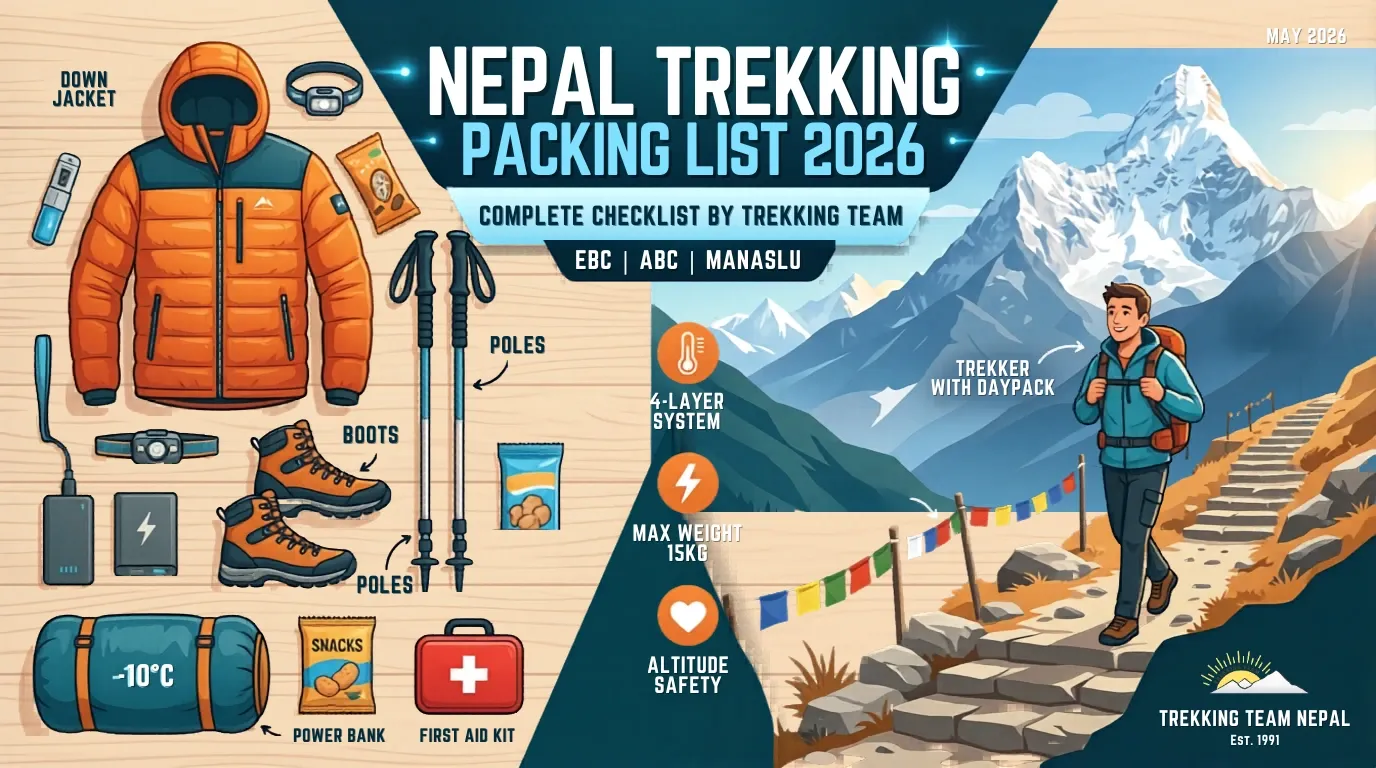
Nepal Trekking Packing List 2026: What to Pack for EBC, ABC & Manaslu
Published by Trekking Team Nepal | Est. 1991 | TAAN Member #1106
📅 May 2026 • ⏱️ 28 min read
Last Updated: May 1, 2026 | Reviewed monthly. Thamel gear prices verified April 2026.
Written by the Trekking Team editorial team. Gear recommendations reviewed by Senior Guide Bijay (12+ years, reviewed on TripAdvisor) and verified against PPGI porter welfare standards. Thamel prices last checked in-person: April 2026.
Key Takeaways:
- Target weight: 7-10 kg daypack, 10-12 kg porter duffel. Never exceed 15 kg total at Lukla.
- The 4-layer system (base, fleece, down, shell) handles every condition from Lukla to Kala Patthar.
- Most gear is 50-80% cheaper in Thamel, but always bring your own boots and waterproof shell from home.
What should I pack for trekking in Nepal? Pack four layers (base, fleece, down, shell), broken-in waterproof boots, a -10°C to -15°C sleeping bag, trekking poles, water purification, sun protection, and a 10,000+ mAh power bank. Target 7-10 kg in your daypack and 10-12 kg in the porter duffel. The most common mistake is overpacking.
Who this guide is for: Trekkers doing Everest Base Camp, Annapurna Base Camp, Manaslu Circuit, Annapurna Circuit, Langtang, Mardi Himal, Poon Hill, or other standard teahouse treks in Nepal. Not for technical mountaineering, expeditions above 6,000 m, or Mera/Island Peak climbs.
We have packed bags for over 10,000 trekkers since 1991. This is the only Nepal trekking packing list you need for 2026 - with current Thamel prices verified this month, what your licensed guide actually carries, and the Lukla flight weight limit most guides forget to mention.
What our gear checks reveal: The most common item we remove is a second pair of shoes. The average duffel weight has dropped from 16 kg in 2010 to 12 kg in 2025 as trekkers have become better informed. At our pre-departure briefings, guides typically remove 3-5 kg of unnecessary items from first-time trekkers' bags. The trekkers who enjoy themselves most consistently pack the lightest.
"I tell every trekker the same thing at the gear check the night before: take everything out, put back only what you would carry up five flights of stairs three times in a row. If you hesitate on an item, leave it." - Bijay, Lead Guide, 12+ years on EBC and ABC trails
In This Guide
- The Golden Rule: Pack Light
- Packing Decision Engine: What Should YOU Pack?
- Complete Packing Checklist (Printable)
- Clothing: The Layering System
- Footwear
- Bags and Packing Strategy
- Sleeping Gear
- Trekking Gear and Accessories
- Electronics and Charging
- Documents and Money
- First Aid and Medications (incl. Khumbu Cough)
- Toiletries and Personal Items
- Food and Hydration
- Female-Specific Packing
- Photography Gear
- Packing by Trek: What Changes by Route
- Packing by Season: What to Add or Remove
- Packing by Altitude Zone
- Buy, Rent, or Bring? The Kathmandu Gear Guide
- What NOT to Pack
- What Guides Remove From Your Bag (Every Time)
- What to Leave at Your Kathmandu Hotel
- What Your Guide and Agency Provide
- Frequently Asked Questions (22 FAQs)
The Golden Rule: Pack Light
Every experienced trekker says the same thing: you packed too much. After 34 years of watching trekkers arrive at our Kathmandu office with bags they could barely lift, here is the reality.
A trekker at Thorong Phedi (4,540 m) with a 22 kg bag will struggle to cross Thorong La Pass. A trekker with a 10 kg bag will enjoy it. The views are the same. The altitude is the same. The difference is entirely in what you packed.
Ideal pack weight for Nepal trekking:
- Daypack (carried by you while walking): 5-8 kg maximum
- Porter duffel (carried by porter): 10-12 kg maximum per trekker
- Total: 15-20 kg absolute maximum including everything
The test: If you cannot comfortably carry your loaded daypack up 5 flights of stairs at home, it is too heavy for the trail.
🔔 2026 Update: Licensed guides are mandatory on all major Nepal trekking routes since April 2023. Your guide carries a comprehensive first aid kit, pulse oximeter, and emergency communication. You do NOT need to pack your own extensive medical kit. Pack personal medications only. Nepal trekking rules 2026.
Lukla Flight Weight Limit (EBC Trekkers: Read This)
If you are flying to Lukla for the Everest Base Camp trek, airlines enforce strict baggage limits:
Lukla flight luggage allowance (Tara Air, Summit Air):
- Checked baggage: 10 kg maximum per passenger
- Hand luggage: 3 kg maximum per passenger
- Total: 13 kg
Excess baggage is charged per kilogram and, during peak season, may not be accepted at all due to aircraft weight restrictions on the short Lukla runway. For current STOL airport regulations: Civil Aviation Authority of Nepal (CAAN). Pack accordingly. Your porter's duffel bag counts as your checked luggage.
For Pokhara to Jomsom flights (Upper Mustang), similar limits apply. Confirm with your airline at booking.
"The Lukla weigh-in catches people every season. I have seen trekkers frantically unpacking bags at the airport, stuffing extra clothes into porter bags. Pack under the limit at home and you avoid the stress." - Bijay, Lead Guide
Packing Decision Engine: What Should YOU Pack?
Most packing lists treat every trekker the same. They are not. A first-time trekker doing Poon Hill in April has different needs than a photographer doing EBC in November. Use this table to adjust the standard checklist for your situation.
| If you are... | Adjust your packing this way |
|---|---|
| First-time trekker | Pack 2 extra pairs of blister plasters, 1 extra pair of trekking socks, and trekking poles even if you "don't usually use them." Cut clothing by one item per category. |
| Cold-sensitive sleeper | Upgrade sleeping bag rating by one tier (-15°C for ABC, -20°C for EBC). Add a silk liner. Pack a buff to wear at night. |
| Budget-conscious | Bring boots, base layers, and shell from home. Buy or rent everything else in Thamel and save 50-80% versus international prices. |
| Photographer | Add 3-4 spare batteries (cold drains them 2-3x faster), microfibre lens cloths, and a small dry bag for camera. Cut clothing weight to compensate. |
| Doing EBC in November or later | Upgrade to -20°C sleeping bag, heavy expedition-weight down jacket, and insulated gloves (not just fleece). Pack microspikes. |
| Doing ABC in May or June | Add full waterproof shell + overtrousers, leech socks for forest sections below 2,500 m, and an extra dry bag for monsoon shoulder rains. |
| Solo female trekker | Add a pee cloth or FUD, privacy sarong, extra menstrual products (full trek + buffer), and request a female guide if preferred. |
| Trekking with a porter | Daypack stays light (5-7 kg). Duffel can be 12 kg. Total under 15 kg per Lukla flight rules. |
| Trekking without a porter | Cut everything by 30%. Single base layer, single trekking trouser, lightest possible sleeping bag for the season. Total target 10-12 kg. |
| Over 50 or with knee issues | Trekking poles non-negotiable. Consider a knee brace. Add ibuprofen for inflammation. Allow extra acclimatization days. |
This table is a starting point. Talk to your guide for trek-specific adjustments based on weather conditions in your trekking window.
Complete Packing Checklist
This is the master list. Every item below is explained in detail in the sections that follow. Print this, tick items off, then read the detail for anything you are unsure about.
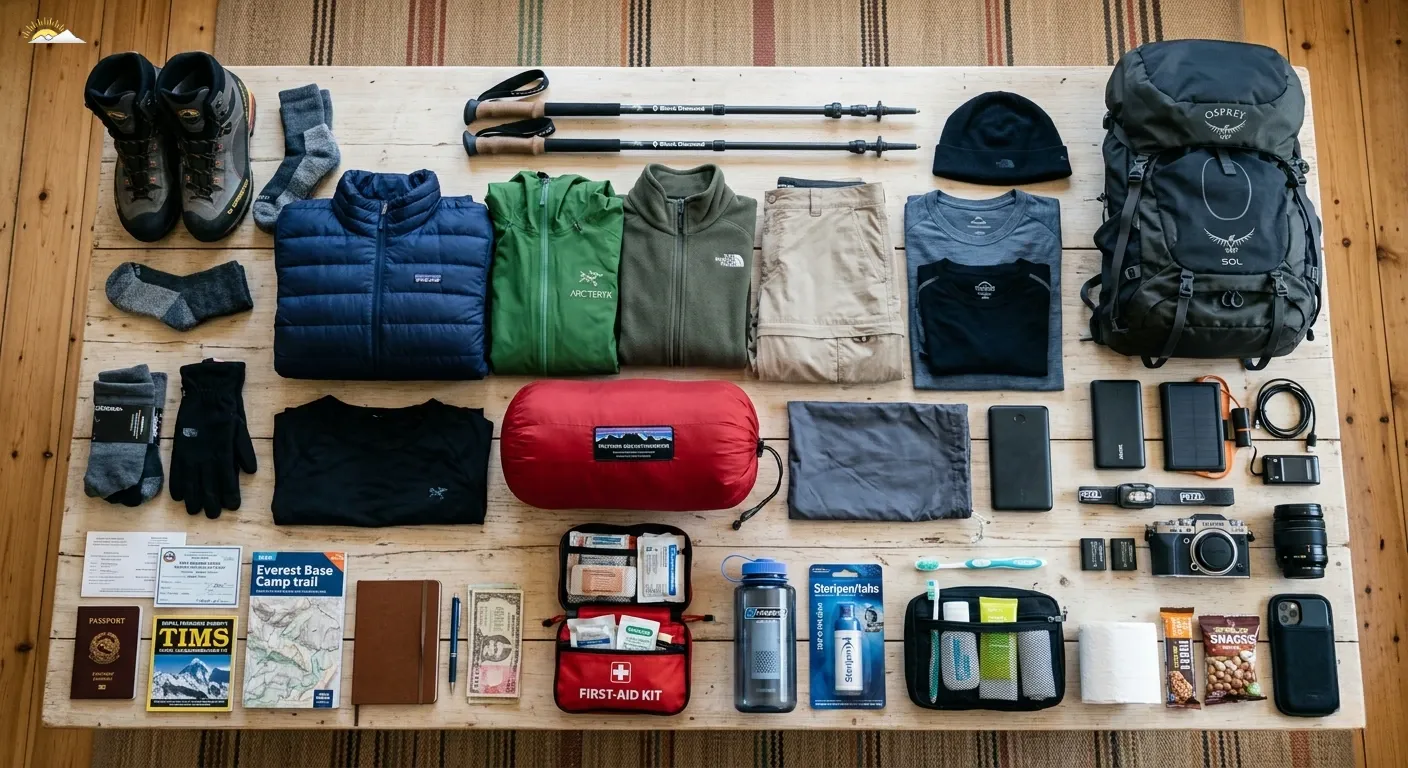
Clothing (worn + packed)
- ☐ 2 moisture-wicking base layer tops (synthetic or merino wool)
- ☐ 1 moisture-wicking base layer bottom (long johns/leggings)
- ☐ 1 insulating mid-layer (fleece jacket or pullover)
- ☐ 1 down jacket (insulated, compressible)
- ☐ 1 waterproof shell jacket (Gore-Tex or equivalent, sealed seams)
- ☐ 2 trekking trousers/pants (quick-dry, zip-off optional)
- ☐ 3-4 underwear (synthetic, quick-dry)
- ☐ 3-4 pairs trekking socks (merino wool or synthetic blend, NOT cotton)
- ☐ 1 warm hat/beanie (fleece or wool)
- ☐ 1 sun hat or cap (wide brim preferred)
- ☐ 1 pair lightweight gloves
- ☐ 1 buff/neck gaiter
- ☐ 1 pair waterproof overtrousers (optional for monsoon shoulder)
Footwear
- ☐ 1 pair waterproof trekking boots (ankle-high, broken in)
- ☐ 1 pair camp shoes/sandals (for teahouses and hot springs)
- ☐ Gaiters (optional, for monsoon or snow)
Bags
- ☐ Daypack (25-35 litre with rain cover)
- ☐ Duffel bag (50-70 litre, for porter to carry)
- ☐ 3-4 dry bags or zip-lock bags (for electronics, documents, clean clothes)
Sleeping
- ☐ Sleeping bag (rated to -10°C minimum for EBC/Annapurna; -15°C for winter)
- ☐ Sleeping bag liner (optional, adds warmth and hygiene)
Trekking Gear
- ☐ Trekking poles (adjustable, collapsible)
- ☐ Headlamp with spare batteries
- ☐ Water bottles (2 x 1 litre) or hydration bladder
- ☐ Water purification (SteriPen, Aquatabs, Lifestraw, or Grayl)
- ☐ Sunglasses (UV400, category 3-4, side shields for snow)
- ☐ Sunscreen (SPF 50+, high altitude formula)
- ☐ Lip balm with SPF
- ☐ Trekking umbrella (optional but surprisingly useful)
Electronics
- ☐ Power bank (10,000-20,000 mAh)
- ☐ Phone + charger cable
- ☐ Universal adapter (Nepal uses Type C/D/M sockets, Indian-style round pins)
- ☐ Camera + spare batteries (optional)
- ☐ Headphones (optional)
Documents
- ☐ Passport (6+ months validity)
- ☐ Nepal visa (obtain on arrival or via ETA)
- ☐ Travel insurance policy (printed copy, must cover trekking altitude + helicopter evacuation)
- ☐ 4 passport photos (for permits)
- ☐ Cash: NPR 25,000-40,000 + USD 50-100 emergency reserve
- ☐ Photocopies of passport, visa, insurance (separate from originals)
First Aid (personal items only)
- ☐ Personal prescription medications (full supply for trip duration)
- ☐ Diamox/acetazolamide (if prescribed by your doctor for altitude)
- ☐ Paracetamol/ibuprofen
- ☐ Anti-diarrheal (Imodium/loperamide)
- ☐ Rehydration salts (ORS sachets)
- ☐ Blister plasters (Compeed or similar)
- ☐ Throat lozenges (dry air at altitude causes sore throats)
- ☐ Antihistamines
- ☐ Hand sanitiser
Toiletries
- ☐ Toothbrush + toothpaste (travel size)
- ☐ Biodegradable soap/shampoo (small bottle)
- ☐ Quick-dry travel towel
- ☐ Toilet paper (1-2 rolls, teahouses above 3,000 m often do not supply it)
- ☐ Wet wipes (biodegradable)
- ☐ Sunscreen (if not listed above)
Clothing: The Layering System
What is the layering system for Nepal trekking? Wearing four removable garments to handle Nepal's 30-40°C daily temperature swings between dawn and midday at altitude. Layer 1 (base) wicks moisture. Layer 2 (fleece) insulates while moving. Layer 3 (down) traps heat when stopped. Layer 4 (shell) blocks wind and rain.
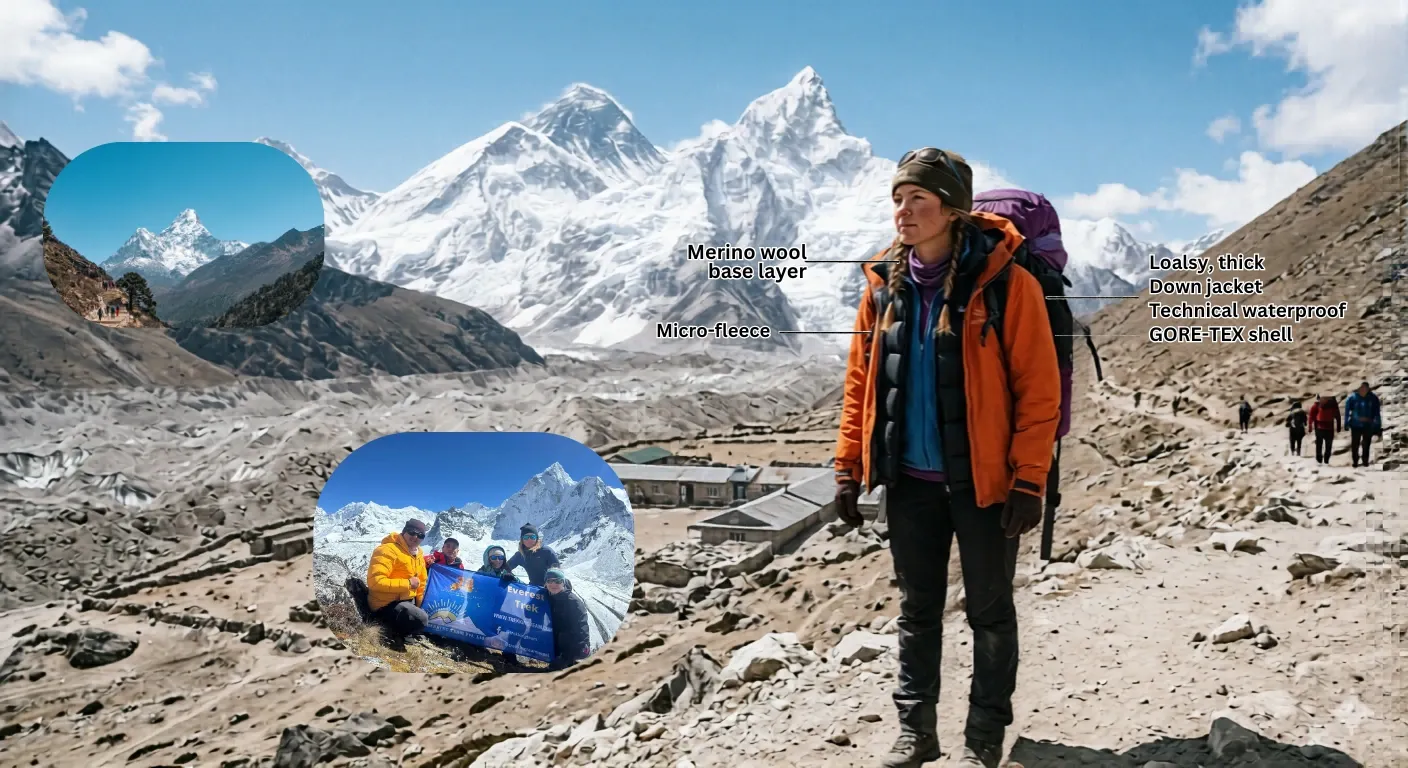
Layering is the foundation of mountain dressing. Nepal's trekking altitude range (1,000-5,545 m) means you experience temperature swings of 30-40°C within a single day. A morning at Gorak Shep might be -15°C; by noon, direct sun can feel like 15°C. You cannot pack for both extremes with single garments. You layer.
Layer 1: Base Layer (Against Skin)
What: Moisture-wicking top and bottom worn directly against the skin. Moves sweat away from your body. Material: Merino wool (naturally anti-odour, can be worn 3-5 days without washing) or synthetic (dries faster, cheaper). NEVER cotton. Cotton absorbs moisture, does not dry, and makes you cold. Quantity: 2 tops, 1 bottom. Buy in Thamel: NPR 500-1,500 for synthetic. Merino wool harder to find locally; bring from home if you prefer it.
Layer 2: Mid Layer (Insulation When Moving)
What: Fleece jacket or pullover. Worn over base layer during cold mornings and at altitude. Material: Fleece (100-200 weight). Lightweight, breathable, dries fast. Quantity: 1. Buy in Thamel: NPR 800-2,000 for a decent fleece.
Layer 3: Insulation Layer (Warmth When Stopped)
What: Down jacket or synthetic insulated jacket. Worn at rest stops, in teahouses, and during early morning starts above 4,000 m. Material: Down (lighter, more compressible, warmer per gram) or synthetic (works when wet, cheaper). For Nepal teahouse treks, down is preferred. Quantity: 1. Buy in Thamel: NPR 2,000-4,000 for a functional (non-branded) down jacket. Quality varies significantly; inspect stitching and zipper quality before buying. Rent in Thamel: NPR 100-200/day. Bring from home: If you own a quality down jacket (North Face Nuptse, Patagonia Down Sweater, Rab Microlight Alpine, Mountain Equipment Lightline, or similar), bring it. A good down jacket is the single most important warmth item on the trek.
Layer 4: Shell Layer (Wind and Rain Protection)
What: Waterproof, windproof outer jacket. Your shield against rain, wind, and snow. Material: Gore-Tex or equivalent with sealed seams. Must be genuinely waterproof, not "water-resistant." Quantity: 1. Note: On the EBC trek, rain is rare at altitude; the shell is primarily for wind. On the ABC trek, the Annapurna region receives 3x more rainfall, so waterproofing matters more. Buy in Thamel: NPR 1,500-4,000. Branded Gore-Tex is expensive everywhere; Thamel alternatives work for a single trek but may not last years. Bring from home: Recommended. A trusted waterproof jacket is worth bringing.
Trousers
What: Quick-dry trekking trousers. Zip-off (convertible to shorts) are popular but not essential. Quantity: 2 pairs. Material: Synthetic, quick-dry, lightweight. NOT jeans (heavy, slow to dry, restrict movement). NOT cotton. Buy in Thamel: NPR 800-2,000.
Socks
What: Trekking-specific socks with padding at heel and toe. Material: Merino wool blend or synthetic. NEVER cotton (causes blisters and does not insulate when wet). Quantity: 3-4 pairs. Rotate daily. Note: Socks are arguably the most important item after boots. Bad socks with good boots still produce blisters. Good socks with mediocre boots can work.
Head, Hands, Neck
- Warm hat/beanie: Fleece or wool. Essential above 3,500 m and for every evening.
- Sun hat/cap: Wide brim preferred for UV protection. Critical at altitude where UV increases approximately 10% per 1,000 m elevation.
- Lightweight gloves: Fleece inner gloves for most conditions. Add waterproof over-gloves only for winter treks or Thorong La crossings.
- Buff/neck gaiter: Multipurpose (dust protection at lower elevations, warmth at altitude, sun protection). The single most versatile item on the list.
Footwear
Trekking Boots
This is the most important purchase decision on this entire list. Bad boots ruin treks. Good boots make everything easier.
Requirements:
- Waterproof (sealed seams, not just "water-resistant")
- Ankle-high (support on uneven terrain and stepped descents)
- Stiff sole with good grip (Vibram or equivalent)
- Broken in before departure (minimum 50 km of walking in them)
How long to break in trekking boots before Nepal: At least 50 km of walking, ideally over 5-6 long walks before departure. Do NOT bring new boots to Nepal. Blisters from new boots on Day 2 of a 14-day trek can turn your entire experience into a painful ordeal. In our operational experience, foot problems from inadequately broken-in boots are the single most common gear-related complaint on the trail.
Recommended brands: Salomon X Ultra, La Sportiva Nucleo, Scarpa Zodiac, Merrell Moab. Any waterproof, ankle-high boot with Vibram or equivalent sole from a reputable outdoor brand will work if properly broken in.
Buy in Thamel: NPR 3,000-8,000 for functional boots. Quality is inconsistent. For a 12-14 day EBC trek, bring your own tested boots from home. For shorter treks (Poon Hill, Mardi Himal), Thamel boots may be acceptable.
Camp Shoes
Lightweight sandals or slip-ons for teahouse evenings, hot springs (Jhinu Danda on the ABC trek), and giving your feet a break. Crocs, Teva sandals, or any lightweight shoe that is easy to slip on and off.
Bags and Packing Strategy
Daypack (What You Carry While Walking)
Size: 25-35 litres. Recommended: Osprey Talon 33, Deuter Speed Lite 32, Gregory Miwok 32. Contents during the day: Water (2 litres), snacks, rain jacket, sun protection, camera, phone, power bank, headlamp, personal valuables. Weight target: 5-8 kg. Features: Rain cover (essential), hip belt (distributes weight), side pockets for water bottles.
Duffel Bag (Carried by Porter)
Size: 50-70 litres. Contents: Everything you do not need during the day: spare clothes, sleeping bag, toiletries, electronics chargers, extra food. Weight limit: 12 kg per trekker (one porter typically carries for two trekkers; total porter load maximum 25 kg including both duffel bags). Source: PPGI porter welfare standards. Note: Many agencies provide duffel bags, sleeping bags, and down jackets on request. Ask your agency what they supply before buying or renting.
Dry Bags / Zip-Lock Bags
Pack electronics, documents, cash, and one set of clean dry clothes in waterproof bags inside your duffel. If it rains and your duffel gets wet (it happens), your critical items stay dry. Three to four large zip-lock bags cost almost nothing and save enormous grief.
Sleeping Gear
Sleeping Bag
Sleeping bag temperature ratings by Nepal trek:
| Trek | Minimum Rating | Why |
|---|---|---|
| EBC (Oct-Nov) | -15°C | Nights at Gorak Shep (5,164 m) reach -20°C |
| EBC (Apr-May) | -10°C | Slightly warmer spring nights |
| ABC (Oct-Nov) | -10°C | Max altitude 4,130 m, milder than EBC |
| Langtang / Manaslu | -10 to -15°C | Similar altitude range to EBC |
| Poon Hill / Mardi Himal | -5°C | Lower altitude, shorter duration |
| Upper Mustang (monsoon) | -5 to -10°C | Max 3,810 m but windy |
| Any winter trek (Dec-Feb) | -15 to -20°C | Add 5°C to the standard rating |
Buy in Thamel: NPR 5,000-8,000 for a functional bag. Quality is lower than branded bags but works for a single trek. Rent in Thamel: NPR 100-150/day (NPR 1,500-2,000 for a 14-day trek). Bring from home: If you own a good sleeping bag, bring it. If not, renting in Kathmandu is the most cost-effective option.
Sleeping Bag Liner
A silk or cotton liner adds 5-8°C of warmth, keeps your sleeping bag cleaner, and can be used alone in lower-altitude teahouses. Worth the minimal weight and space.
Trekking Gear and Accessories
Trekking poles: Non-negotiable for any trek involving descent (which is all of them). Studies show trekking poles reduce knee joint loading by 25-40% on downhill walking (per research published in the Journal of Sports Sciences). Adjustable, collapsible poles pack in your duffel for flights. Recommended brands: Black Diamond Trail, Leki Makalu, Komperdell Carbon Expedition. Buy in Thamel: NPR 800-1,500 per pair. Bring from home if you have quality poles.
Headlamp: Essential. Early morning starts (4:00 AM for Kala Patthar), nighttime toilet visits, power cuts in teahouses. Bring spare batteries (cold drains them faster). Recommended brands: Petzl Actik, Black Diamond Spot, Nitecore NU25. Buy in Thamel: NPR 500-1,000.
Water bottles: 2 x 1 litre. Nalgene Wide Mouth or similar hard bottles that can handle hot water (teahouses sell boiled water for NPR 50-100 per litre). Hydration bladders (Osprey, CamelBak) work but are harder to refill and clean on the trail.
Water purification: Bottled water costs NPR 100 at Pokhara and NPR 400-500 at high-altitude teahouses. Over 14 days, that is NPR 8,000+ and creates significant plastic waste. Use purification instead:
- SteriPen: UV purification, fast (90 seconds per litre), battery-dependent.
- Aquatabs/chlorine tablets: Cheap, lightweight, 30-minute wait time, slight taste.
- Lifestraw/Grayl bottle: Filter + purify in one step, no wait time.
UV exposure at high altitude in Nepal: UV radiation increases approximately 10-12% per 1,000 m of elevation gain (per WHO UV Index guidelines). At 5,000 m, UV is approximately 50% higher than at sea level. Snow reflection at altitude can cause snow blindness within hours without proper eye protection. Sunglasses must be UV400, category 3 or 4 lens with side shields above 4,500 m. Recommended brands: Julbo, Oakley Prizm, or any CE-rated UV400 lens with category 3-4 tint.
Sunscreen: SPF 50+ minimum. Apply every 2 hours. The high-altitude sun burns faster than you expect, especially on snow. Bring a full tube, not a sample. Buy in Kathmandu pharmacy if needed.
Electronics and Charging
How cold affects power bank and battery performance at altitude: Cold temperatures reduce lithium-ion battery capacity by 20-40% below 0°C. Keep your power bank in an inside jacket pocket against your body at altitude, not in an outer pocket or external mesh. Camera batteries drain 2-3x faster in cold for the same reason. Recommended power banks: Anker PowerCore, Nitecore, or any reputable brand with USB-C and USB-A output. Minimum capacity: 10,000 mAh. Recommended for 10+ day treks: 20,000 mAh. Charging at teahouses costs:
| Location | Fee Per Device |
|---|---|
| Below Namche / Chhomrong | NPR 200-300 |
| Namche / Dingboche / Bamboo | NPR 300-400 |
| Lobuche / Deurali | NPR 400-500 |
| Gorak Shep / ABC / MBC | NPR 500+ (when available) |
A 20,000 mAh power bank charges a phone 4-5 times and costs NPR 0 to use. Over 14 days of teahouse charging at NPR 400/day, you would spend NPR 5,600. The power bank pays for itself.
Phone: NCELL has the best coverage on most trekking routes, working up to approximately 4,000 m on the EBC trail and 3,700 m on the ABC trail. NTC coverage is weaker at altitude. Buy a NCELL SIM in Kathmandu or Pokhara for approximately NPR 1,500 with a data package. Keep your home SIM for emergency international calls.
Nepal socket type: Type C, D, and M (Indian-style round pins). Most teahouses have these sockets. Bring a universal adapter if your device uses a different plug type.
Documents and Money
- Passport: Minimum 6 months validity from entry date. Machine-readable (not handwritten).
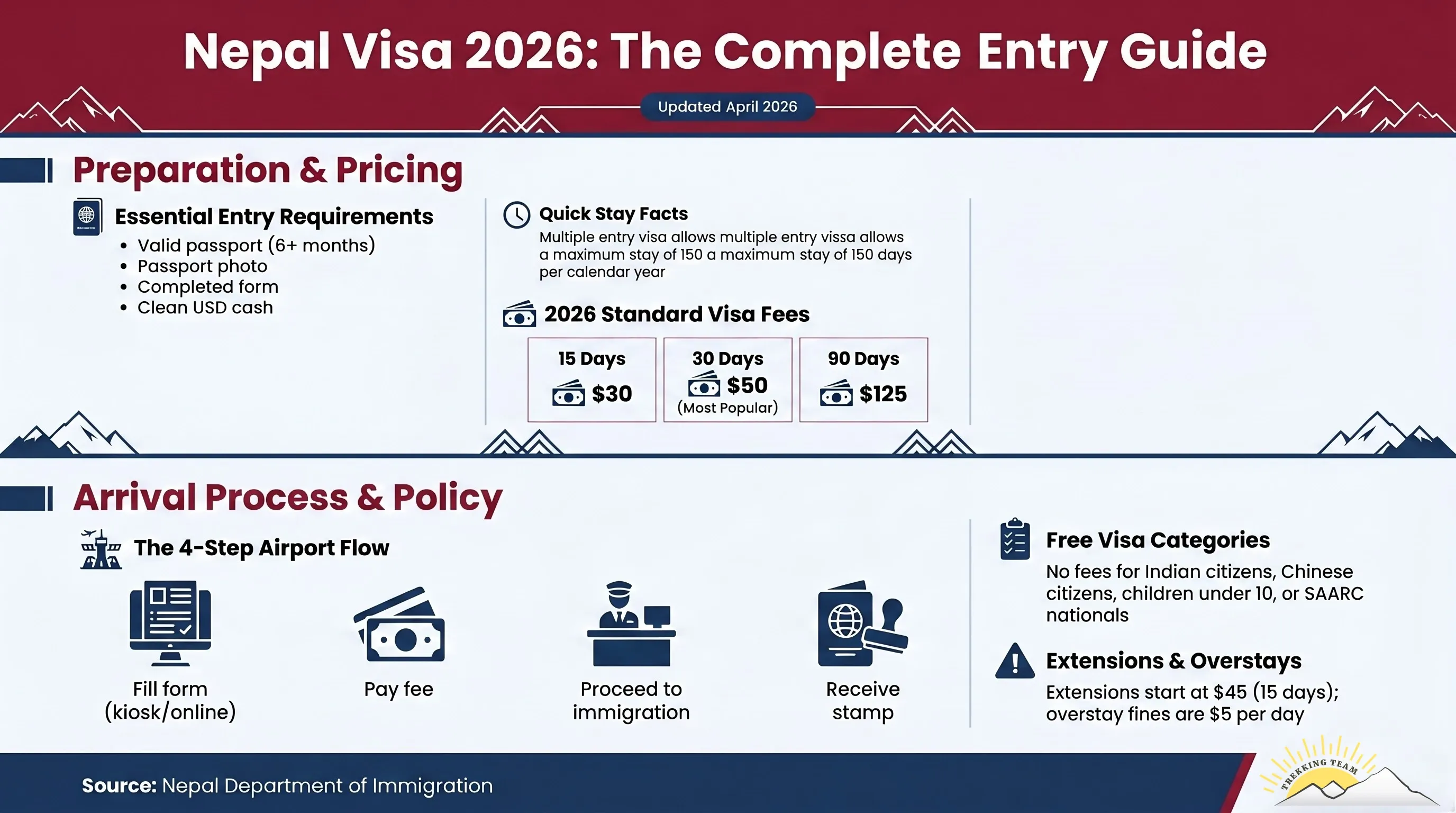
- Nepal visa: Obtain on arrival at Kathmandu airport or via ETA online with credit card. USD 50 for 30 days (recommended for trekkers). Current visa fees and processing rules: Nepal Department of Immigration.
- Travel insurance: MANDATORY. Must specifically cover trekking to your trek's maximum altitude AND helicopter evacuation. Standard travel insurance does NOT cover high-altitude trekking. Print the policy and carry it. Helicopter evacuation without insurance costs USD 3,000-5,000. Read more about trekking insurance requirements.
- Passport photos: Carry 4 spare photos (35x45mm, white background). Needed for permits.
- Cash: Last ATM is in Namche Bazaar (EBC) or Pokhara (ABC), and they frequently run out during peak season. Withdraw NPR 25,000-40,000 before starting. Carry USD 50-100 as emergency reserve (clean, undamaged bills).
- Photocopies: Keep copies of passport, visa, and insurance in a separate bag from originals. Save digital copies on your phone and email.
First Aid and Medications
Your licensed guide carries a comprehensive first aid kit including bandages, antiseptic, altitude medication, and emergency supplies. You do NOT need to duplicate this. Pack only personal items.
Personal medications:
- Any prescription medication you take regularly (bring full supply for the trip plus 3 extra days)
- Diamox/acetazolamide if prescribed by your doctor for altitude sickness prevention. Start 1-2 days before ascent above 3,000 m. Standard prophylactic dose: 125 mg twice daily (250 mg twice daily may be recommended for higher-risk profiles, per physician guidance). Per Wilderness Medical Society Clinical Practice Guidelines. Consult your travel doctor before departure. Diamox is a sulfonamide - do not take if you have a sulfa allergy.
- Paracetamol and/or ibuprofen (headache, muscle pain, mild altitude symptoms)
- Loperamide/Imodium (diarrhea, common from dietary changes)
- ORS sachets (rehydration salts for diarrhea or dehydration)
- Blister plasters (Compeed or similar hydrocolloid plasters)
- Throat lozenges (see Khumbu cough section below)
- Antihistamines (allergic reactions, insect bites)
- Broad-spectrum antibiotic (e.g., azithromycin, consult your travel doctor; useful when medical help is days away)
- Contact lens solution if applicable (altitude dust is hard on lenses; carry backup glasses)
The Khumbu Cough: What It Is and What to Pack for It
What is the Khumbu cough? A persistent, dry, hacking cough that develops in almost every trekker above 4,000 m, caused by breathing cold, dry air at altitude. Also called high-altitude cough (HAC). It is not an infection. The low humidity above 4,000 m (often below 20%) and increased respiratory rate from exertion at altitude combine to irritate and dehydrate the bronchial lining, producing a cough that can keep you awake at night and persist for weeks after descent.
The Khumbu cough is not dangerous, but it is miserable. In severe cases, sustained coughing has been known to crack ribs (documented in high-altitude medical literature, including High Altitude Medicine and Biology).
What to pack for it:
- Throat lozenges (menthol or honey-based, bring 2 bags, not one)
- A buff or neck gaiter to breathe through at altitude (warms and humidifies inhaled air)
- Hard candy or cough drops (sucking stimulates saliva, keeping the throat moist)
- Ibuprofen for inflammation if the cough becomes painful
- A Nalgene bottle filled with hot water from the teahouse kitchen to keep in your sleeping bag (humidifies air around your face at night)
"The cough is the one thing I cannot prepare people for. Every trekker thinks it will not happen to them. Then we reach Lobuche and everyone is coughing. I tell them: breathe through your buff, drink hot water constantly, and do not fight the cough. It goes away when you descend." - Bijay, Lead Guide
Toiletries and Personal Items
- Toothbrush and toothpaste (travel size)
- Biodegradable soap/shampoo (small bottle, for the rare hot shower)
- Quick-dry travel towel (microfibre)
- Toilet paper (1-2 rolls; teahouses above 3,000 m often do not supply it)
- Wet wipes (biodegradable preferred)
- Hand sanitiser
- Lip balm with SPF (lips crack at altitude)
- Small mirror (optional)
- Ear plugs (teahouse walls are thin; snoring neighbours are guaranteed)
- Eye mask (useful at altitude where you sleep at 7 PM and light leaks through thin curtains)
Food and Hydration
Teahouses provide breakfast, lunch, and dinner on all standard routes. You do not need to carry full meals. But carry:
- Trail snacks: Energy bars, nuts, dried fruit, chocolate. 2-3 snacks per day. Availability decreases with altitude and prices triple. Buy in bulk in Kathmandu or Pokhara.
- Electrolyte sachets: Add to water for hydration at altitude. Drink 3-4 litres daily above 3,000 m.
- Tea bags or instant coffee: Some trekkers prefer their own. Not essential but comforting.
The dal bhat rule: Eat dal bhat (rice, lentil soup, vegetables) at least once per day. It is the most nutritious, calorie-dense, reliably prepared, and cheapest meal on every teahouse menu. Unlimited refills at most teahouses. Your body needs 3,500-5,000 calories per day while trekking at altitude.
Female-Specific Packing
Everything above applies equally. These additional items address needs specific to female trekkers:
- Menstrual products: Bring enough for your entire trek plus buffer days. Tampons and pads are available in Kathmandu and Pokhara pharmacies but NOT on trekking trails above small villages. If you use a menstrual cup, it works well on treks (no waste, no resupply needed; bring biodegradable wipes for cleaning).
- Pee cloth or female urination device (FUD): Squat toilets and outdoor toilet stops are the norm above 3,000 m. A pee cloth (antimicrobial reusable cloth) or a FUD (Shewee, pStyle) makes these significantly more comfortable.
- Sports bras: 2, moisture-wicking. You will be walking 5-7 hours per day for up to 14 days. Comfort matters.
- Privacy sarong/buff: A large buff or lightweight sarong provides privacy for changing and toilet stops in shared spaces.
Safety note: The ABC trek and EBC trek are safe for solo female trekkers. Licensed guides are mandatory (since April 2023), teahouses offer private rooms, and trails are well-populated during spring and autumn seasons. Female guides are available on request.
Photography Gear
Most trekkers use their smartphone. Modern phones produce excellent photos at altitude. If you bring dedicated camera gear:
- Mirrorless or compact camera: Lighter is better. A full DSLR setup with multiple lenses adds 2-3 kg and you will regret the weight by Day 5.
- One versatile lens: 24-105mm or similar zoom covers landscapes, portraits, and detail. Leave specialty lenses at home.
- Extra batteries: Camera batteries drain 2-3x faster in cold. Keep a spare in your jacket's inner pocket (body heat preserves charge).
- Memory cards: Bring more than you think. You will take more photos than you plan.
- Protective bag: Dust, moisture, and impact. A small padded case in your daypack is sufficient.
- Drone: Legal in Nepal with permits but practically difficult on trekking trails (wind, altitude, battery life in cold, charging logistics). Most trekkers find it is not worth the weight and hassle.
Packing by Trek: What Changes by Route
Most items are identical across all treks. These are the meaningful differences:
| Item | EBC | ABC | Manaslu Circuit | Upper Mustang |
|---|---|---|---|---|
| Sleeping bag rating | -15°C | -10°C | -15°C | -10°C |
| Down jacket thickness | Heavy (6 nights above 4,500 m) | Medium (1-2 nights above 3,700 m) | Heavy | Medium |
| Waterproof priority | Low (dry at altitude) | High (wet region) | Medium | Low (rain shadow) |
| Leech socks | Not needed | Needed if May/early Oct | Needed if Sep/Oct | Not needed |
| Trekking poles | Recommended | Non-negotiable (stone steps) | Recommended | Optional |
| Cash needed | NPR 30,000-40,000 (ATM only in Namche) | NPR 25,000-35,000 (no ATM after Pokhara) | NPR 30,000-40,000 | NPR 20,000-30,000 |
| Sun protection intensity | Extreme (snow glare at 5,000 m) | High | High | Extreme (open desert) |
| Dust protection | Low | Low | Low | High (buff/neck gaiter essential) |
Packing by Season: What to Add or Remove
Spring (March-May): Standard list as above. Add: light rain jacket for afternoon showers below 3,000 m. The rhododendron forests on the ABC trail bloom March-April and create stunning but sometimes muddy trail conditions.
Autumn (October-November): Standard list as above. The best season. Clear skies, stable weather. Cold above 4,000 m, especially November. Ensure your sleeping bag and down jacket meet the temperature ratings listed.
Winter (December-February): Add to standard list: thicker thermal base layers, insulated gloves (not just fleece), balaclava or face mask, microspikes or light crampons for icy trails above 4,000 m, hot water bottle (fill at teahouses for sleeping bag warmth). Upgrade sleeping bag to -15 to -20°C. Some teahouses close in winter; confirm availability before departure.
Monsoon (June-August): Add to standard list: full waterproof jacket AND waterproof trousers, pack cover (essential), leech socks (below 3,000 m), extra dry bags, quick-dry everything. Remove: sun hat (less sun). Not recommended for EBC or ABC. For monsoon trekking, see our rain-shadow routes guide.
Packing by Altitude Zone
This section is rarely covered in detail by other guides. What you need changes significantly with altitude:
| Altitude Zone | What You Need Here | What You Do NOT Need |
|---|---|---|
| 1,000-2,000 m (Nayapul, Ghandruk, Lukla) | Light layers, sun protection, rain jacket, leech socks (monsoon), trekking umbrella | Down jacket (too warm), heavy sleeping bag |
| 2,000-3,000 m (Chhomrong, Namche) | Add fleece mid-layer for evenings, sleeping bag liner | Still too warm for heavy down jacket most days |
| 3,000-4,000 m (Tengboche, Dingboche, Deurali, MBC) | Down jacket essential for mornings and evenings, warm hat, gloves, full sleeping bag, altitude medication starts | Light rain jacket less important (drier at altitude) |
| 4,000-5,000 m (Lobuche, Gorak Shep, ABC) | Everything layered. Down jacket worn most of the day. -15°C sleeping bag. Sunglasses mandatory (snow glare). Lip balm critical. | Cotton anything. Camera batteries in outer pockets (keep them warm inside jacket) |
| 5,000-5,545 m (Kala Patthar, EBC, Thorong La) | All four layers worn simultaneously. Balaclava/face cover for wind. Heavy gloves. Headlamp for pre-dawn start. | Nothing removed; everything on your body |
Buy, Rent, or Bring? The Kathmandu Gear Guide
Thamel, the tourist district in central Kathmandu, has hundreds of trekking gear shops. Most sell unbranded or counterfeit gear at 50-80% less than international prices. Quality varies from "surprisingly good" to "falls apart on Day 3."
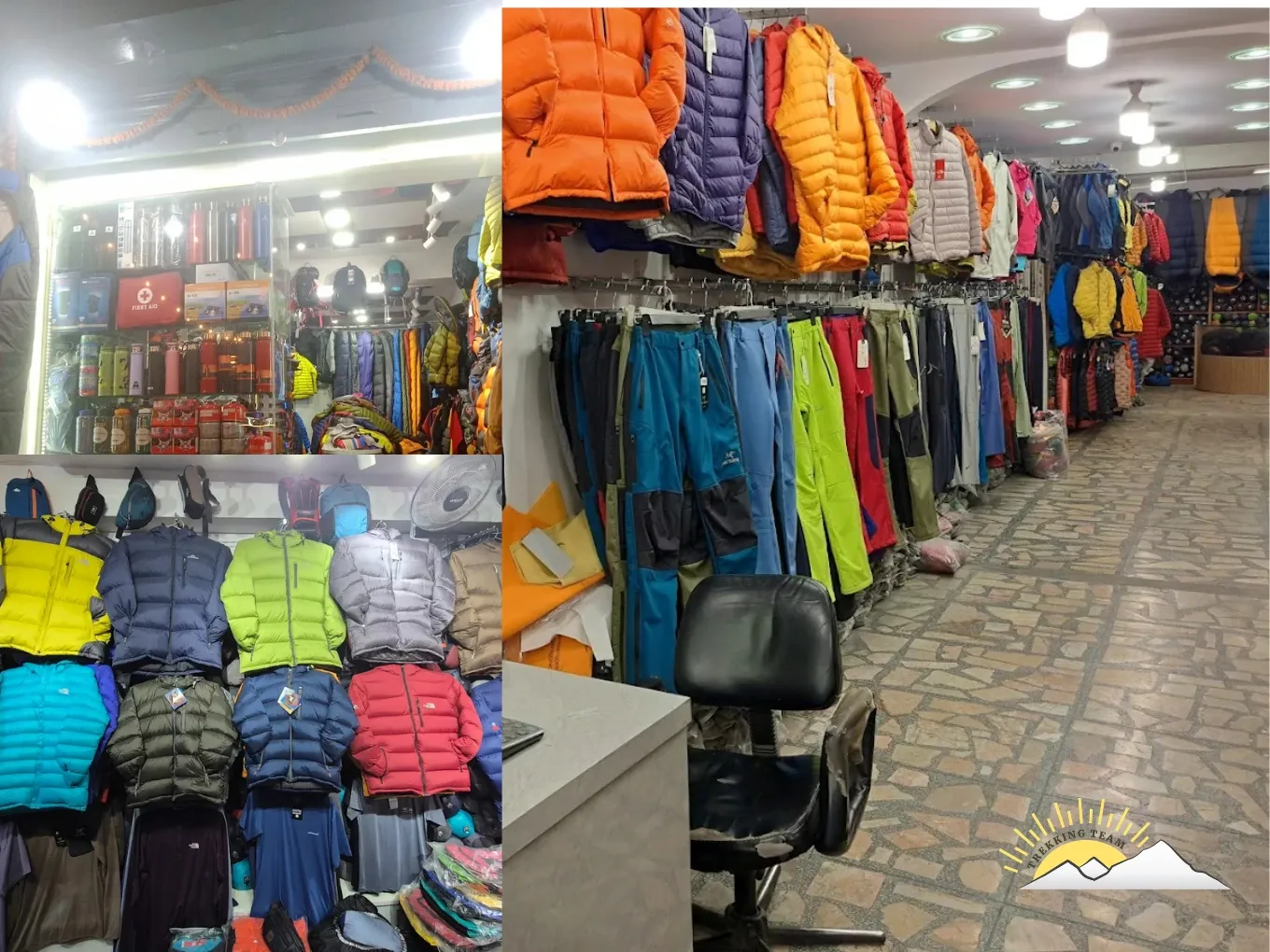
Here is the honest breakdown as of April 2026:
| Item | Buy in Thamel | Rent in Thamel | Bring From Home | Our Recommendation |
|---|---|---|---|---|
| Down jacket | NPR 2,000-4,000 | NPR 100-200/day | Best if you own one | Buy if budget-conscious; bring if quality matters |
| Sleeping bag | NPR 5,000-8,000 | NPR 100-150/day | Heavy to fly with | Rent (most cost-effective for a single trek) |
| Trekking poles | NPR 800-1,500 | NPR 50-100/day | Best if you have good ones | Buy in Thamel (cheap and functional) |
| Fleece jacket | NPR 800-2,000 | Not typically rented | Fine either way | Buy in Thamel (good quality available) |
| Waterproof jacket | NPR 1,500-4,000 | Rare to rent | Bring from home | Bring (critical item, need reliable quality) |
| Trekking boots | NPR 3,000-8,000 | Not rented | MUST bring broken-in | Bring from home (non-negotiable) |
| Trekking trousers | NPR 800-2,000 | Not rented | Either works | Buy in Thamel if needed |
| Base layers | NPR 500-1,500 | Not rented | Bring from home | Bring (merino wool hard to find in Thamel) |
| Headlamp | NPR 500-1,000 | Not typically rented | Bring if you have one | Buy in Thamel (cheap, functional) |
Thamel shopping tip: Bargain. The first price quoted is always 30-50% higher than the expected final price. Compare prices across 3-4 shops before buying. Inspect seams, zippers, and down fill quality on jackets and sleeping bags. Ask to see the item outside in daylight, not under shop fluorescent lights.
What NOT to Pack
The items below are what we most frequently remove from trekkers' bags at our pre-departure gear check in Kathmandu. In our experience, the average first-time trekker arrives with approximately 4-5 kg of items they will never use on the trail.
Cotton clothing. Cotton absorbs moisture, does not dry, loses insulation when wet, and causes chafing on long walking days. This is the single most common packing mistake.
Jeans. Heavy, slow to dry, restrict movement on steep terrain. Leave them in Kathmandu.
Heavy books. E-reader or phone. One paperback weighs 300 g. Over 14 days, you will resent those 300 grams.
Multiple pairs of shoes. Boots + camp sandals = 2 pairs. That is all. No trail runners, no dress shoes, no "just in case" shoes.
Full-size toiletries. Travel sizes only. Decant into small bottles. A full shampoo bottle is 400 ml of weight you carry for 14 days and use 50 ml of.
Laptop. Unless you are a working digital nomad who genuinely needs it on the trek, leave it in Kathmandu. Your phone does everything a laptop does on a teahouse trek.
Crampons and ice axes. You are trekking, not mountaineering. Teahouse treks (EBC, ABC, Langtang, Manaslu Circuit) do not require technical equipment. Microspikes for winter treks are the exception.
"Just in case" items. If you are packing something because it "might be useful," leave it. The mountains do not care how prepared your bag looks. Pack for what WILL happen, not what might.
"I met a trekker at Thorong Phedi who had a 22 kg bag. He made it over the pass, barely, and spent two days recovering in Muktinath. The trekker behind him had a 9 kg bag and was drinking tea in Muktinath while the first man was still in bed." - Bijay, Lead Guide
What Guides Remove From Your Bag (Every Time)
We do a pre-departure gear check at our Kathmandu office the night before every trek. After 34 years and thousands of these checks, the same items get pulled out almost every time. If any of these are in your bag, take them out now.
Second pair of shoes beyond boots and camp sandals. Trail runners "in case the boots fail," dress shoes for "nice teahouses," extra hiking shoes "as backup." All unused. All weight.
Extra clothing layers beyond the four-layer system. Trekkers routinely overpack clothing by 3-5 kg. Multiple "fresh outfits" stay in the duffel for 14 days untouched because teahouse laundry above 2,500 m is rare and slow.
Full-size toiletries. A 400 ml shampoo bottle, a full toothpaste tube, a full deodorant. Travel sizes do the same job at a tenth of the weight. Decant before you fly.
"Just in case" gear. Crampons for a teahouse trek, an ice axe for a non-technical route, a survival blanket on top of a -15°C sleeping bag, a second headlamp, a third power bank. Almost always unused.
Heavy reading material. Hardcovers, thick paperbacks, multiple guidebooks. An e-reader or your phone holds your entire library at 200 g.
Excessive first aid. Trekkers arrive with full pharmacy kits when their licensed guide already carries comprehensive first aid, a pulse oximeter, and emergency communication. Pack only personal medications and the small kit listed in the first aid section.
Cotton anything. Cotton t-shirts, cotton underwear, cotton socks. Removed every time. They get wet, stay wet, and make you cold and chafed.
"The most satisfying moment of every gear check is when a trekker steps back and sees how much smaller their bag has become. Most people leave 3-5 kg behind in our office and pick it up two weeks later. They never miss it on the trail." - Bijay, Lead Guide
What to Leave at Your Kathmandu Hotel
Most Kathmandu hotels store luggage for trekking guests at no charge. Leave:
- City clothes (you need them when you return)
- Laptop and work equipment
- Extra toiletries and full-size bottles
- Souvenirs purchased before the trek
- Any gear you decide is too heavy after final packing
Pack your trek gear, weigh it, walk up 5 flights of stairs with it. Then remove 20% of what you packed. That is the final list.
What Your Guide and Agency Provide
Ask your trekking agency what they include before you buy or pack. Agencies differ significantly. Here is what registered TAAN operators typically provide:
- All trekking permits (ACAP, Sagarmatha NP, restricted area permits)
- Licensed guide with first aid kit, pulse oximeter, and satellite phone (on remote treks)
- Porter for luggage (one porter per two trekkers standard)
- Duffel bag (many agencies provide on request)
- Emergency coordination and operations desk
- Some agencies also offer: sleeping bags, down jackets, trekking poles on request
What you always provide yourself: boots, personal clothing, toiletries, personal medications, travel insurance, camera, phone, snacks, and cash.
Frequently Asked Questions
How much should my pack weigh for trekking in Nepal? Daypack: 5-8 kg. Duffel bag (porter-carried): 10-12 kg. Total: 15-20 kg maximum. The lighter you pack, the more you enjoy the trek.
Can I buy trekking gear in Kathmandu? Yes. Thamel has hundreds of shops selling and renting gear at 50-80% less than international prices. Down jackets (NPR 2,000-4,000), sleeping bags (NPR 100-150/day rental), trekking poles (NPR 800-1,500), and fleece layers (NPR 800-2,000) are all readily available as of April 2026.
Should I bring or rent a sleeping bag? Rent if doing a single trek. Buy or bring from home if trekking multiple times. Thamel rental: NPR 100-150/day, approximately NPR 1,500-2,000 for a 14-day trek. This is cheaper than flying with a sleeping bag or buying one.
Do I need trekking poles for Nepal? Yes, especially for the ABC trek (thousands of stone steps) and descent days on any trek. Poles reduce knee impact by 25-40%. Buy a pair in Thamel for NPR 800-1,500 if you do not have them.
What boots should I wear for trekking in Nepal? Waterproof, ankle-high trekking boots with stiff soles and good grip. Break them in with at least 50 km of walking before departure. This is the single most important gear decision. Do not bring new, untested boots.
Is cotton okay for trekking? No. Cotton absorbs moisture, does not dry, loses insulation when wet, and causes chafing. Use synthetic or merino wool for all layers.
What power bank size do I need? 10,000 mAh minimum. 20,000 mAh recommended for 10+ day treks. Teahouse charging costs NPR 200-500 per device and availability decreases with altitude.
Which phone SIM works best on Nepal treks? NCELL has the best coverage on major trekking routes, working up to approximately 4,000 m on EBC and 3,700 m on ABC trails. Buy a SIM in Kathmandu or Pokhara for approximately NPR 1,500 with data.
Do I need a sleeping bag for the ABC trek? Yes. Teahouse blankets are insufficient above Bamboo (2,335 m). A sleeping bag rated to -5°C to -10°C is recommended. Colder rating (-15°C) for EBC.
What medications should I bring? Personal prescriptions, Diamox (if prescribed by your doctor for altitude), paracetamol/ibuprofen, anti-diarrheal, rehydration salts, blister plasters, and throat lozenges. Your guide carries a full first aid kit.
How much cash should I bring on the trek? NPR 25,000-40,000 depending on trek duration and spending habits. Last ATM: Namche (EBC) or Pokhara (ABC). ATMs at altitude frequently run out during peak season. Carry USD 50-100 as emergency reserve.
Can I charge my devices on the trek? Yes, at most teahouses. Fees: NPR 200-500 per device, increasing with altitude. A power bank is more cost-effective and reliable than teahouse outlets.
What should I definitely NOT pack? Cotton clothing, jeans, heavy books, multiple shoes, full-size toiletries, laptop, crampons (for teahouse treks), and anything packed "just in case."
Does my trekking agency provide any gear? Varies by agency. Most TAAN-registered operators provide all permits, a licensed guide, and a porter. Some also provide duffel bags, sleeping bags, and down jackets on request. Ask before buying.
Is there a printable version of this packing list? The checklist at the top of this guide can be printed directly from your browser (Ctrl+P / Cmd+P). For a formatted PDF version, contact us.
What is the Lukla flight weight limit for EBC trekking? 10 kg checked baggage and 5 kg hand luggage per passenger on Tara Air and Summit Air flights to Lukla. This is strictly enforced, especially during peak season. Your porter's duffel bag counts as checked luggage. Pack under the limit at home.
How cold does it get at Everest Base Camp at night? At Gorak Shep (5,164 m, the overnight stop for EBC): -10°C to -20°C in October/November, -15°C to -25°C in winter. A sleeping bag rated to -15°C minimum is essential. At Annapurna Base Camp (4,130 m): -5°C to -10°C in October/November, milder due to lower altitude.
Can I trek Nepal without a guide in 2026? No. Since April 2023, all foreign trekkers on major routes must hire a licensed guide through a TAAN-registered agency. This is enforced at permit checkpoints. Full regulations.
What is the difference between EBC and ABC packing? The main differences: EBC requires a warmer sleeping bag (-15°C vs -10°C for ABC), heavier down jacket (6 nights above 4,500 m vs 1-2 nights above 3,700 m), and less waterproof priority (Khumbu is drier than the Annapurna region). ABC requires better waterproofing, leech socks in shoulder months, and trekking poles are more critical due to stone stepped descents. Full EBC vs ABC comparison.
How do I prevent the Khumbu cough? You cannot fully prevent it. The cold, dry air above 4,000 m irritates the bronchial lining in nearly everyone. Minimise it by: breathing through a buff or neck gaiter, staying hydrated (3-4 litres daily), sucking throat lozenges frequently, drinking hot water throughout the day, and sleeping with a hot water bottle near your face to humidify the air. See the full Khumbu cough section above.
Do trekking poles really make a difference? Yes. Trekking poles reduce knee impact by 25-40% on descent, which is critical on the stepped trails of the ABC trek and the rocky moraine descents on the EBC trek. They also improve balance on uneven terrain and river crossings. Buy a pair in Thamel for NPR 800-1,500 if you do not have them.
Is Diamox safe for altitude sickness? Diamox (acetazolamide) is a prescription medication approved for altitude sickness prevention. It is a carbonic anhydrase inhibitor that speeds acclimatization. Common side effects include tingling in fingers and toes, increased urination, and altered taste of carbonated drinks. It is a sulfonamide - do not take if you have a sulfa allergy. Consult your doctor before departure. Standard prophylactic dose: 125 mg twice daily, starting 1-2 days before ascent above 3,000 m (250 mg twice daily for higher-risk profiles, per physician guidance). Source: Wilderness Medical Society Clinical Practice Guidelines. Full altitude sickness guide.
Plan Your Trek
Need help deciding what to bring for your specific trek? Talk to a guide who has packed for this trail hundreds of times.
- Get a custom packing list: WhatsApp +977 9869400739
- Email: info@trekkingteam.com
- Website: trekkingteam.com
Read our trek guides:
- Everest Base Camp Trek Complete Guide 2026
- Annapurna Base Camp Trek Complete Guide 2026
- EBC vs ABC Comparison
- Nepal Visa Guide 2026
- Nepal Trekking Rules and Permits 2026
- Altitude Sickness Prevention
- Monsoon Trekking: Rain-Shadow Routes
Follow us:
Walking Nepal's trails since 1991.