Everest Base Camp Trek Cost 2026: Complete Breakdown | Trekking Team Nepal
Everest Base Camp Trek Cost in 2026: What You Will Actually Spend (Complete Breakdown from 34 Years of Guiding)
Published by Trekking Team Nepal — Est. 1991 | TAAN & NTB Member Since 1991 | trekkingteam.com
📅 March 29, 2026 • ✍️ Trekking Team Editorial • ⏱️ 18 min read
We have quoted more than 10,000 Everest Base Camp treks since 1991. In 34 years, we have watched permit fees change seven times, Lukla flight prices triple, and teahouse rates evolve from a few rupees to a structured economy. We have also watched trekkers arrive with wildly inaccurate budgets because they read a blog that was either outdated, dishonest, or written by someone who has never walked the trail.
This guide is different. Every number in this article comes from our current 2026 operating costs, verified against the latest government permit schedules and real teahouse pricing in the Khumbu region. We are not guessing. We are telling you what we charge, what we pay, and what you will spend , down to the cost of charging your phone at Gorak Shep.
How Much Does the Everest Base Camp Trek Cost in 2026?
Here is the direct answer before we break everything down.
A fully guided 14-day Everest Base Camp trek with a reputable local agency in Nepal costs between USD 1,200 and USD 2,500 per person from Kathmandu to Kathmandu. The exact price depends on your group size, comfort level, and what is included in your package.
Your total trip budget including international flights to Nepal, visa, travel insurance, gear, and personal spending will be higher. Most trekkers from the US or Europe should plan for USD 2,800 to USD 4,500 total, while trekkers from India can expect INR 1,50,000 to INR 2,50,000 all-in.
Luxury treks with premium lodges, private guides, and helicopter return start at around USD 3,500 and can reach USD 6,000 or more.
Here is a snapshot of the three main budget tiers before we examine each cost category in detail.
Budget vs Standard vs Luxury: Side by Side
| Cost Category | Budget | Standard | Luxury |
|---|---|---|---|
| Agency Package (14 days, from Kathmandu) | USD 950–1,200 | USD 1,300–1,800 | USD 3,000–5,000+ |
| Accommodation | Basic shared teahouse | Private room teahouse | Premium lodge, attached bath |
| Meals | Standard teahouse menu | Full board included | Full board + premium dining |
| Guide | Shared guide (group trek) | Private guide, 1 porter | Senior private guide, 2 porters |
| Lukla Flights | Included | Included | Included (+ heli return option) |
| Permits | Included | Included | Included |
| International Flights (avg) | USD 600–1,500 | USD 600–1,500 | USD 600–1,500 |
| Travel Insurance | USD 80–150 | USD 80–150 | USD 150–300 |
| Gear (rental/buy) | USD 30–80 (rental) | USD 100–300 (mix) | USD 300–600 (buy) |
| Tips + Personal Spending | USD 100–200 | USD 200–400 | USD 400–800 |
| Estimated Total (all-in) | USD 1,800–3,000 | USD 2,500–4,200 | USD 4,500–7,500+ |
Now let us walk through every single cost category so you know exactly where your money goes.
1. Trekking Permits and Park Fees
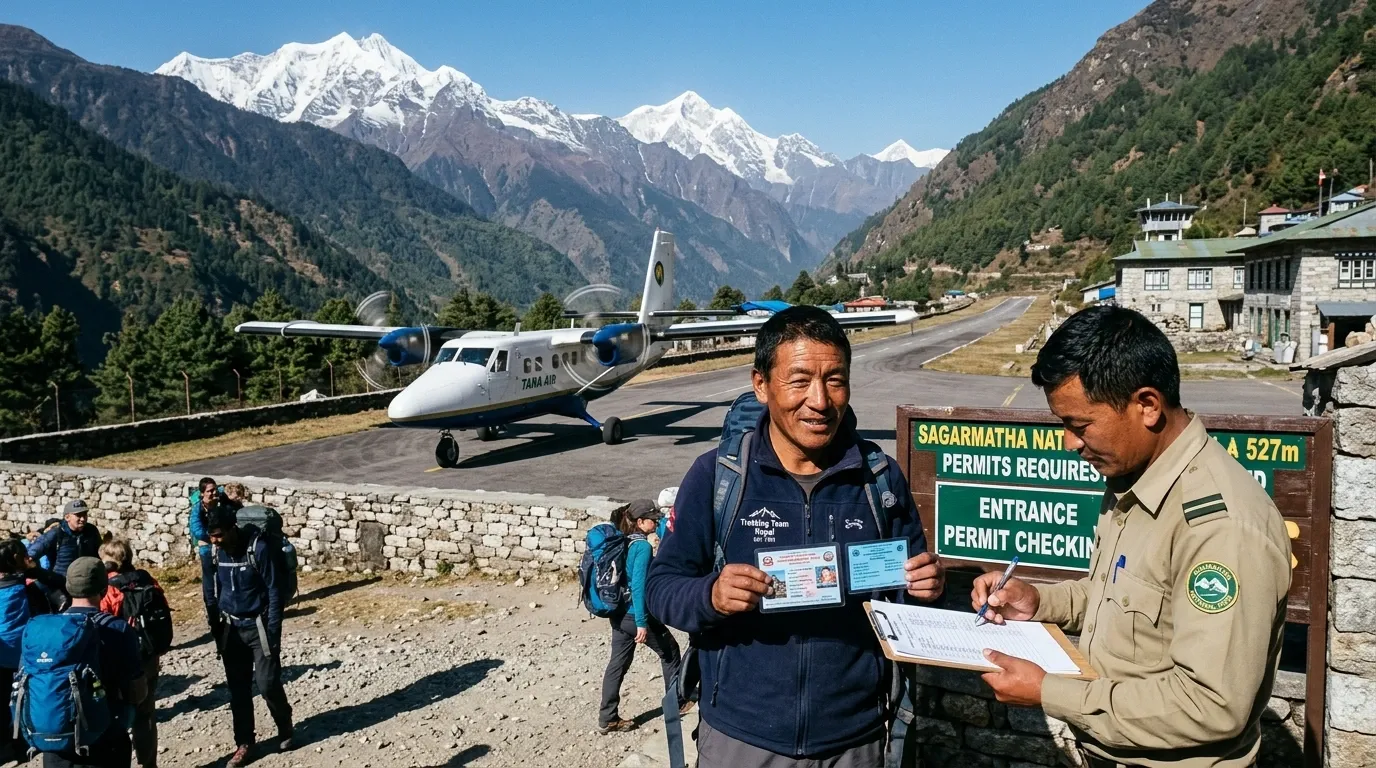
Every trekker entering the Everest region needs two mandatory permits. No exceptions, no negotiating. These fees are set by the Government of Nepal and are checked at multiple points along the trail.
Sagarmatha National Park Entry Permit
- Foreign nationals: NPR 3,000 (approximately USD 22)
- SAARC nationals (India, Bangladesh, Sri Lanka, etc.): NPR 1,500 (approximately USD 11)
Khumbu Pasang Lhamu Rural Municipality Permit
- Foreign nationals: NPR 2,000 (approximately USD 15)
- SAARC nationals: NPR 500 (approximately USD 4)
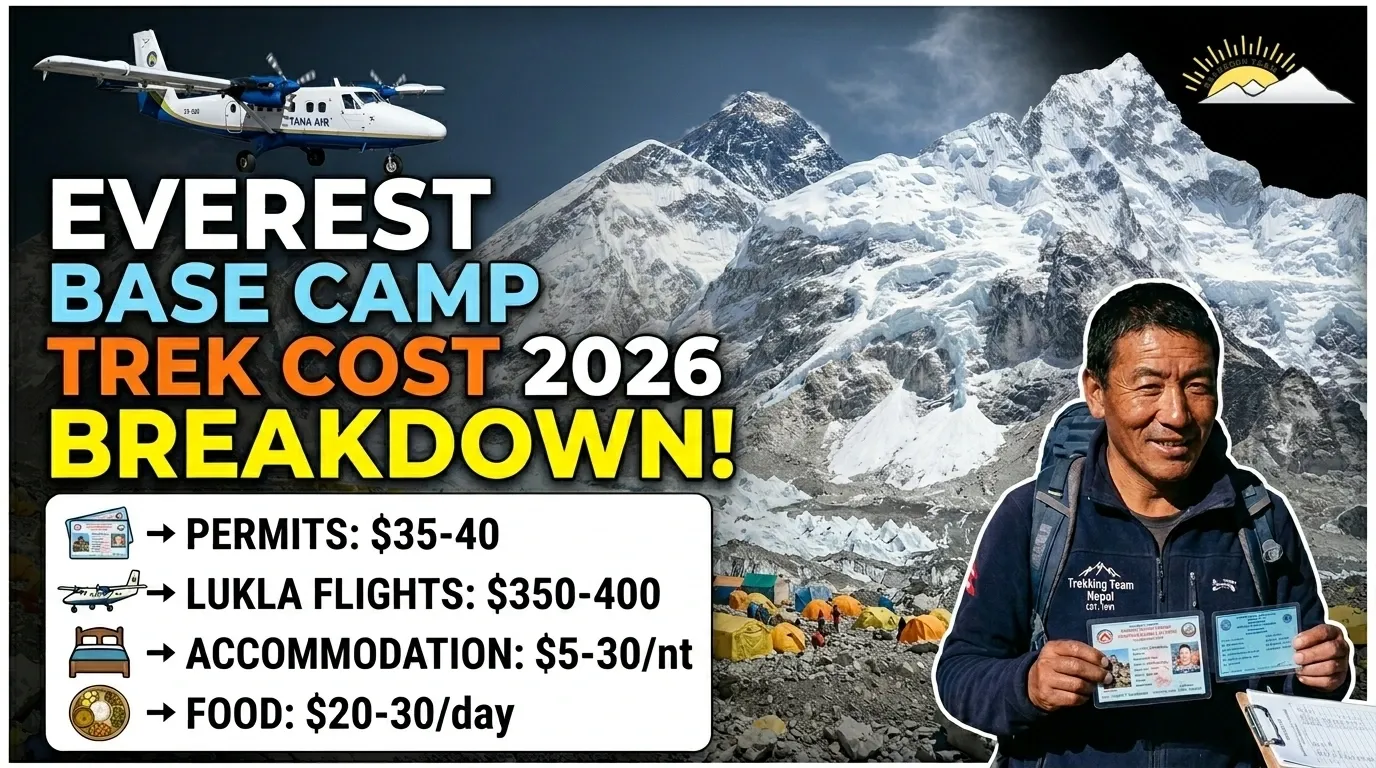
Total permit cost: approximately USD 35–40 per person.
These fees go directly toward trail maintenance, waste management, and conservation in the Khumbu region. They are among the most reasonable permit costs anywhere in the Himalayas, especially when you consider that you are entering a UNESCO World Heritage Site.
Most reputable agencies include permits in their package price. If a company does not include permits, ask why — and add USD 40 to their quoted figure when comparing prices.
What we have seen change: When we started operations in 1991, there was no Khumbu Rural Municipality permit — it was introduced much later as local governance structures evolved. Sagarmatha National Park fees have been revised several times over the decades, but they remain remarkably affordable compared to similar protected areas worldwide.
2. Kathmandu to Lukla Flights
The trek begins with a flight from Kathmandu (or Ramechhap during peak season) to Lukla — home of the famous Tenzing-Hillary Airport with its 527-metre runway ending at a mountain wall.
Domestic flight cost (round trip):
- Foreign nationals: USD 350–400 (round trip)
- Nepali nationals: Approximately NPR 9,000–12,000 (round trip)
Important note about Ramechhap: During peak season (March to May and October to November), flights to Lukla often depart from Ramechhap airport, which is about 4.5 to 5 hours by road from Kathmandu. Budget an additional USD 25–40 for the road transfer if your agency does not include it.
Most guided trek packages include Lukla flights in the price. Confirm this explicitly before booking — some agencies quote their price without flights, which creates a misleading impression of the total cost.
Helicopter alternative: A one-way helicopter return from Gorak Shep or Lukla to Kathmandu costs approximately USD 800–1,200 per person. This option is increasingly popular for trekkers who want to skip the 3-day descent and fly over the Khumbu Valley instead. We offer this as an add-on to any of our EBC itineraries.
From our experience: Lukla flights are the single most unpredictable element of any EBC trek budget. Weather cancellations can delay flights by 1 to 3 days, which means additional hotel nights in Kathmandu or Ramechhap. Always build at least one buffer day into your itinerary, and make sure your return international flight is not scheduled the day after your planned Lukla arrival. We have seen trekkers miss international flights because they did not plan for this.
3. Accommodation on the Trail
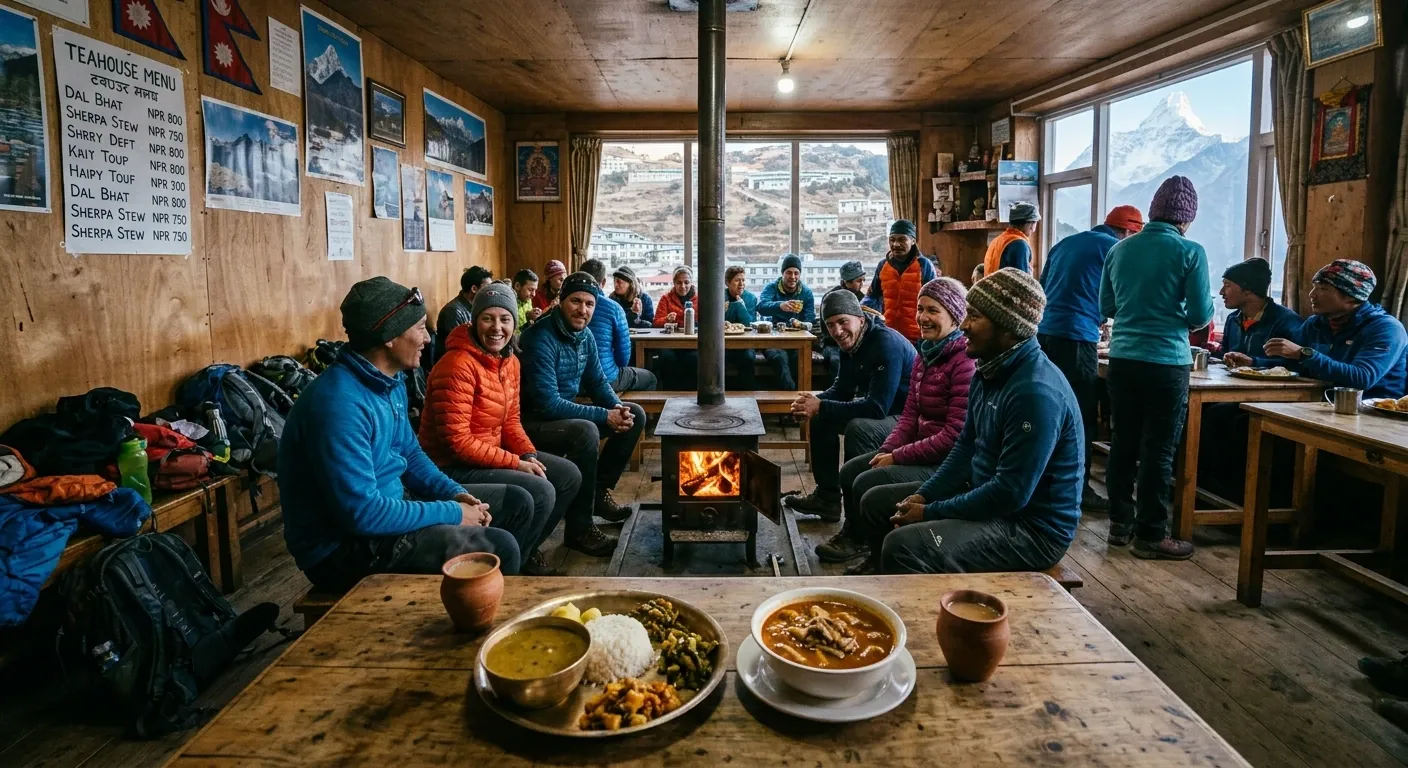
The entire EBC trek route operates on a teahouse system. These are family-run mountain lodges that offer basic rooms and meals at every stop along the trail.
Teahouse costs in the Khumbu region (2026):
| Location | Basic Room (shared bath) | Private Room (attached bath) | Premium Lodge |
|---|---|---|---|
| Phakding (2,610m) | USD 5–8 | USD 15–25 | USD 40–60 |
| Namche Bazaar (3,440m) | USD 8–15 | USD 20–35 | USD 50–80 |
| Tengboche (3,867m) | USD 8–12 | USD 18–30 | USD 40–60 |
| Dingboche (4,410m) | USD 8–12 | USD 15–25 | Limited options |
| Lobuche (4,940m) | USD 8–15 | USD 15–25 | Limited options |
| Gorak Shep (5,164m) | USD 10–15 | USD 20–30 | Not available |
At lower elevations like Namche Bazaar, accommodation is relatively comfortable , some lodges offer hot showers, heated dining rooms, and even Western-style toilets. As you climb higher, facilities become more basic. Above 4,500 metres, expect thin plywood walls, shared toilets, and temperatures that drop well below freezing at night.
Most guided trek packages include all teahouse accommodation. The agency pre-books lodges and pays the lodges directly, so you do not need to negotiate rooms or worry about availability during peak season.
A word on "free rooms": In the Khumbu region, many teahouses offer rooms at very low cost (or even free) on the condition that you eat all your meals there. This is how the teahouse economy works : the money is in food sales, not room fees. When an agency includes meals in your package, they are paying the full food rates to the lodge, which is the real cost of your stay.
4. Food and Drinks on the Trail
If meals are included in your guided trek package, you will eat three meals a day at teahouses along the route. Menus are surprisingly varied dal bhat, pasta, pizza, pancakes, soups, momos, fried rice, and a range of Sherpa stews and noodle dishes. Quality is generally good at lower elevations and more basic above 4,500 metres.
If you need to budget for meals separately (not included in package):
| Meal | Cost Range |
|---|---|
| Breakfast (eggs, toast, porridge, tea) | USD 5–8 |
| Lunch (dal bhat, pasta, fried rice) | USD 6–10 |
| Dinner (soup, main course, tea) | USD 7–12 |
| Hot drinks (tea, coffee, hot chocolate) | USD 2–4 per cup |
| Bottled water (1 litre) | USD 2–5 (price increases with altitude) |
| Soft drinks / beer | USD 3–8 |
Daily food budget if meals are not included: USD 20–30 per day.
Over 12 days on the trail, that adds up to USD 240–360 for food alone. This is why all-inclusive packages often represent better value — the agency negotiates fixed rates with teahouses, which are usually lower than what individual trekkers pay.
Water strategy: Do not buy bottled water on the trail. A single litre can cost USD 4–5 at higher elevations, and the plastic waste is devastating for the Khumbu environment. Instead, bring water purification tablets (USD 8–10 for a full trek supply) or a SteriPen (USD 40–60 one-time purchase) and fill from tap sources. We provide safe water advice to all our clients as part of our pre-trek briefing.
5. Guide and Porter Fees
Since April 2023, all foreign trekkers in Nepal are required to hire a licensed guide through a registered agency. Solo trekking without a guide is no longer permitted in any national park or conservation area, including the Everest region.
Guide costs (2026):
- Licensed trekking guide: USD 25–35 per day
- Guide food and accommodation: USD 10–15 per day (covered by trekker as employer)
- Total guide cost for 14 days: USD 490–700
Porter costs (2026):
- Porter: USD 18–25 per day
- Porter food and accommodation: USD 8–12 per day
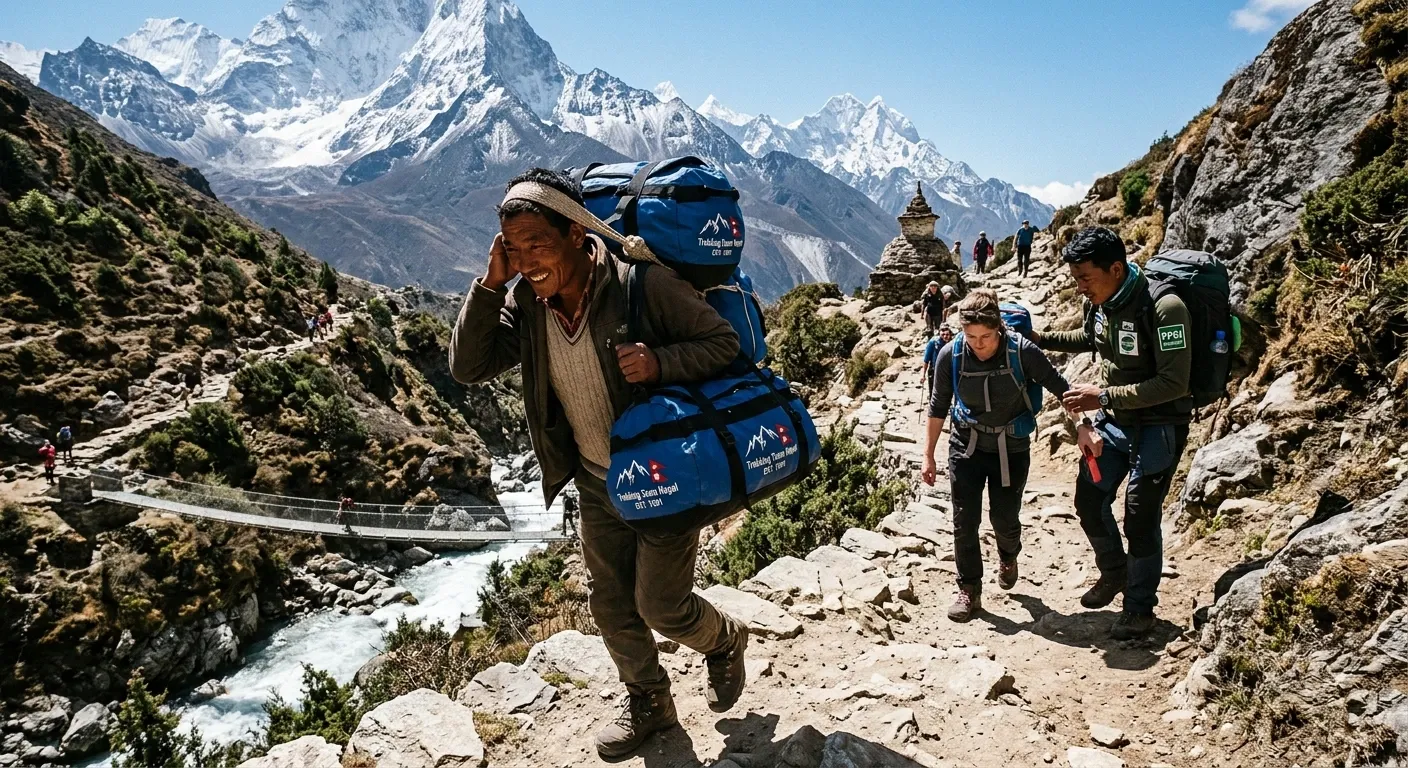
- Each porter carries a maximum of 25–30 kg (for 2 trekkers)
- Total porter cost for 14 days: USD 365–520
In a guided package, guide and porter fees are built into the total price. You do not pay them separately.
On porter welfare — a note from 34 years of operations: The cheapest trek package is not always the best value. When an agency offers an EBC trek for USD 600–800, ask yourself: what are they cutting? Often, it is porter wages and insurance. At Trekking Team Nepal, we pay our porters above TAAN-recommended minimums and provide full accident insurance, proper clothing, and sleeping bags for altitude. We are members of the Porter Protection Group International (PPGI). When you choose a responsible agency, your money directly supports the families of the people carrying your gear through some of the toughest terrain on Earth. This is not a cost to minimize — it is an investment in human dignity.
6. Gear and Equipment
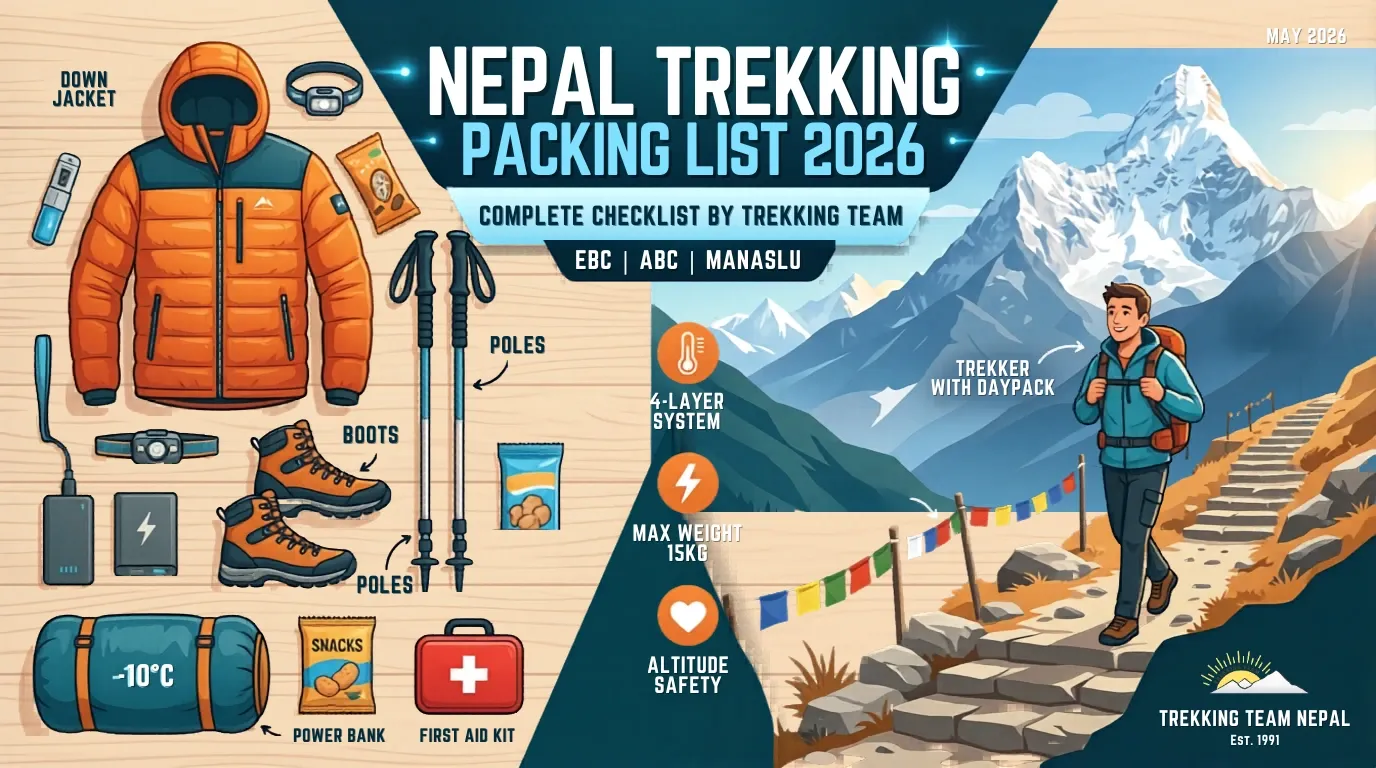
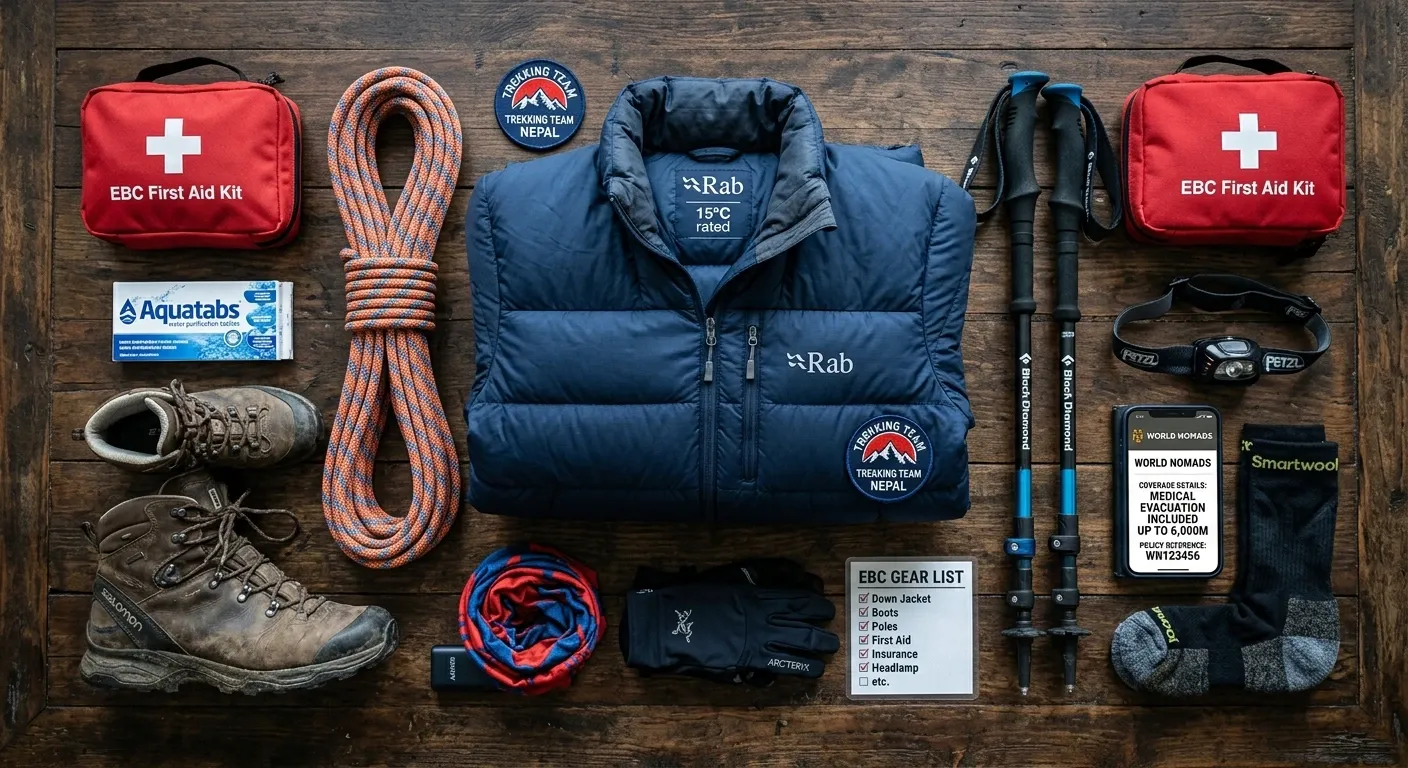
You do not need to buy expensive mountaineering gear for the EBC trek. Kathmandu's Thamel district is packed with shops selling and renting everything you need.
Gear rental in Kathmandu (full trek):
| Item | Rental Cost (14 days) |
|---|---|
| Down jacket | USD 8–15 |
| Sleeping bag (-15°C rated) | USD 10–20 |
| Trekking poles (pair) | USD 5–10 |
| Duffel bag | USD 5–8 |
| Full rental package | USD 30–60 total |
Buying gear in Kathmandu:
| Budget Level | Total Cost |
|---|---|
| Basic (local brands + some rentals) | USD 150–250 |
| Mid-range (mix of branded and local) | USD 300–500 |
| Premium (North Face, Arc'teryx, etc.) | USD 500–1,000+ |
Our advice after outfitting 10,000 trekkers: Bring your own trekking boots (broken in), base layers, and underwear. Rent or buy the bulky items (down jacket, sleeping bag) in Kathmandu. The quality of rental gear has improved dramatically over the years — a rented down jacket from a reputable shop will keep you warm at 5,500 metres.
7. Travel Insurance
Travel insurance that covers high-altitude trekking and emergency helicopter evacuation is mandatory. Do not skip this. A helicopter evacuation from the Everest region costs USD 3,000–5,000 if you are not insured.
Insurance cost: USD 80–200 for a 30-day policy covering altitude up to 6,000 metres.
Recommended providers that cover Nepal high-altitude trekking include World Nomads, Global Rescue, and IMG (International Medical Group). Verify that your policy explicitly covers helicopter evacuation from altitudes above 5,000 metres.
A reality check from the trail: We have arranged emergency evacuations for trekkers who did not have insurance. The financial and logistical burden was devastating for them. In one case, a trekker's family had to arrange a USD 4,500 helicopter payment via international bank transfer from the UK while their relative was in a Kathmandu hospital. This is preventable. Insurance costs less than two nights at a Namche Bazaar lodge. Get it.
8. Nepal Visa
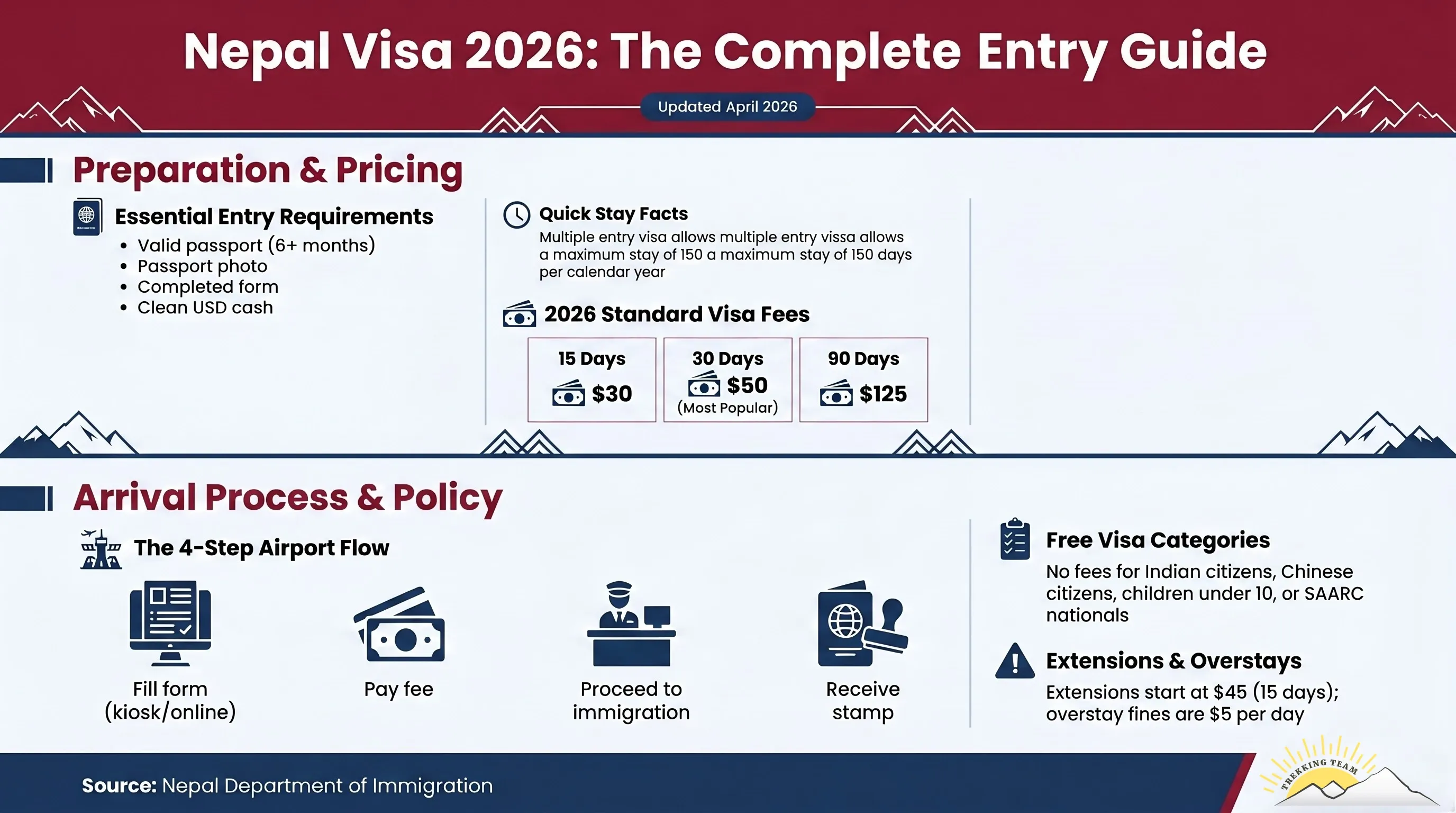
All foreign nationals (except Indian passport holders) require a visa to enter Nepal. Visas are available on arrival at Tribhuvan International Airport in Kathmandu.
| Duration | Cost |
|---|---|
| 15 days | USD 30 |
| 30 days | USD 50 |
| 90 days | USD 125 |
For a standard 14-day EBC trek with 2–3 days in Kathmandu, a 30-day visa provides comfortable buffer time for flight delays and sightseeing.
SAARC nationals: Indian citizens do not need a visa for Nepal. Citizens of other SAARC countries pay reduced rates.
9. International Flights to Kathmandu
This is often the single largest expense of your trip, and it varies enormously by origin country and booking timing.
| Origin | Approximate Round-Trip Cost |
|---|---|
| India (Delhi, Mumbai, Bangalore) | USD 200–400 (INR 15,000–25,000) |
| United Kingdom | USD 500–900 |
| Europe (Germany, France, Spain) | USD 550–950 |
| United States (East Coast) | USD 900–1,400 |
| United States (West Coast) | USD 1,000–1,500 |
| Australia | USD 700–1,200 |
| Southeast Asia | USD 250–500 |
Booking tip: Fly via Middle Eastern hubs (Qatar Airways via Doha, Emirates via Dubai, Etihad via Abu Dhabi) for the best combination of price and convenience from most Western countries. From India, direct flights on Buddha Air, Yeti Airlines, and IndiGo are available and affordable.
10. Kathmandu Spending
Plan for 2–4 nights in Kathmandu before and after your trek. You need time for gear shopping, permit processing, pre-trek briefing, and a buffer for Lukla flight delays on return.
| Category | Budget | Mid-Range | Luxury |
|---|---|---|---|
| Hotel per night | USD 15–30 | USD 40–80 | USD 100–250 |
| Meals per day | USD 10–15 | USD 15–25 | USD 25–50 |
| Sightseeing + transport | USD 10–20 total | USD 25–40 total | USD 50–100 total |
| Kathmandu total (3 nights) | USD 80–150 | USD 160–320 | USD 350–700 |
11. Tips for Your Trekking Crew
Tipping is customary and deeply appreciated by guides and porters, for whom tips represent a significant portion of their income.
Recommended tipping guidelines (per trekker):
| Role | Recommended Tip (total, for 14 days) |
|---|---|
| Lead guide | USD 100-150 |
| Assistant guide | USD 80-100 |
| Porter | USD 80-100 |
These are guidelines, not obligations. Tip based on the quality of service you receive. If your guide went above and beyond — carrying your pack when you were struggling, staying with you through a difficult night, making you laugh on a hard day — tip generously. These are people who work at extreme altitude so that you can have the experience of a lifetime.
12. On-Trail Extras (The Hidden Costs Nobody Mentions)
These small costs add up over 12 days on the trail and are rarely included in any agency package.
| Extra | Cost |
|---|---|
| Phone/device charging | USD 2–5 per charge (above Namche) |
| Wi-Fi | USD 3–5 per day (above Namche) |
| Hot shower | USD 3–6 per shower |
| Snacks (chocolate, chips, energy bars) | USD 2–5 per item |
| Laundry | USD 5–8 per load (lower elevations only) |
| Beer or alcohol | USD 4–8 per bottle |
| Souvenirs | USD 10–50 |
Realistic on-trail extras budget: USD 100–250 for the full trek.
Our recommendation is to carry NPR 15,000–25,000 in cash (approximately USD 110–185) for on-trail extras. ATMs exist in Namche Bazaar but are unreliable — do not depend on them. Withdraw all the cash you need in Kathmandu before flying to Lukla.
Your Complete EBC Cost Calculator
Here is the full picture, combining every category into one realistic total budget.
Budget Trekker (USD 1,800–2,800 total)
Join a group departure with a local agency (USD 1,000–1,300). Rent gear in Kathmandu (USD 40–60). Eat local food. Stay in basic teahouses. Fly economy on a Middle Eastern carrier. Stay at budget hotels in Kathmandu. Tip modestly but fairly.
Standard Trekker (USD 2,800–4,200 total)
Book a standard private trek with a reputable agency (USD 1,400–1,800). Buy or rent good gear (USD 150–300). Enjoy full-board meals included in package. Get private rooms where available. Allow comfortable spending money. Tip well.
Luxury Trekker (USD 4,500–7,000+ total)
Book a premium lodge trek with helicopter return (USD 3,500–5,500). Buy quality gear. Stay in premium lodges with attached bathrooms and heated rooms at lower elevations. Add a Kathmandu sightseeing day with private vehicle. Fly business class if budget allows. Tip generously.
How to Spot a Dangerous Deal
After 34 years in this industry, we have seen agencies come and go , some leave behind unpaid porters, stranded trekkers, and damaged reputations that hurt the entire sector. Here are the warning signs that a low price is too good to be true.
The agency quotes below USD 800 for a 14-day EBC trek. At this price, something is being cut usually porter wages, porter insurance, guide qualifications, or food quality. The operational cost floor for a safe, compliant EBC trek is approximately USD 900–1,000 per person. Anything significantly below this means someone in the chain is not being paid fairly.
Permits are not included in the quoted price. Reputable agencies include all permits. If they are excluded, the headline price is misleading.
The agency is not a registered TAAN member. TAAN membership means the agency meets minimum operating standards, has proper insurance, and is accountable to an industry body. Ask for their TAAN membership number. Ours is 1106 — you can verify it on the TAAN website.
You cannot reach a real person before booking. If the agency does not respond to WhatsApp, email, or phone calls before you pay, imagine trying to reach them when you are sick at 5,000 metres.
The agency has no physical office in Kathmandu. Some online-only operators subcontract everything to the cheapest available local provider, with no quality control and no accountability.
Frequently Asked Questions
What is the cheapest way to do the Everest Base Camp trek in 2026? The most affordable safe option is joining a group departure with a reputable local agency during shoulder season (March or late November). Expect to pay USD 1,000–1,300 for the trek package, plus USD 800–1,500 for flights, gear, insurance, and spending money. The absolute floor for a safe, guided experience is approximately USD 1,800 all-in from Kathmandu.
How much cash should I carry on the trail? Carry NPR 15,000–25,000 (USD 110–185) in cash for on-trail extras like hot showers, charging devices, snacks, and beer. ATMs in Namche Bazaar are unreliable withdraw everything you need in Kathmandu.
Is travel insurance really necessary? Yes. A helicopter evacuation without insurance costs USD 3,000–5,000. Travel insurance with high-altitude helicopter coverage costs USD 80–200. This is not optional it is the single most important financial decision of your trek.
Can I do EBC independently without an agency? As of 2023, all foreign trekkers in Nepal must hire a licensed guide through a registered agency. Independent trekking without a guide is no longer permitted in the Everest region. You can still set your own pace and make your own choices , the guide walks with you as a companion and safety resource, not a chaperone.
How much should I tip my guide and porter? A fair tip for a 14-day trek is USD 100-150 for your guide and USD 80-100 for each porter. Tips are customary and deeply appreciated , they represent a significant part of your crew's income.
Are Lukla flights included in the trek price? With most reputable agencies, including Trekking Team Nepal, Lukla flights are included in the package price. Always confirm this explicitly before booking, as some agencies quote prices without flights.
What is the cost difference between peak season and off-season? Peak season (October–November, March–May) packages typically cost 10–20 percent more than off-season treks. Teahouse prices also increase slightly during peak season due to higher demand.
How far in advance should I book? For peak season treks, book 2–3 months in advance to secure Lukla flights and preferred lodge rooms. Off-season treks can often be arranged with shorter notice.
Plan Your EBC Trek with Trekking Team Nepal
We have been guiding trekkers to Everest Base Camp since 1991 , before most of today's agencies existed. Our 14-day EBC trek includes all permits, Lukla flights, teahouse accommodation, full-board meals, a licensed guide, porter service, and airport transfers. We are registered with TAAN (member since 1991), the Nepal Tourism Board, and the Nepal Mountaineering Association.
Whether you want a budget group departure or a luxury lodge experience with helicopter return, we will build an itinerary that matches your budget and your ambitions.
Get in touch:
- Visit: trekkingteam.com
- WhatsApp: +977 9869400739
- Email: info@trekkingteam.com
Your adventure partner since 1991.
How much does the Everest Base Camp trek cost in 2026? Complete cost breakdown from a company with 34 years of guiding experience. Budget, standard & luxury tiers compared. Permits, flights, food, gear, tips every expense covered.