Shamanism in Nepal: Complete Guide to Jhankri, Rituals, Ban Jhankri & Tours 2026
Published by Trekking Team Nepal | Est. 1991 | TAAN Member #1106
📅 April 2026 • ✍️ Trekking Team Editorial • ⏱️ 35 min read
Last Updated: April 18, 2026
What is shamanism in Nepal? Shamanism in Nepal is the world's oldest continuously practiced healing tradition. Predating both Hinduism and Buddhism by thousands of years, it is still actively practiced by shamans known as Jhankri or Dhami across more than 60 ethnic groups, from the Kathmandu Valley to the highest inhabited valleys of the Himalayas. Nepal is one of the last places on Earth where shamanism is not history but a living, breathing part of daily life.
Nepal is one of the last places on Earth where shamanism is not a museum exhibit, a reconstruction, or a Western interpretation. It is a living practice woven into the daily life of millions of people.
We have been operating cultural and spiritual tours across Nepal since 1991. In 34 years, we have walked through villages where the sound of a shaman's drum at midnight is as ordinary as a rooster at dawn. We have watched families call a Jhankri before calling a doctor. We have seen politicians, farmers, students, and grandmothers sit before a shaman seeking answers to questions that science and religion leave unanswered.
A Brahmin priest at a temple in Patan once put it simply: "If it is a small matter, I can take care of it through some jhar-phuk. But if it is a complicated case, then one should go to find a shaman." That statement was recorded by writer Adrian Storrs in his book Jhankris. It remains true in 2026.
This guide is the most comprehensive resource on Nepali shamanism available online. It covers the history, the cosmology, the ethnic traditions, the rituals, the sacred objects, the Ban Jhankri legend (in full, with the Banjhakrini), the Gosainkunda festival, the role of shamans in modern Nepal, and how to experience authentic shamanic traditions respectfully as a visitor.
Shamanism in Nepal at a Glance
| Question | Answer |
|---|---|
| What is a shaman called in Nepal? | Jhankri (झाँक्री) or Dhami (धामी). Each ethnic group has its own name: Bombo (Tamang), Phedangba (Limbu), Bijuwa (Rai), Poju (Gurung), Bonpo (Tibetan communities) |
| How old is shamanism in Nepal? | Predates both Hinduism and Buddhism. Connected to the ancient Bon religion. Estimated 3,000 to 5,000+ years |
| Which ethnic groups practice it? | Tamang, Gurung, Magar, Rai, Limbu, Sherpa, Sunuwar, Thami, Chhetri, Newar, Lepcha, Yakkha, and others |
| Is it still practiced in 2026? | Yes, actively. Shamans are the first point of contact for health and spiritual issues in much of rural Nepal. Even Kathmandu has practicing shamans who see clients daily |
| Can tourists witness ceremonies? | Yes, through respectful, guided programmes arranged with community consent |
| What is the most important festival? | Janai Purnima at Gosainkunda Lake (August), where hundreds of shamans converge at 4,380 m for rituals, trance, and healing |
| Is shamanism the same as witchcraft? | No. Shamans are healers and community protectors. The Dhami-Jhankri tradition is a structured spiritual practice with deep cultural roots |
Part 1: What Is Shamanism?
Shamanism is not a religion. It has no scripture, no church, no centralised authority, no conversion process, and no fixed doctrine. It is a practice, a worldview, and a technology of consciousness that existed in virtually every human culture before organised religion emerged.
At its core, Nepali shamanism rests on three beliefs:
Everything is alive. Rocks, rivers, mountains, trees, animals, the sun, the moon, the wind. Every element of the natural world carries spiritual energy. This is called animism. In Nepal, specific mountains are homes of gods, specific trees are dwelling places of spirits, and specific springs are gates between the physical and spiritual worlds. A banyan tree on the edge of a village may be understood as a spirit repository, a place where the shaman transfers negative energies extracted during healing rituals. These trees are adorned with religious threads and ornaments, marking them as sacred.
The universe has layers. Nepali shamanic cosmology divides existence into three realms. The upper realm (Swarga Lok) is home to gods, celestial beings, the sun, and the moon. The middle realm (Manush Lok) is where humans live. The lower realm (Patal Lok) is the domain of earth spirits, water spirits, and the spirits of the dead. These three realms are not separate. They are interconnected, and the boundary between them is permeable, especially at night, during certain lunar phases, and at specific locations in the landscape.
Certain people can cross between realms. The shaman is a human being who, through natural gift, spiritual calling, and rigorous training, develops the ability to enter altered states of consciousness and travel between the three realms. In the upper realm, the shaman communicates with gods and celestial beings. In the lower realm, the shaman negotiates with spirits of illness, misfortune, and death. The shaman returns to the middle realm with information, healing, and guidance for the community.
The shamans work extensively with the five gross elements of creation: earth, water, fire, air, and ether. They sing the songs of these elements and their qualities, understanding that maintaining balance among them is essential to health and harmony.
This is not metaphor. For millions of Nepalis in 2026, this is how the world works.
Dhami vs. Jhankri: An Important Distinction
The terms Dhami and Jhankri are often used interchangeably, but they describe different specialisations within the same tradition.
A Dhami is primarily a spirit medium. Someone who becomes a vehicle for a deity or spirit to speak and act through them. Lineage mediums (Kul-Dhami) serve specifically as vehicles for the ancestral deities of a particular patrilineage. The Kul-Dhami is possessed quickly by lineage deities and serves primarily his own family and clan.
A Jhankri is a healer-shaman in the broader sense. The Jhankri uses tools (especially the drum), enters trance states, diagnoses spiritual causes of illness, and performs healing work for anyone, regardless of caste or ethnicity. The rituals of the Jhankri are not caste-specific or lineage-specific. A Chhetri Jhankri is as competent in performing a healing rite for a Tamang client as for a member of his own community.
This cross-caste, cross-ethnic healing function is one of the most remarkable features of Nepali shamanism. As anthropologists have noted, the rites of the Dhami-Jhankri serve to bind various communities into a broad network of shared experience. The beat of the shamans' drums resonating across the valley throughout the night reinforces these connective associations.
Part 2: The History of Shamanism in Nepal
Before Hinduism, Before Buddhism
The oldest spiritual tradition in the Himalayan region is not Hinduism or Buddhism. It is Bon, the pre-Buddhist religion of Tibet and the Himalayan highlands. Bon is fundamentally shamanic: it centres on the worship of nature spirits, the use of ritual to maintain balance between the human and spiritual worlds, and the role of spiritual practitioners who enter trance states to communicate with unseen forces.
When Buddhist missionaries arrived in Tibet in the 7th century CE, they did not eliminate Bon. They absorbed it. Tibetan Buddhism to this day contains Bon elements: the prayer flags, the use of ritual drums, the propitiation of local mountain deities, the belief in spirit possession. In Nepal, the process was similar. Hindu and Buddhist traditions did not replace shamanism. They grew around it, over it, and through it, creating a layered spiritual landscape that is unique in the world.
The indigenous peoples of Nepal's middle hills, the Tamang, Gurung, Magar, Rai, Limbu, Sunuwar, and Thami, maintained their shamanic traditions through every political and religious change. The arrival of the Hindu Licchavi dynasty (400 to 750 CE), the Malla kingdoms (1200 to 1769 CE), the Shah unification (1769), and the Rana autocracy (1846 to 1951) did not break the lineage. Village shamans continued to practice, passing their knowledge from teacher to student through oral tradition, exactly as they had for thousands of years.
A Living, Not Fossil, Tradition
Shamanism in Nepal is not a fossil but a recognised way of life. The Nepal Shaman Association (Rashtriya Jhankri Sangh) works to preserve traditions, protect practicing shamans' rights, and educate the public. Academic researchers at Tribhuvan University and international institutions have documented these practices extensively. Key works include Larry Peters' research on the Ban Jhankri (Journal of Transpersonal Psychology, 1997), Robert Desjarlais' ethnography of healing in the Nepal Himalaya (University of Pennsylvania Press, 1992), and the writing of Bhola Nath Banstola, a 27th-generation Jhankri from the Bhojpur district, who has dedicated his life to preserving these oral traditions in written form.
Part 3: The Ethnic Traditions of Nepali Shamanism
One of the most remarkable aspects of shamanism in Nepal is its diversity. There is not one shamanism. There are dozens, each tied to a specific ethnic community with its own cosmology, ritual language, sacred objects, and training methods.
Tamang Bombo
The Tamang are one of Nepal's largest ethnic groups, concentrated in the hills surrounding the Kathmandu Valley and in the Langtang and Helambu regions. Their shamans are called Bombo.
The Tamang Bombo uses a dhyangro (double-sided frame drum) as the primary ritual instrument. The drum is understood as a vehicle, literally a "horse" that carries the shaman between the three realms. The Bombo enters trance through sustained rhythmic drumming, often accompanied by chanting in a ritual language distinct from everyday Tamang speech.
Tamang shamanic practices are deeply influenced by Tibetan Bon and Buddhist traditions. The Bombo may invoke Buddhist protector deities alongside pre-Buddhist nature spirits in the same ceremony. The Tamang funeral tradition, in which the Bombo guides the soul of the deceased through the intermediate state (bardo) to its next destination, is one of the most elaborate shamanic death rituals in the Himalayan region.
Rai and Limbu Traditions (Kirant)
The Rai and Limbu peoples of eastern Nepal (collectively known as Kirant or Kirati) are among the oldest inhabitants of the Himalayan region. Their culture has been mentioned in the Hindu Vedas, the great epics, and even in Greek and German historical chronicles. Their shamanic practitioners are called Bijuwa (among some Rai groups), Phedangba (Limbu), or Nakchhong.
Kirant shamanism is notable for its emphasis on ancestral spirits. The Mundhum, the oral scripture of the Kirant peoples, contains cosmological narratives, ritual instructions, and genealogies that are recited by shamans during ceremonies. The Phedangba serves as both shaman and keeper of the Mundhum, memorising thousands of lines of sacred text passed down through generations.
The Kirati people classify their shamans into four different categories, each with a distinct special power. The Kirant tradition is perhaps the most "purely" shamanic in Nepal, with less Hindu and Buddhist syncretism than the Tamang or Gurung traditions.
Gurung Poju
The Gurung people of the Annapurna region have a complex spiritual system with multiple categories of ritual practitioner. The Poju serves as the primary shamanic healer and funeral officiant. The Ghyabri performs agricultural and seasonal rituals. The Klihbri handles ancestral rites.
The Gurung Pae (funeral ceremony) is one of the most elaborate death rituals in Nepal, lasting up to three days and involving the Poju guiding the soul of the deceased through a detailed cosmological journey. The ceremony includes masked dances, animal offerings, and extended chanting in the Gurung ritual language.
Magar Jhankri
The Magar people of western Nepal are one of the country's largest ethnic groups and have produced many of Nepal's most renowned shamans. The Magar Jhankri tradition emphasises the relationship with nature spirits, particularly forest spirits and water spirits. Their shamanic practitioners are sometimes called Bijuwa.
The Ban Jhankri mythology is particularly strong in Magar communities, with the forest spirit's presence traced from the Kham Magars of west-central Nepal across to the eastern hills.
Sherpa Shamans (Lhawa)
The Sherpa people of the Everest region, known worldwide for their mountaineering prowess, also maintain shamanic traditions alongside their Tibetan Buddhist practices. The Sherpa shaman is called a Lhawa, and the tutelary deity of Sherpa shamans closely resembles the Ban Jhankri rather than any native Sherpa god, suggesting that the shamanic tradition crossed ethnic boundaries long before recorded history.
Chhetri and Brahmin Shamans
Contrary to what many assume, shamanism in Nepal is not limited to indigenous ethnic groups. Chhetri (Kshatriya) and even Brahmin communities in Nepal's hill regions have their own shamanic traditions. These shamans tend to incorporate more Sanskrit mantras and Hindu ritual elements, creating a uniquely syncretic form that blends Vedic Hinduism with pre-Hindu animist traditions.
The Chhetri lineage medium (Kul-Dhami) is a distinct category: a practitioner who is possessed specifically by the ancestral deities of his patrilineage. Unlike the Jhankri, who serves the entire community regardless of caste, the Kul-Dhami serves primarily his own lineage. However, both categories of practitioner coexist within the same communities and often collaborate.
Newari Traditions
The Newar people of the Kathmandu Valley have a spiritual tradition so complex that it defies simple categorisation. Newari practice blends Hindu Tantra, Vajrayana Buddhism, and animist shamanism into a system that includes the Kumari (living goddess), the Jhankri (healer), the Gubhaju (Buddhist priest), and various categories of spirit medium.
The Newari tradition is visible in the architecture, festivals, and daily rituals of the Kathmandu Valley. The butter lamps at Boudhanath, the cremation ghats at Pashupatinath, the living goddess at Kumari Ghar, and the naga (serpent spirit) shrines in every Newari neighbourhood all reflect the animist and shamanic layer beneath the surface of Hindu and Buddhist Kathmandu.
Part 4: The Shaman's Calling and Training
You Do Not Choose to Become a Shaman. The Spirits Choose You.
In Western New Age culture, people sometimes "decide" to become shamans and attend training workshops. In Nepal, this is not how it works. The calling is understood as a spiritual event that the individual does not control and often does not want.
The calling typically manifests through:
Illness. The most common sign. The future shaman develops unexplained physical symptoms (seizures, fainting, prolonged fever, loss of appetite, insomnia) that do not respond to conventional medicine. The illness is understood as a spiritual crisis caused by ancestral or nature spirits demanding that the individual accept his or her destiny.
Dreams and visions. Vivid, recurring dreams of encounters with spirits, ancestors, or the Ban Jhankri (forest spirit). These dreams often include instruction in ritual techniques that the dreamer has never been taught while awake.
The Ban Jhankri abduction. The most distinctive initiatory experience in Nepali shamanism. (Covered in full detail in Part 6.)
Bhola Nath Banstola, a 27th-generation Jhankri from the Bhojpur district south of Mount Everest, describes being chosen by ancestral spirits as a young child. He experienced what he calls a "divine embodiment," an instinctive communication with spirits that left him feeling isolated and different from everyone around him. His grandfather, a well-known local shaman, recognised what was happening and performed a ceremony to investigate. The calling was confirmed, and Banstola's training began under his grandfather's guidance.
Banstola's story illustrates two important points. First, the shamanic calling often runs in families, with knowledge passing through lineages. Second, even when the spirits choose you, human teachers are essential. The spiritual gift must be disciplined and directed through years of apprenticeship.
The Training
After the initial calling, the future shaman must find an established shaman willing to serve as guru (teacher). The teacher-student relationship is not determined by caste or ethnicity. A Tamang Bombo may train a Chhetri apprentice, or vice versa. What matters is the teacher's skill and reputation.
Training lasts years and is entirely oral. The apprentice learns:
- The sacred chants and mantras specific to their tradition
- The use of the dhyangro (drum) and other ritual instruments
- The identification and preparation of medicinal plants (jadi buti)
- The cosmological map: the three realms, the names and natures of spirits, the geography of the spirit world
- The techniques for entering and controlling trance states
- The diagnostic methods for identifying spiritual causes of illness
- The rituals for healing, exorcism, death, birth, harvest, and protection
- The songs of the five elements (earth, water, fire, air, ether) and their qualities
There are no textbooks. The apprentice learns by watching, listening, practising, and gradually taking on increasingly complex ritual responsibilities.
Female Shamans
While the majority of Nepali shamans are male, female shamans exist and are sometimes considered even more powerful than their male counterparts. Some ethnic communities specifically recognise female shamanic power. At the Gosainkunda Janai Purnima festival, female shamans have been documented performing rituals with tridents, tying white and red cloth to sacred objects, and entering trance states alongside their male counterparts.
Aama Bombo, a female Tamang shaman documented by researcher Larry Peters, was the guru of one of his primary informants. Her case demonstrates that while the tradition is male-dominated, it is not exclusively male.
Part 5: The Ceremony
What Happens During a Shamanic Healing Ritual
A full Jhankri or Bombo healing ceremony typically takes place in the evening or at night. The darkness is functional, not atmospheric. The shaman's trance work is understood to be more effective when the boundary between the physical and spiritual worlds is thinner.
Preparation. The shaman prepares the ritual space: incense (usually juniper or sal resin), butter lamps or candles, offerings of rice, flowers, and sometimes alcohol. The sacred objects are arranged.
Invocation. The shaman begins drumming and chanting. The rhythm starts slowly and builds in intensity. The chants invoke protective deities, ancestral spirits, and the shaman's personal tutelary spirit (often the Ban Jhankri).
Trance. Through sustained drumming and chanting, the shaman enters an altered state of consciousness. The body may shake, sway, or move in ways that appear involuntary. The shaman's voice may change, speaking in the voice of a spirit or ancestor.
Diagnosis. In trance, the shaman identifies the spiritual cause of the patient's illness. Common causes include: an angry nature spirit disturbed by human activity, an ancestral ghost with unfinished business, a curse from an enemy, or a soul fragment that has been lost or stolen.
Healing. The specific remedy depends on the diagnosis. It may involve negotiation with the offending spirit (offering food, drink, or sacrifice), extraction of a spiritual intrusion from the patient's body, retrieval of a lost soul fragment, or breaking of a curse through counter-mantras. A specific practice called jhar-phuk involves the shaman blowing healing mantras into food, which the patient then eats from both the front and back of their hands. When eating from the front of the right palm (uito, "the right way"), it represents healing. When eating from the back of the hand (sulto, "the wrong or opposite way"), it represents reversal of the illness.
Closing. The shaman returns from trance, thanks the spirits, and closes the ritual space. The patient may be given herbal preparations, dietary instructions, or behavioural guidance. A protective thread (janai or doro) may be tied around the patient's wrist. Follow-up ceremonies may be scheduled if the case is complex.
The entire ceremony typically lasts 1 to 3 hours. Some complex cases require multiple sessions over several days.
The Sacred Objects
| Object | Nepali Name | Purpose |
|---|---|---|
| Double-sided drum | Dhyangro | The shaman's "horse" for travelling between realms. Made of animal leather banded to a hollow wooden frame. The heartbeat of the ceremony |
| Ritual dagger | Phurba | Used to pin down or control malevolent spirits |
| Seed bead necklace | Rudraksha mala | Protection and power amplification. Worn around the neck and shoulders |
| Ritho seed necklace | Ritho mala | Additional protective beads, often worn alongside rudraksha |
| Peacock feather headdress | Mor pankh | Symbol of spiritual vision and the ability to see into the spirit world |
| Bells | Ghanti | Worn around the waist. Used to attract benevolent spirits and ward off malevolent ones |
| White skirt-like garment | Jama | Traditional ceremonial dress |
| Incense (juniper/sal) | Dhup | Purification of the ritual space and attraction of spirits |
| Sacred thread | Janai / Doro | Protection tied around the patient's wrist after healing |
| Medicinal herbs | Jadi buti | Physical healing preparations, often blown with mantras |
Part 6: The Ban Jhankri and Banjhakrini
No discussion of Nepali shamanism is complete without the Ban Jhankri. This figure is central to the shamanic traditions of the Tamang, Magar, Chhetri, Sherpa, and other groups. The Ban Jhankri mythology is found from the Kham Magars of western Nepal to the Limbus of the eastern hills.
Banjhakri: The Forest Shaman
The Ban Jhankri (ban = forest/wilderness, jhankri = shaman) is described as a short being, typically 2 to 5 feet tall, always male. His ears are large. His feet point backwards. Long, matted hair covers his entire body, except for his face and palms. He plays a golden dhyangro. He is described as a "simian trickster," a descendant of the Sun.
The Ban Jhankri is not human, not animal, not ghost. He is a primordial shamanic teacher who existed before humans and who continues to call and train chosen individuals.
Banjhakrini: His Fearsome Wife
What most guides and blogs never mention is that the Ban Jhankri has a wife. Her name is Banjhakrini, also known as Lemlemey. She is described as both ursine (bear-like) and humanoid, with long hair on her head, long, pendulous breasts, and backward-pointing feet. She is described as bloodthirsty and brutal. She carries a symbolic golden sickle.
The Banjhakrini serves as the test. When the Ban Jhankri brings an abducted child to his cave, the child is in danger of being eaten by the Banjhakrini. Only candidates who are pure (chokho) in body and heart-mind (man) are accepted for teaching. Candidates who are spiritually impure (jutho) are "thrown" from the cave by the Ban Jhankri, or worse, the Banjhakrini threatens to kill them, to cut off their limbs and heads with her golden blade, and to eat them.
This is not a fairy tale designed to frighten children. It is a mythic structure that establishes the stakes of shamanic initiation. Becoming a shaman requires purity of intention and spirit. Those who are not ready are rejected, sometimes violently. The Banjhakrini represents the destructive aspect of spiritual power: the same forces that heal can also destroy if approached without the proper foundation.
The Abduction
The abduction narrative follows a consistent pattern across ethnic groups:
- The Ban Jhankri identifies a child or young person (typically between 7 and 17 years old) with shamanic potential
- The candidate is taken from their village, often while alone in a forest or field
- The Ban Jhankri causes the candidate to become naked so he may inspect them for spiritual imperfections
- Only candidates who pass the purity test are accepted
- The candidate is brought to a hidden cave, often behind a waterfall
- There, the Ban Jhankri teaches the secrets of healing, herbalism, drumming, trance, and the spirit world
- The teaching takes place outside of normal time. Reports vary: some shamans describe 3, 5, 7, or 9 day ordeals. Others speak in terms of weeks. Gajendra, a Tamang shaman documented by researcher Larry Peters, spent seven days with his Ban Jhankri teacher after being abducted at age thirteen
- The candidate is returned to the place of their abduction, often disoriented but carrying knowledge they never learned from any human teacher
The Yeti Connection
One of the most fascinating aspects of the Ban Jhankri, which almost no travel blog mentions, is the scholarly connection between the Ban Jhankri and the Yeti.
The Ban Jhankri shares physical characteristics with the Yeti: small stature (in some versions), hair-covered body, backward-pointing feet, forest dwelling, superhuman powers. In the Sherpa tradition, the Yeti is called chu mung (spirit of the glacier) or lo mung (mountain spirit) and is considered the lord of all mountain and forest animals. In Hindi, the Yeti is called vanmanus; in Nepali, banmanche, both meaning "forest man."
Researchers including Larry Peters have argued that the Ban Jhankri and certain categories of Yeti may represent different aspects of the same mythological complex. The Ban Jhankri is the benevolent aspect (teacher, initiator), while the larger, dangerous Yeti types represent the wild, untamed aspects of nature that shamans must learn to navigate.
In 1958, the Nepalese government declared the Yeti a protected species. Whether the Ban Jhankri, the Yeti, or both are understood as literal beings, mythological archetypes, or visionary experiences, they occupy a central place in the Himalayan imagination that is inseparable from the shamanic tradition.
Part 7: Janai Purnima at Gosainkunda: Nepal's Greatest Shamanic Gathering
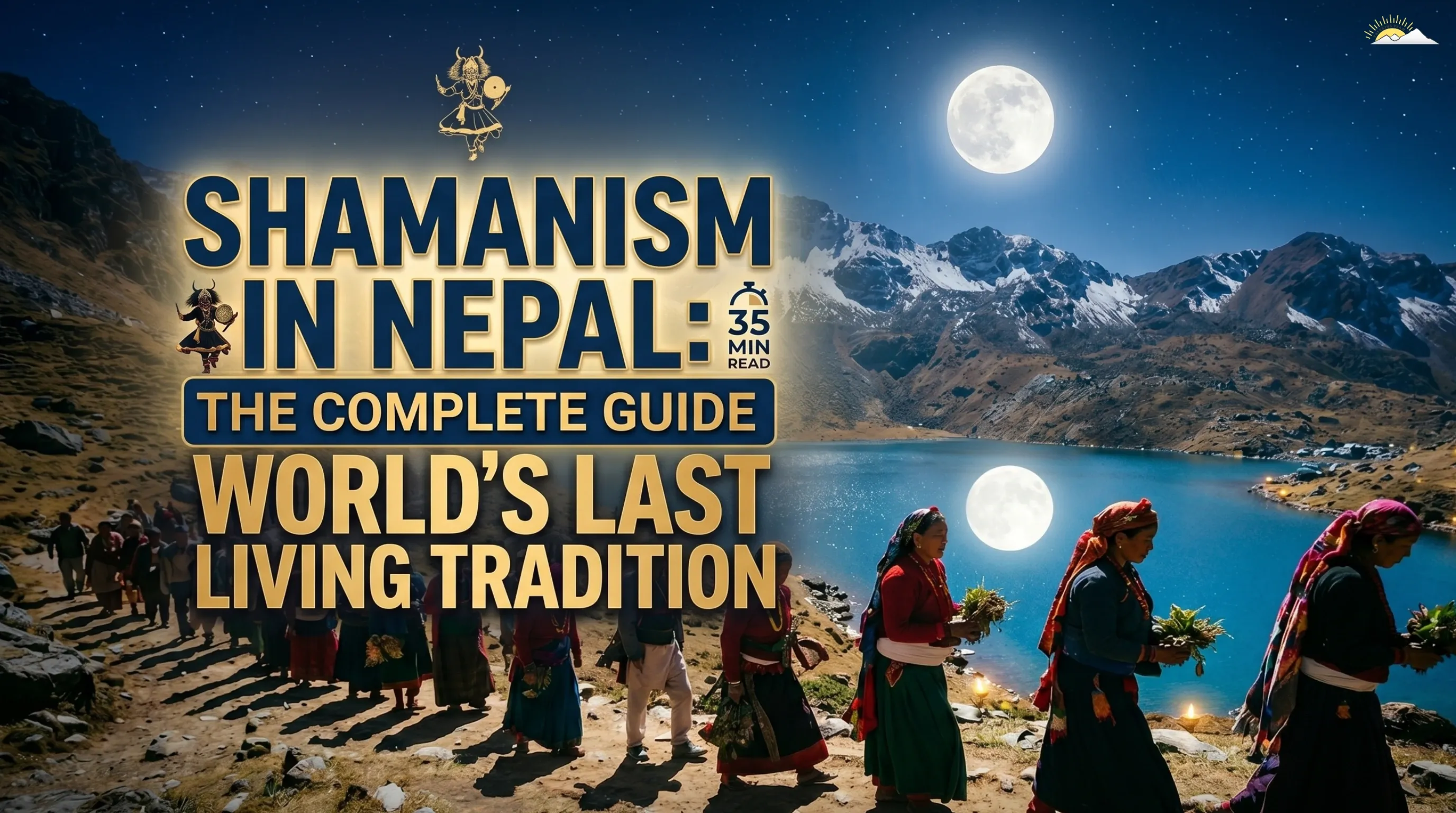
The most important shamanic gathering in Nepal takes place at Gosainkunda Lake (4,380 m) during the full moon of Shrawan (July/August). This is not merely a festival. It is the annual renewal of the entire shamanic tradition.
The Sacred Lake
According to Hindu mythology, when the gods and demons churned the ocean of milk to extract the nectar of immortality, a deadly poison also emerged. To save the universe, Lord Shiva drank the poison and held it in his throat, turning it blue (earning him the name Neelkantha, "the blue-throated one"). The poison was so intense that Shiva struck his trident into a mountainside in the Langtang region, creating a spring of cold water that became Gosainkunda. The waters are believed to still carry Shiva's divine presence and healing energy.
What Happens There
Tens of thousands of pilgrims, 20,000 to 40,000 in peak years, trek for three days from Dhunche to reach the lake. Among them, hundreds of practicing shamans from across Nepal make the pilgrimage.
The shamans arrive in traditional attire, carrying drums and bells. On the shores of the lake, at 4,380 metres under the full moon, they perform trance-like dances, chant mantras, beat their dhyangros, and conduct purification rituals. They reconnect with nature and the divine, renewing their healing powers.
A Nepali Times journalist who witnessed the festival described this scene: "In the open space near the temple were hundreds of people dressed in colourful attire singing and dancing. It was raining, but not strong enough to break the festive spirit."
A competition takes place among the shamans. Each shaman must play the dhyangro without dropping an egg placed on top of the drum. The shaman who balances the egg longest wins. The winning shaman then breaks the egg against the top frame of the temple door, a ritual act of spiritual power.
At night, when the full moon lights up the lake, butter lamps flicker by the shore, prayers float in the thin air. It is a rare blend of Hindu devotion and ancient Himalayan shamanism, raw and alive at extreme altitude.
Other Janai Purnima Gathering Sites
Gosainkunda is not the only location. Shamans also gather at:
- Kumbeshwar Mahadev Temple in Patan (Lalitpur), whose spring-fed pond is believed to be connected underground to Gosainkunda
- Lake Phoksundo near Dolpo
- Lake Panchpokhari near Helambu
- Jattapokhari at Numbur
- Dudh Kunda Lake
- Muktinath Temple
For visitors who cannot make the challenging trek to Gosainkunda, the Kumbeshwar Temple gathering in Patan is accessible from Kathmandu and features significant shamanic activity.
How to visit Gosainkunda for Janai Purnima: The trek takes 3 to 4 days from Dhunche (accessible by road from Kathmandu). Janai Purnima in 2026 falls in August. Contact us for the exact date and a guided trek timed to the festival.
Part 8: Other Shamanic Festivals and Sacred Sites
Dashain (October)
Nepal's biggest festival has deep shamanic roots. During Dashain, shamans perform rituals to honour the goddess Durga and protect communities from malevolent forces. In many villages, the Jhankri performs specific Dashain ceremonies that predate the Hindu overlay of the festival. Bhola Nath Banstola's book The Nepalese Shamanic Path includes an appendix specifically describing the shamanic dimensions of Dashain.
Udhauli and Ubhauli (Kirant Festivals)
The Rai and Limbu communities celebrate Udhauli (November/December) and Ubhauli (April/May), seasonal festivals tied to the agricultural calendar and migratory patterns. Shamanic practitioners (Phedangba, Bijuwa) play central roles, reciting the Mundhum and performing rituals for harvest protection.
Losar (Tamang/Sherpa New Year, February)
Tamang Losar involves extensive shamanic activity: Bombo ceremonies to cleanse the community of the old year's accumulated spiritual pollution and to invite blessings for the new year.
Maghe Sankranti (January)
Celebrates the return of the sun's warmth. Shamans perform healing rituals and prayers to ensure prosperity in the coming year.
Key Districts for Shamanic Practice
Shamanism is practised throughout Nepal's hill regions, but certain districts are particularly known: Dhading, Nuwakot, Dolakha, Sindhupalchok, Ramechhap (Sailung), Rukum, Jajarkot, Kaski, Bhojpur, and the Kathmandu Valley itself.
Part 9: Shamanism in Modern Nepal
It Has Not Disappeared. It Has Adapted.
In rural areas, shamans remain the first point of contact for many health and spiritual issues. Government health posts may be hours or days away. The Jhankri lives in the village. He comes to your home. He charges what you can afford (or nothing at all). He speaks your language and understands your family history.
As Adrian Storrs wrote, "From time immemorial, jhankris have given medical care to the rural people. Much of the jhankris' success is due to the fact that they are well known, respected and accepted, especially as intermediaries between man and spirits. Furthermore, the jhankris will go to patients at any time and treat them in their homes."
In urban Kathmandu, shamanism has not disappeared. It has moved indoors. Practicing shamans see clients in temples and private homes throughout the city. The shaman's house in Tangia Basti, a village documented by a Record Nepal journalist, was described as "a space where differences are temporarily suspended, and all are allowed to enter." The journalist found people from multiple castes and ethnicities waiting to see the shaman: a woman with insomnia, an old man with a food allergy, a young girl whose sudden silence had worried her teachers and parents.
Challenges and Preservation
Shamanism in Nepal faces genuine pressures. Modern education sometimes dismisses it as superstition. Younger generations in cities are less connected to traditional practices. The media sometimes ridicules shamanism even as it is studied intensively by academics.
But the tradition persists because it addresses needs that modern systems do not: the need for spiritual meaning, the need for community ritual, the need for a framework that connects individual suffering to the larger web of relationships between humans, nature, and the spirit world. These needs are not easily replaced by medicine or religion alone.
Cultural preservation efforts are growing. The Nepal Shaman Association protects practitioners' rights. Bhola Nath Banstola (27th-generation Jhankri, Eagle Feather Award recipient 2018 from the Society for Shamanic Practice) teaches traditional practices in Europe and North America while maintaining his practice in Nepal. Academic documentation continues through Tribhuvan University and international research partnerships.
Shamanism Tours vs. Authentic Shamanism
A critical distinction. There is a growing global industry in "shamanism tourism" that often bears little resemblance to actual Nepali practice. Institutions offering 3-day "shamanism courses" where tourists learn to drum and chant provide a packaged experience. They have a place in the market, but they are not the same as witnessing a genuine healing ceremony performed by a practicing village shaman for a real patient.
When we arrange shamanic experiences for our clients, we work directly with practicing shamans in their own communities. The ceremonies are real. The shamans are real. The communities are real. We are facilitators of respectful cultural exchange, not producers of spiritual entertainment.
Part 10: How to Experience Shamanism in Nepal in 2026
Our Programmes
Trekking Team Nepal offers two dedicated shamanism programmes:
3-Day Kathmandu Shamanism Experience: A compact introduction based entirely in the Kathmandu Valley. Sacred site visits through a shamanic lens (Pashupatinath, Boudhanath, Swayambhunath), a private consultation with a practicing shaman, and a full-day village visit with an evening Tamang Bombo healing ceremony. No trekking required. Suitable for all fitness levels.
10-Day Nepal Shamanism and Healing Traditions Tour: A deep immersion into the villages and forests where these traditions live. Three different ethnic traditions (Tamang Bombo, Khas Jhankri, Gurung Poju), multiple ceremonies, village homestays, gentle trekking through the middle hills, a medicinal plant walk with a Jhankri, and time in both Kathmandu and Pokhara.
Both programmes can be combined with any Trekking Team trek: Everest Base Camp, Mardi Himal Yoga Trek, Upper Mustang, or any other itinerary.
Cultural Protocols for Visitors
Ask before photographing. Some shamans welcome photography. Others do not, particularly during trance. Always ask through your guide.
Dress modestly. Cover your shoulders and knees. Remove shoes if asked.
Do not interrupt. Observe quietly. Ask questions afterwards.
Accept offerings graciously. At the end of many ceremonies, food and drink (often meat curry and locally brewed millet alcohol) are offered to all present. Accepting, even a small taste, is a sign of respect.
Women visitors: In some shamanic traditions, women do not visit the shaman during the first four days of their menstrual period. Your guide will advise on specific protocols.
Do not compare to Western "shamanism." Nepali shamanism is not ayahuasca retreats, sweat lodges, or drum circles. Approach the experience on its own terms.
Contribute to the community. A donation to the shaman and a contribution to the host village (arranged through your guide) is appropriate and appreciated.
Part 11: Why Shamanism Matters
In a world of algorithms and MRI machines, why does a tradition based on drums and spirits still matter?
Because it addresses something that modern life does not. The shaman asks a question that no doctor, no therapist, and no algorithm asks: what is the relationship between your suffering and the world around you? What spirits have you disturbed? What ancestors have you forgotten? What part of your soul has gone missing?
For millions of people in Nepal, these are the questions that matter most. And the shamans who answer them are not relics of the past. They are living practitioners of the world's oldest healing tradition, still working, still drumming, still crossing between worlds in the thin air of the Himalayas.
Bhola Nath Banstola, the 27th-generation Jhankri, puts it differently. After the devastating 2015 earthquake killed almost 9,000 people and destroyed sacred sites across Nepal, Banstola collaborated with writer Evelyn Rysdyk to put the oral teachings of Nepali shamanism into written form for the first time, a book called The Nepalese Shamanic Path. Their purpose was to ensure that if the earthquake had destroyed the physical lineage, the knowledge would survive. It did not need to. The lineage held. The shamans rebuilt. The drums play on.
If you come to Nepal only for the mountains, you will see something beautiful. If you come for the shamans too, you will see something true.
Frequently Asked Questions About Shamanism in Nepal
What is shamanism in Nepal? Shamanism in Nepal is the world's oldest continuously practiced healing tradition. It predates both Hinduism and Buddhism and is actively practiced by shamans known as Jhankri (झाँक्री) or Dhami (धामी) across more than 60 ethnic groups. Shamans serve as healers, spiritual guides, and mediators between the human and spirit worlds.
What is the difference between a Dhami and a Jhankri? A Dhami is primarily a spirit medium who becomes a vehicle for a deity or spirit to speak through. A Jhankri is a healer-shaman who uses tools like the drum, enters trance states, and performs healing work for anyone regardless of caste or ethnicity. Both terms are often used interchangeably in everyday Nepali speech.
How old is shamanism in Nepal? Nepali shamanism is connected to the ancient Bon tradition of Tibet and is estimated at 3,000 to 5,000+ years old. It predates both Hinduism and Buddhism in the Himalayan region.
What is the Ban Jhankri? The Ban Jhankri is a primordial forest spirit central to Nepali shamanic tradition. Described as small, hairy, with backward-pointing feet and a golden drum, the Ban Jhankri abducts chosen children and teaches them shamanic knowledge in a hidden cave. His wife, the Banjhakrini (also called Lemlemey), serves as the test of the candidate's spiritual purity. Multiple practicing shamans report this abduction experience.
What happens during a shamanic ceremony? A typical healing ceremony involves drumming, chanting, incense, invocation of spirits, trance, diagnosis of spiritual causes of illness, and healing work. Ceremonies usually last 1 to 3 hours and take place in the evening or at night.
When is the best time to experience shamanism in Nepal? Year-round. The most powerful gathering is Janai Purnima at Gosainkunda Lake (August full moon), where hundreds of shamans converge at 4,380 metres for rituals and trance. Dashain (October) and Losar (February) also feature significant shamanic activity. The Kumbeshwar Temple gathering in Patan during Janai Purnima is accessible from Kathmandu.
Can women be shamans in Nepal? Yes. While the tradition is male-dominated, female shamans exist and are sometimes considered more powerful than their male counterparts. Female shamans have been documented performing rituals at Gosainkunda and in village communities across Nepal.
Is shamanism the same as witchcraft? No. Dhami-Jhankri shamanism is a structured spiritual tradition with deep cultural and historical roots. Shamans are healers and community protectors. The tradition is distinct from negative stereotypes associated with "witchcraft."
Do I need to believe in spirits to attend a shamanism tour? No. Many visitors approach shamanism with curiosity rather than belief. The ceremonies are culturally and historically fascinating regardless of your personal framework. An open mind and respectful attitude are the only requirements.
Where can I book a shamanism tour in Nepal? Trekking Team Nepal offers 3-day Kathmandu experiences and 10-day immersive programmes. Both are led by licensed cultural guides with deep relationships in shamanic communities. Contact us to book.
The definitive guide to shamanism in Nepal. History, rituals, ethnic traditions (Tamang Bombo, Rai, Gurung Poju), Ban Jhankri and Banjhakrini legend, Gosainkunda Janai Purnima, sacred objects, and how to experience authentic ceremonies in 2026.