Everest Base Camp vs Annapurna Base Camp (2026): Which Trek Is Better for You?
Published by Trekking Team Nepal | Est. 1991 | TAAN Member #1106
📅 April 2026 • ✍️ Trekking Team Editorial • ⏱️ 22 min read
Last Updated: April 23, 2026
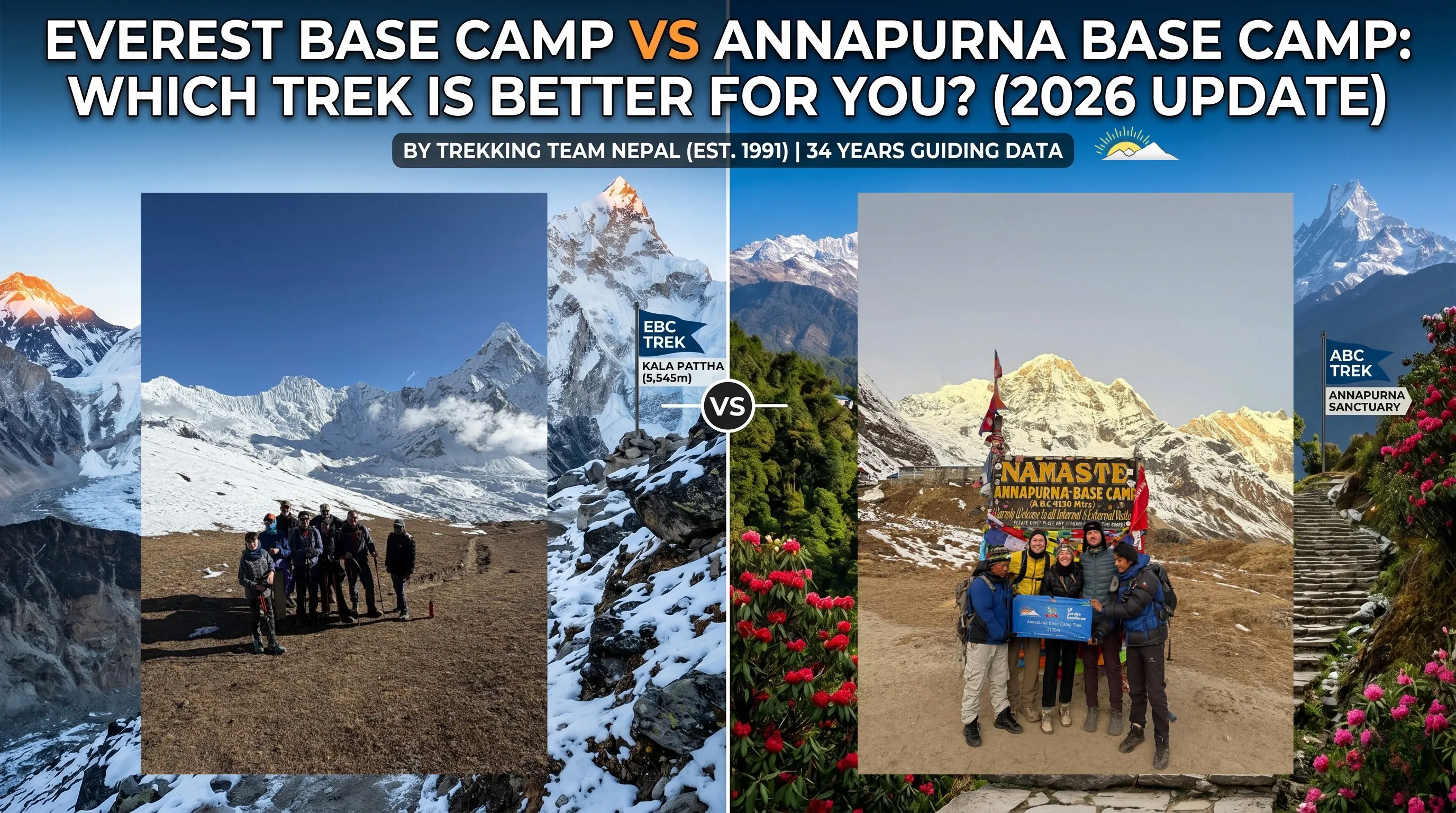
The Everest Base Camp vs Annapurna Base Camp decision comes down to what kind of trek you want. Everest Base Camp (EBC) is a high-altitude, 12 to 14 day journey to 5,364 m in the Khumbu region, while Annapurna Base Camp (ABC) is a shorter, 7 to 10 day trek to 4,130 m through forests, villages, and a natural mountain amphitheatre. Neither trek is "better." But one is definitely better for you.
Which is better, Everest Base Camp or Annapurna Base Camp? EBC tests your lungs at extreme altitude with views of four of the world's six highest peaks. ABC tests your legs on steep stone staircases through diverse landscapes and a 360-degree ring of Himalayan giants. This guide compares them across every factor that actually matters, written by an operator who has guided 10,000+ trekkers across both routes since 1991.
Everest Base Camp vs Annapurna Base Camp: Quick Answer
After guiding over 10,000 trekkers to both Everest Base Camp and Annapurna Base Camp since 1991, here is our quick recommendation:
| If you want... | Choose |
|---|---|
| The iconic bucket-list experience | Everest Base Camp |
| A shorter, more affordable trek | Annapurna Base Camp |
| The ultimate altitude challenge | Everest Base Camp |
| Best trek for beginners | Annapurna Base Camp |
| Diverse landscapes (forest to glacier) | Annapurna Base Camp |
| The single most famous mountain view on Earth | Everest Base Camp |
| A 360-degree amphitheatre of peaks | Annapurna Base Camp |
| Multi-ethnic cultural experience | Annapurna Base Camp |
| Deep Sherpa Buddhist immersion | Everest Base Camp |
| The most cost-effective option | Annapurna Base Camp |
For the full EBC vs ABC trek comparison with detailed data on altitude, cost, difficulty, culture, and logistics, read on. Everything below is based on 34 years of operating both routes, not guesswork from a single trip.
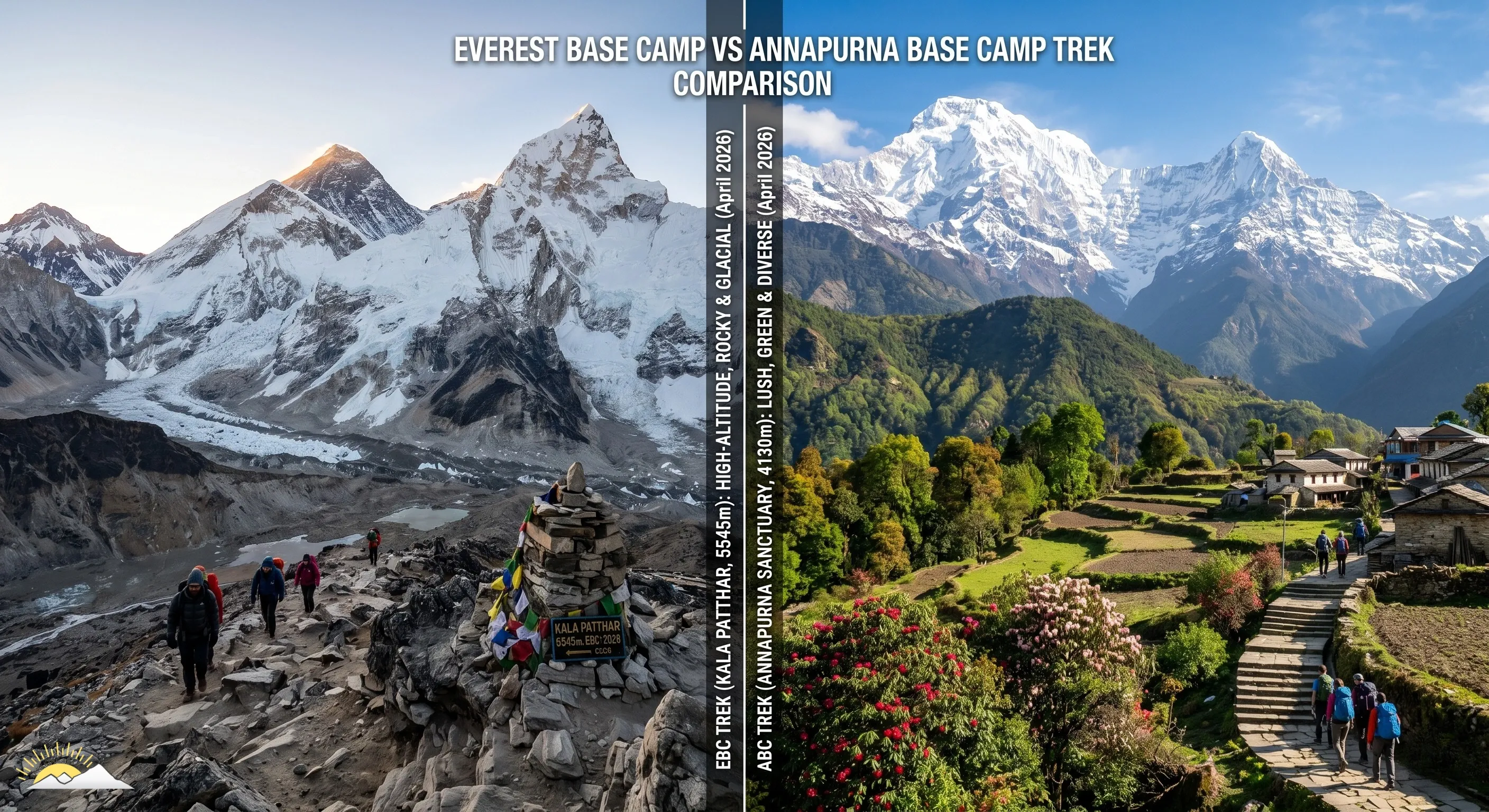
We operate both treks. Not one. Both. Every month, every year, since 1991.
We have walked a 70-year-old grandmother to the Kala Patthar sunrise at 5,545 metres. We have watched a first-time trekker cry at the Annapurna Sanctuary amphitheatre because she did not expect mountains could look like that. We have evacuated clients from the Khumbu at 3 AM by helicopter. We have rerouted groups through monsoon rain on the Annapurna trail when a bridge washed out.
After guiding over 10,000 trekkers across both the Everest and Annapurna regions for 34 years, we do not have opinions about which trek is "better." We have data. We have thousands of client experiences. And we have zero financial incentive to push you toward either one, because we sell both equally.
Most Everest Base Camp vs Annapurna Base Camp comparisons online are written by someone who did one trek and guessed about the other. This is different. This is the EBC vs ABC comparison written by the only team that needs to be right, because our reputation depends on matching you with the trek that will actually make you happiest.
EBC vs ABC Trek Comparison: The Numbers Side by Side
| Factor | Everest Base Camp (EBC) | Annapurna Base Camp (ABC) |
|---|---|---|
| Max elevation | 5,545 m (Kala Patthar) | 4,130 m (ABC) |
| Trek distance | 130 km round trip | 110 km round trip |
| Duration | 12-14 days trekking | 7-10 days trekking |
| Total trip days | 16-18 days (including Kathmandu) | 10-14 days (including Kathmandu/Pokhara) |
| Starting point | Lukla (flight required) | Nayapul/Ghandruk (drive from Pokhara) |
| Acclimatization days needed | 2 mandatory rest days | Usually none formally needed |
| Altitude sickness risk | Significant above 4,000 m | Low to moderate |
| Terrain difficulty | Moderate (rocky moraine at high altitude) | Moderate-hard (steep stone staircases) |
| Permits (2026) | SNP + municipality (~$37) | ACAP (~$22) + municipality |
| Lukla flight needed | Yes (~$300-350 round trip) | No |
| Total cost (standard) | $2,200-3,000 | $1,200-2,000 |
| Teahouse quality | Good to basic (decreases with altitude) | Good throughout (better logistics) |
| Best months | April, May, October, November | March, April, October, November |
| Crowds (peak season) | Heavy on main trail | Moderate to heavy |
| Cultural experience | Sherpa Buddhist culture | Multi-ethnic (Gurung, Magar, Sherpa) |
| Route type | Out and back (same trail) | Loop possible (different up/down routes) |
1. Everest vs Annapurna Altitude: The Single Biggest Difference
This is not a minor detail. It is the factor that should drive your decision more than any other.
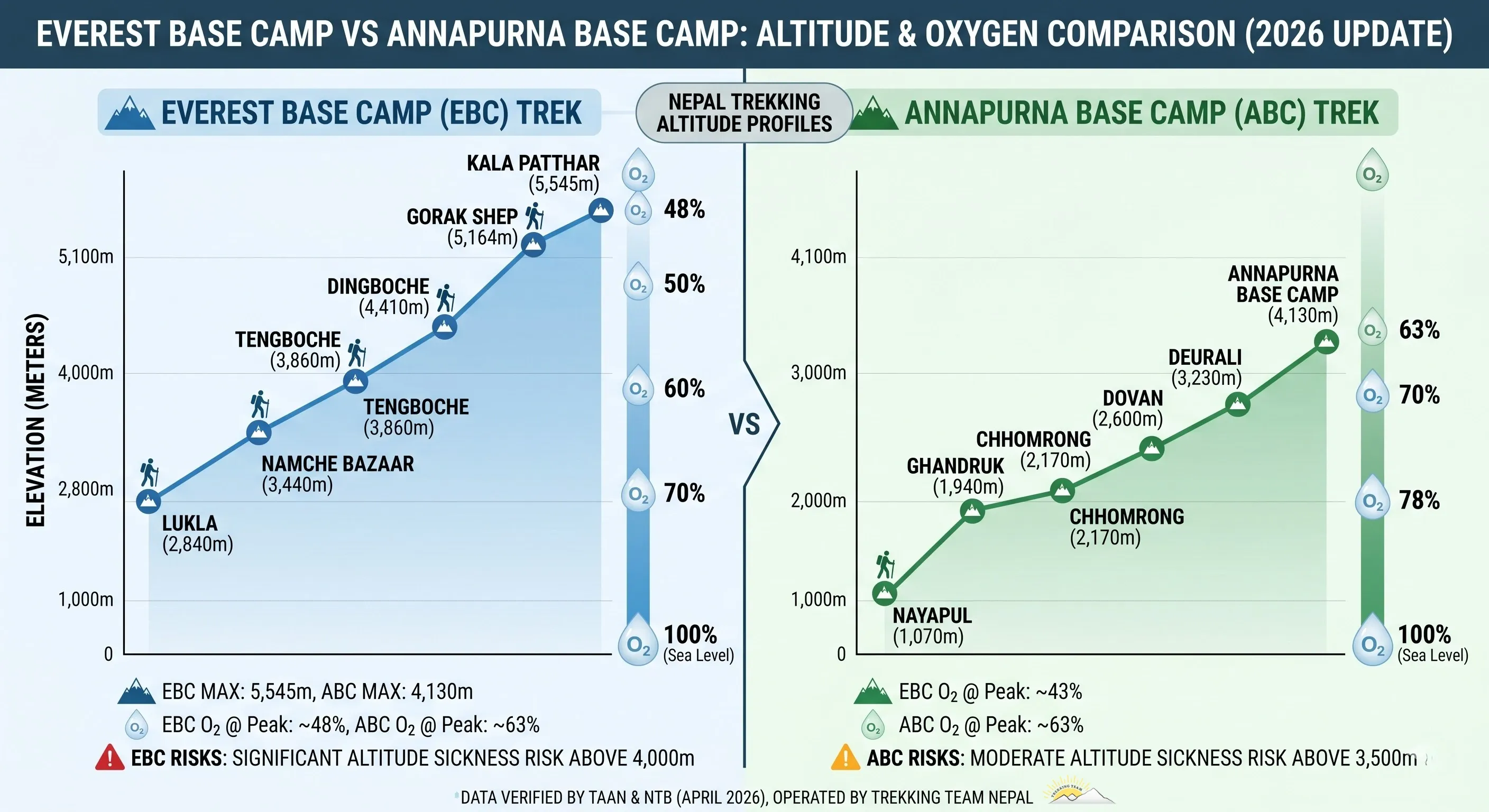
Everest Base Camp sits at 5,364 m. Kala Patthar, the viewpoint most trekkers climb, reaches 5,545 m. At this altitude, you are breathing approximately 50% of the oxygen available at sea level. Your body must produce additional red blood cells to compensate, and this process takes days. That is why the EBC trek includes two mandatory acclimatization days (at Namche Bazaar and Dingboche) and why the total trek takes 12-14 days even though the distance is only 130 km.
Altitude sickness on the Everest Base Camp trek is a genuine risk. Symptoms include headache, nausea, loss of appetite, dizziness, and insomnia. Severe cases can develop into life-threatening pulmonary or cerebral edema. Our guides carry pulse oximeters and check blood oxygen twice daily from Namche onwards. We have evacuated trekkers by helicopter. It happens.
Annapurna Base Camp sits at 4,130 m. That is 1,234 metres lower than EBC. At 4,130 m, you are breathing roughly 60% of sea-level oxygen. The difference between 50% and 60% is enormous in terms of how your body feels and functions. Most trekkers on the ABC route do not require formal acclimatization days. Altitude sickness is possible but significantly less common and less severe.
The honest take: If you have never been above 3,000 m, if you are concerned about altitude, or if you have a pre-existing respiratory or cardiovascular condition, ABC is the safer and more comfortable choice. If you are fit, have trekked at altitude before (or are willing to prepare properly), and want the challenge and prestige of reaching the base of the world's tallest mountain, EBC is achievable with the right operator and itinerary.
2. EBC vs ABC Trek Duration and Logistics
EBC requires more time and more complex logistics. You need to fly to Lukla (25-35 minutes from Kathmandu, or from Ramechhap with a 5-hour drive). Lukla flights are weather-dependent and cancel frequently, which is why every responsible operator builds buffer days into the itinerary. The trek itself takes 12-14 days. Total trip: 16-18 days minimum.
ABC is simpler. You drive from Pokhara to the trailhead (1-2 hours). No flight required, no weather-dependent airport, no cancellation risk. The trek takes 7-10 days depending on your pace and route. Total trip: 10-14 days including Kathmandu and Pokhara time.
If you have 10 days or fewer: ABC is your only realistic option.
If you have 14 days: ABC is comfortable, EBC is tight but possible with a 12-day itinerary (not our recommendation, as it reduces acclimatization).
If you have 16-18 days: Both are fully feasible. EBC with proper acclimatization, or ABC with extensions like Poon Hill.
If you have 20+ days: Consider combining ABC with Poon Hill, or doing the EBC trek with the Gokyo Lakes extension via Cho La Pass. Or do both treks on one trip (we arrange this regularly).
3. Everest Base Camp vs Annapurna Base Camp Views: Different Kinds of Spectacular
This is where personal preference matters most.
EBC: The Vertical Experience
The Khumbu Valley is dominated by sheer verticality. Peaks rise straight up from the valley floor: Ama Dablam's razor-sharp ridge, Nuptse's 3,000-metre south face, Lhotse's ice wall, and Everest's summit pyramid appearing and disappearing behind closer peaks as you walk.
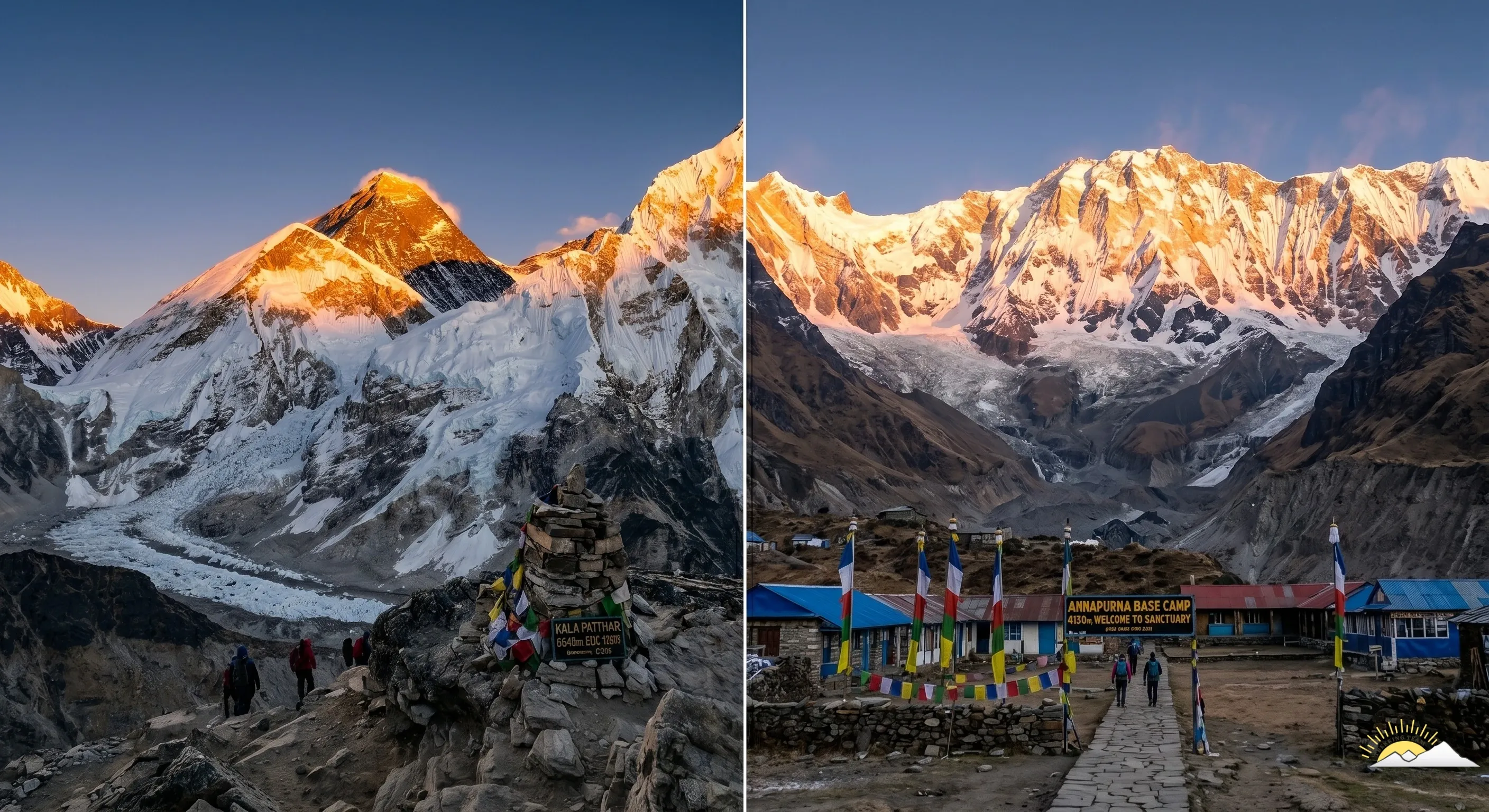
The highest point, Kala Patthar, delivers what many trekkers call the most powerful visual experience of their lives: a panoramic view of Everest, Lhotse, Nuptse, Pumori, Changtse, and the Khumbu Glacier at sunrise. Read the full Kala Patthar sunrise experience in our complete Everest Base Camp trek guide.
Four of the world's six highest peaks are visible from the EBC trail: Everest (8,849 m), Lhotse (8,516 m), Makalu (8,463 m), and Cho Oyu (8,188 m).
The landscape above Dingboche is stark, barren, and otherworldly. Rock, ice, glacier, sky. No trees. No green. Just raw, high-altitude geology. Beautiful in a way that feels almost extraterrestrial.
ABC: The Amphitheatre Experience
The Annapurna Sanctuary is a glacial bowl completely surrounded by mountains. When you arrive at ABC, you are inside the mountains, not looking at them from a distance. Annapurna I (8,091 m), Annapurna South (7,219 m), Machapuchare/Fishtail (6,993 m), Hiunchuli (6,441 m), and Gangapurna (7,455 m) form a 360-degree wall of ice and rock around you.
The sunrise on Annapurna South from the ABC teahouse is one of those experiences that trekkers describe in the same disbelieving tone, every time. The light moves across the peaks in a slow wave, turning ice from blue to pink to gold.
But the ABC trek also offers something EBC does not: variety. The trail moves through multiple ecological zones. Subtropical forest with orchids and ferns at the start. Terraced rice paddies and stone villages in the middle. Dense rhododendron forest that blooms red and pink in April. Then alpine meadows, then bare rock and ice as you approach the sanctuary. The landscape changes dramatically every day. EBC, by comparison, stays in a relatively consistent high-altitude environment from Namche onwards.
The Verdict
EBC has the single most famous mountain view on Earth. ABC has the most immersive mountain amphitheatre. EBC gives you "looking at giants." ABC gives you "standing inside giants." Both are extraordinary. Neither is better. They are different.
4. EBC vs ABC Difficulty: Thin Air vs Burning Legs
This is the comparison that surprises most people.
EBC terrain is actually easier than ABC terrain. The trails in the Khumbu are generally well-graded, with moderate ascents and descents. The difficulty of EBC is almost entirely about altitude: the thin air, the cold, and the physical toll of operating at 50% oxygen for days on end.
ABC terrain is harder on your body. The Annapurna trail is famous for its stone staircases. Thousands of steps, climbing steeply through forest and hillside, then descending just as steeply to river crossings before climbing again. The trail between Chhomrong and the sanctuary involves relentless ascent-descent sequences that drain your legs, knees, and will.
The honest summary:
EBC tests your lungs and your ability to function at extreme altitude. Your body feels progressively more sluggish, your appetite decreases, sleeping becomes difficult, and every physical action requires more effort. The challenge is physiological.
ABC tests your muscular endurance, particularly your knees and quads. You will climb and descend more total vertical metres per day than on EBC. The challenge is physical.
For first-time trekkers: ABC is generally more forgiving because the altitude is lower. Even if your legs are screaming, your brain and lungs are functioning normally. On EBC, altitude sickness can affect anyone regardless of fitness.
Still deciding between Everest Base Camp and Annapurna Base Camp? After guiding 10,000+ trekkers across both routes, we can recommend the right trek based on your fitness, time, and goals. Talk to our trekking experts →
5. Everest vs Annapurna Trek Cost: How Much More Does EBC Actually Cost?
The Lukla flight is the single biggest cost difference. That $300-350 round trip does not exist on the ABC route.
| Cost Component | EBC (Standard) | ABC (Standard) |
|---|---|---|
| Flights to trailhead | $300-350 (Lukla) | $0 (drive from Pokhara) |
| Permits | ~$40 | ~$25 |
| Guide (14 days EBC / 10 days ABC) | $420-490 | $300-350 |
| Porter (14 days / 10 days) | $280-350 | $200-250 |
| Teahouse + meals (14 days / 10 days) | $350-560 | $200-350 |
| Kathmandu hotel | $160-320 | $120-240 |
| Pokhara hotel | N/A | $40-80 |
| Gear rental | $30-50 | $30-50 |
| Insurance | $100-150 | $100-150 |
| Total (standard) | $2,200-3,000 | $1,050-2,000 |
The cost difference is approximately $800-1,200 per person. This is primarily driven by the Lukla flight, the longer duration (more guide/porter/accommodation days), and higher food prices at extreme altitude.
Read our complete Everest Base Camp trek cost breakdown with 2026 prices.
6. EBC vs ABC Culture: Sherpa Homeland vs Multi-Ethnic Corridor
EBC: The Sherpa World
The Khumbu is the Sherpa homeland. You will walk through Sherpa villages, eat in Sherpa teahouses, visit Sherpa monasteries (Tengboche, Pangboche, Khumjung), and learn about a culture that is inseparable from the mountains. The Sherpa relationship with Everest, the history of mountaineering, the role of Buddhist practice in daily life: this is a deep, singular cultural immersion.
The Sherpa Culture Museum in Namche Bazaar, the evening puja at Tengboche Monastery, and the mani walls (prayer stone walls) that line the trail for kilometres are experiences unique to the EBC trek.
ABC: Many Communities, Many Traditions
The ABC trail passes through villages of Gurung, Magar, and Sherpa communities. You experience multiple ethnic traditions, multiple architectural styles, multiple cuisines, and multiple languages within a single trek. The Gurung village of Ghandruk, with its stone houses and panoramic Machapuchare views, is a cultural highlight. The Magar settlements in the lower hills offer a different perspective on Nepali mountain life.
This cultural diversity is one of ABC's strongest features. You see more of Nepal's human landscape in 10 days on the ABC trail than in 14 days on the EBC trail, because the EBC trail stays within one ethnic community.
7. Everest vs Annapurna Crowds and Infrastructure
EBC in peak season (October, April): The trail can feel crowded between Namche and Tengboche. Teahouses at popular stops (Namche, Tengboche, Dingboche, Gorak Shep) fill up and require advance booking. Above Dingboche, crowds thin significantly. The trail never feels as congested as a popular European hiking trail, but you will see other trekkers constantly during the day.
ABC in peak season: The trail is busy around Chhomrong and at ABC itself. But the loop route option (ascending via one valley, descending via another) spreads trekkers out more effectively than the EBC out-and-back route. Teahouse quality is generally better on the ABC trail due to easier logistics (no flight required, road access to lower villages).
The quiet alternative: If you want empty trails, both treks offer off-peak options. November EBC and March ABC are both excellent with dramatically fewer trekkers. For the ultimate quiet experience, consider Upper Mustang or Dolpo during monsoon season.
8. EBC vs ABC Best Season and Weather
Both treks share the same two optimal seasons: spring (March to May) and autumn (September to November). October is the single best month for both.
The key weather differences:
EBC is colder. You are spending 5-6 nights above 4,500 m where nighttime temperatures drop to -15 to -25°C. A -15°C sleeping bag is mandatory. Down jackets are essential, not optional.
ABC is wetter. The Annapurna region receives significantly more rainfall than the Everest region. During spring, afternoon clouds and occasional rain showers are more common on the ABC trail. The lower sections of the trail (below 3,000 m) can be muddy. During monsoon (June-September), the ABC trail is not recommended due to heavy rain and leech activity.
Important 2026 climate note: Monsoon patterns have shifted. Late-monsoon rain hit both regions unexpectedly in October 2023 and 2024. Flexibility and an experienced operator who monitors conditions daily are more important than ever. Full month-by-month weather details in our EBC guide.
9. Everest vs Annapurna Safety: What If Something Goes Wrong
EBC medical infrastructure is better. The Himalayan Rescue Association (HRA) operates a medical clinic in Pheriche (4,280 m) staffed by doctors during trekking season. The Kunde Hospital near Namche provides additional medical support. Helicopter evacuation from the Khumbu is well-established and can be coordinated within hours.
ABC medical support is more spread out. There is no equivalent of the Pheriche clinic on the ABC trail. Medical posts exist in lower villages, but above Chhomrong, you are relying on your guide's first aid skills and helicopter evacuation if needed.
The Lukla risk: EBC has one vulnerability that ABC does not: Lukla Airport. Bad weather can ground flights for 1-3 days. This is why we always include a buffer day. Agencies that do not include buffer days are gambling with your international connection. ABC has no equivalent logistical bottleneck since you drive to and from the trailhead.
Our protocol for both treks (verified by TAAN and NTB standards):
- Licensed guides with wilderness first aid training
- Pulse oximeters on all treks above 3,500 m
- 24/7 Kathmandu operations desk
- Pre-established helicopter evacuation relationships
- Satellite phone communication in areas without mobile coverage
- Full safety protocol details
10. EBC or ABC: Which Trek Should You Actually Do?
After 34 years of guiding both, here is our honest recommendation framework:
Choose EBC if:
- Everest is on your bucket list and nothing else will satisfy that
- You have 16-18 days available
- You have trekked at altitude before (or are willing to prepare seriously)
- You want a singular, intense, high-altitude experience focused on one mountain
- You are drawn to Sherpa Buddhist culture
- Budget is not the primary constraint
- You want to stand where Hillary and Tenzing stood
Choose ABC if:
- You have 10-14 days available
- This is your first Himalayan trek
- You are concerned about altitude sickness
- You want diverse landscapes (forest, farmland, alpine, glacial)
- You want multi-ethnic cultural experiences
- Budget matters (ABC is $800-1,200 cheaper)
- You prefer a loop route with different scenery going up and down
- You want to include Pokhara in your trip
Choose BOTH if:
- You have 25-30 days
- We arrange combined EBC + ABC itineraries regularly
- Doing both on one trip gives you the complete Nepal trekking experience
Choose NEITHER (and do something completely different) if:
- You want zero crowds and true wilderness: Upper Mustang or Upper Dolpo
- You want a spiritual/cultural immersion: Nepal Shamanism Tour or Mardi Himal Yoga Trek
- You want monsoon trekking: 7 rain-shadow routes that stay dry
Final Verdict: Everest Base Camp vs Annapurna Base Camp
| Everest Base Camp | Annapurna Base Camp | |
|---|---|---|
| Choose for | Altitude, prestige, iconic Himalayan views, Sherpa culture, standing where history happened | Variety, shorter duration, lower altitude risk, diverse cultures, budget-friendly |
| Best for | Trekkers chasing a bucket-list dream who have 16+ days and are willing to prepare for altitude | First-time Himalayan trekkers, shorter holidays, anyone who values landscape diversity over a single iconic peak |
| One sentence | "I stood at the base of the tallest mountain on Earth and watched the sunrise turn its summit to gold." | "I walked through forests, villages, and farmland into a natural amphitheatre where mountains surrounded me on every side." |
Both treks are world-class. Both will change you. The right choice is the one that matches your time, your fitness, your budget, and what you dream about when you close your eyes and imagine the Himalayas.
Frequently Asked Questions: Everest Base Camp vs Annapurna Base Camp
Which is harder, EBC or ABC? Different kinds of hard. EBC is harder on your lungs (5,545 m altitude, 50% oxygen). ABC is harder on your legs (relentless stone staircases, steep ascents/descents). Most first-time trekkers find ABC more physically manageable because the lower altitude means your brain and body function normally even when your muscles are tired.
Which is cheaper, EBC or ABC? ABC is approximately $800-1,200 cheaper per person, primarily because it does not require a Lukla flight ($300-350) and the trek is shorter (fewer days of guide, porter, and accommodation costs). Full EBC cost breakdown.
Which has better views? Both are world-class. EBC offers views of four of the six highest peaks on Earth, including the Kala Patthar sunrise over Everest. ABC places you inside a 360-degree amphitheatre with Annapurna I, Machapuchare, and surrounding peaks towering on all sides. EBC is "looking at giants." ABC is "standing inside giants."
Can a beginner do EBC? Yes, with 8-12 weeks of preparation and a properly acclimatized itinerary. Read our complete EBC guide.
Can I do both treks on one trip? Yes. We arrange combined EBC + ABC itineraries (25-30 days). This is the ultimate Nepal trekking experience. Contact us for a custom itinerary.
Which trek is better for photography? EBC for dramatic, high-contrast mountain photography (ice, rock, glacier, extreme altitude light). ABC for diverse landscapes and warmer tones (forest, terraces, flowers in spring, amphitheatre panoramas).
Do I need a guide for both treks? Yes. Since April 2023, the Nepal Tourism Board requires all foreign trekkers to hire a licensed guide registered with the Trekking Agencies' Association of Nepal (TAAN) for both the Everest and Annapurna regions. Full 2026 regulations here.
What permits do I need in 2026? EBC: Sagarmatha National Park permit + Khumbu Pasang Lhamu municipality permit. ABC: Annapurna Conservation Area Permit (ACAP) + local municipality permit. TIMS is no longer required for either trek. All permits must be processed through a TAAN-registered trekking agency as per Nepal Tourism Board regulations. Complete 2026 permit guide.
Is WiFi available on both treks? Yes, in most teahouses up to high altitude on both routes. ABC generally has better connectivity due to proximity to Pokhara. Both treks: bring a power bank. Charging fees apply at teahouses above base elevations.
Book Your Trek
We operate both Everest Base Camp and Annapurna Base Camp treks year-round. Every package includes all permits, licensed guide, porter, accommodation, meals, and 24/7 operational support.
Not sure which is right for you? Send us a message. We will ask about your fitness, your time, your budget, and your goals, and give you an honest recommendation. We have been doing this for 34 years. We know which trek will make you happiest.
- Website: trekkingteam.com
- Email: info@trekkingteam.com
- WhatsApp: +977 9869400739
- Office: Gongabu, Pragatinagar, Kathmandu, Nepal
Follow us:
Walking Nepal's trails since 1991. Your trek starts here.
EBC vs ABC explained by a Nepal trekking operator with 34+ years experience. Compare altitude, cost, difficulty, views, and culture. Find which trek is right for you.