Nepal Festival Season 2026: Dashain, Tihar, Chhath and the Joy That Outlasts Every Disaster
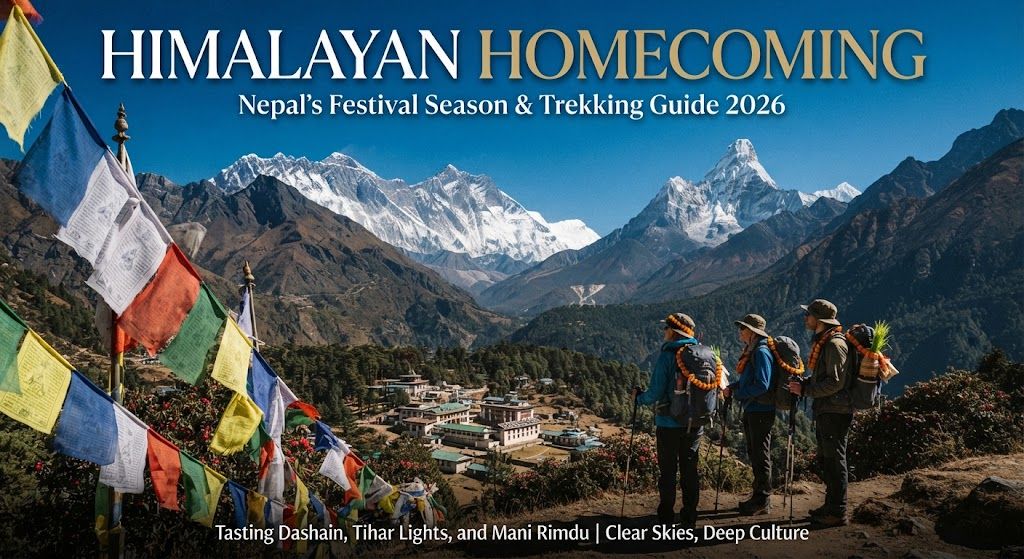
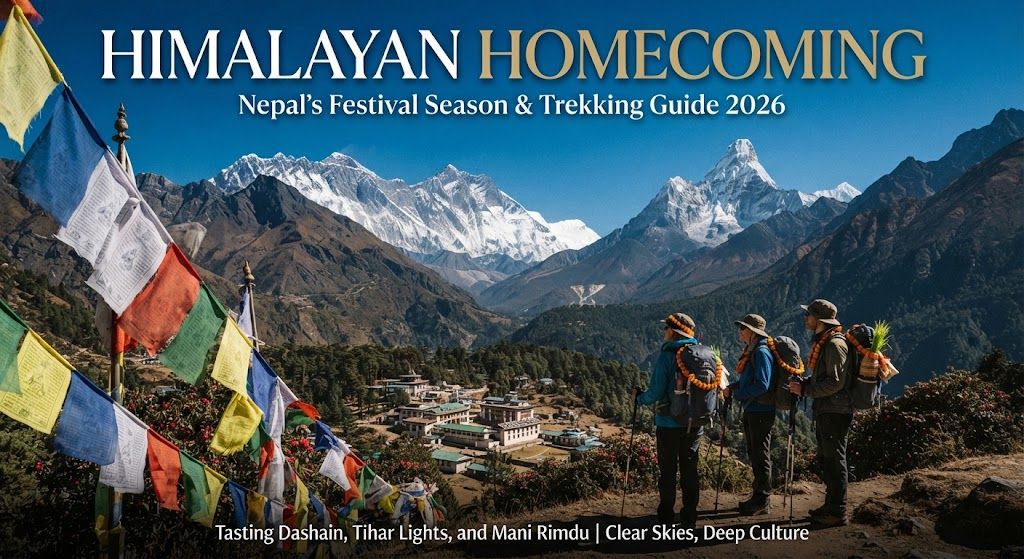
Nepal's festival season 2026 runs from Ghatasthapana on 11 October to Chhath on 15 November. Dashain Tika falls on Wednesday, 21 October, Laxmi Puja on 8 November and Bhai Tika on Wednesday, 11 November. Those five weeks also happen to be the clearest trekking weather of the year.
If you land in Kathmandu in mid-October, you will notice it before you clear immigration. Bamboo swings (ping) go up in village squares. Kites fight over the rooftops of Asan and Patan. Buses leave the valley so full that people ride on the roof with goats and rice sacks. Half the city goes home, and the half that stays cooks for everyone who comes back.
This year that joy has extra weight. On 26 August 2026 a flash flood tore through the Bhotekoshi and Trishuli valleys in Rasuwa, Nuwakot and Dhading. Families in those districts will light the same Tihar lamps as everyone else, some of them in rebuilt homes, some still in borrowed ones. Nepal has done this before: after the 2015 earthquake, after the 2024 monsoon floods, and again now. The festivals do not ignore the hard year. They are how people get through it.
This guide covers the verified 2026 dates, what each festival means, how Nepalis keep celebrating through disaster, what you can actually join as a visitor, and how to plan a trek around it all. We have run treks through 35 festival seasons since 1991, so the practical tips come from the trail, not a brochure.
Nepal festival calendar, October-November 2026
The dates below follow the official Bikram Sambat 2083 calendar (Ramro Patro, Kartik 2083). The exact Dashain and Bhai Tika auspicious minute (sait) is announced by the Nepal Panchanga Nirnayak Bikas Samiti shortly before each day, so check a Nepali patro the week before.
| Date (2026) | BS 2083 | Festival / day | What happens | Where to see it |
|---|---|---|---|---|
| Sun 11 Oct | Ashoj 25 | Ghatasthapana | Dashain begins, barley seeds (jamara) sown in a sacred pot | Every Hindu home; Taleju temple, Kathmandu Durbar Square |
| Sat 17 Oct | Ashoj 31 | Phulpati | Sacred flowers and leaves carried from Gorkha to Kathmandu, army parade at Tundikhel | Hanuman Dhoka, Tundikhel |
| Sun 18 Oct | Kartik 1 | Maha Ashtami (Kal Ratri) | Night of offerings to Durga, animal sacrifice in many temples | Dakshinkali, Taleju, Bhaktapur |
| Tue 20 Oct | Kartik 3 | Maha Navami | Tools and vehicles worshipped; Taleju's inner temple opens to the public once a year | Taleju, Kathmandu Durbar Square |
| Wed 21 Oct | Kartik 4 | Vijaya Dashami (Tika) | Elders give red tika and jamara blessings | Family homes everywhere |
| 21-26 Oct | Kartik 4-9 | Tika visits continue | Relatives travel to receive tika until the full moon | Whole country |
| Mon 26 Oct | Kartik 9 | Kojagrat Purnima | Full moon, Laxmi worshipped, Dashain closes | Homes, temples |
| 26-28 Oct | Kartik 9-11 | Mani Rimdu | Sherpa masked dances (cham) and blessings; reconfirm dates before booking | Tengboche Monastery, Everest region |
| Fri 6 Nov | Kartik 20 | Dhanteras | Buying gold, silver and new utensils for luck | Markets in Asan, New Road |
| Sat 7 Nov | Kartik 21 | Kag Tihar | Crows fed as messengers | Rooftops |
| Sun 8 Nov | Kartik 22 | Kukur Tihar + Laxmi Puja | Dogs garlanded in the morning; oil lamps and Laxmi worship at night | Every street |
| Mon 9 Nov | Kartik 23 | Gai Puja | Cows honoured | Homes, farms |
| Tue 10 Nov | Kartik 24 | Govardhan Puja, Mha Puja, Nepal Sambat 1147 New Year | Oxen worshipped; Newar self-worship ritual and New Year parades | Kathmandu, Patan, Bhaktapur |
| Wed 11 Nov | Kartik 25 | Bhai Tika | Sisters give seven-colour tika to brothers | Family homes, Rani Pokhari |
| Sun 15 Nov | Kartik 29 | Chhath | Sunset offerings to the Sun God at rivers and ponds | Janakpur, Birgunj, Kamal Pokhari and Gaurighat in Kathmandu |
You may see some travel sites list Dashain Tika as 20 October. The official calendar places Bijaya Dashami on Kartik 4, which is Wednesday, 21 October.
Dashain 2026: Nepal's biggest festival, day by day
Dashain (Bada Dashain, Vijaya Dashami) is a 15-day Hindu festival celebrating the goddess Durga's victory over the buffalo demon Mahishasura. In 2026 it starts on 11 October and peaks with Tika on 21 October. It is the longest national holiday in Nepal, and for many families the only time of year everyone is in one house.
The story is good versus evil, but the feeling is homecoming. Students in Australia, workers in Qatar and Malaysia, cousins in Pokhara and Dharan all try to get back. Remittance money flows in during September, and markets fill with new clothes, goats and sacks of rice.
Ghatasthapana (11 October)
A clay pot (kalash) filled with holy water is placed in a dark corner of the house called the Dashain ghar. Barley and maize seeds are sown in sand around it. Over ten days they grow into pale yellow shoots called jamara, kept out of sunlight so they stay golden.
Phulpati (17 October)
On the seventh day a bundle of sacred flowers, leaves and banana stalks arrives in Kathmandu from the old royal palace in Gorkha. It is received at Hanuman Dhoka with a military parade and gunfire at Tundikhel. The day feels like the city taking a deep breath before the big days.
Maha Ashtami and Maha Navami (18 and 20 October)
These are the nights of Durga's fiercest forms. Many temples and households offer animal sacrifices of goats, ducks and buffalo. Visitors who are squeamish should skip Dakshinkali and the Kot area courtyards on these mornings. On Navami, Nepalis bless cars, motorbikes, taxis and even laptops so they run safely all year, and the inner shrine of Taleju temple opens to the public for its one day of the year.
Vijaya Dashami, Tika day (21 October)
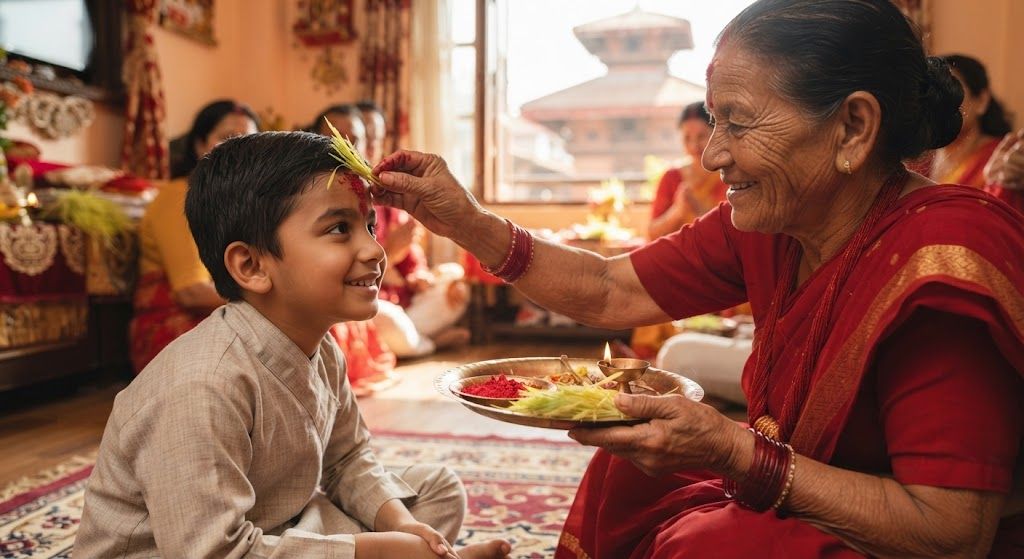
This is the heart of Dashain. Elders mix rice, yoghurt and vermilion into a red paste, press it onto the foreheads of younger relatives, tuck jamara behind their ears, and recite a blessing for long life and success. Younger family members bow, receive a little money (dakshina), and move on to the next elder's house.
The official sait for 2026 will be announced by the Nepal Panchanga Nirnayak Bikas Samiti. In 2025 it was set at 11:53 AM, and the committee noted the whole day is auspicious anyway (Nepal News).
Tika visits to Kojagrat Purnima (21-26 October)
For five more days people travel to receive tika from elders they missed. Kojagrat Purnima, the full moon, closes the festival. Traditionally families stay awake that night because Laxmi is said to bless those who are awake.
The sounds and tastes of Dashain
- Ping (bamboo swings): built by village youth, some over 6 m tall. Locals believe your feet should leave the ground at least once during Dashain.
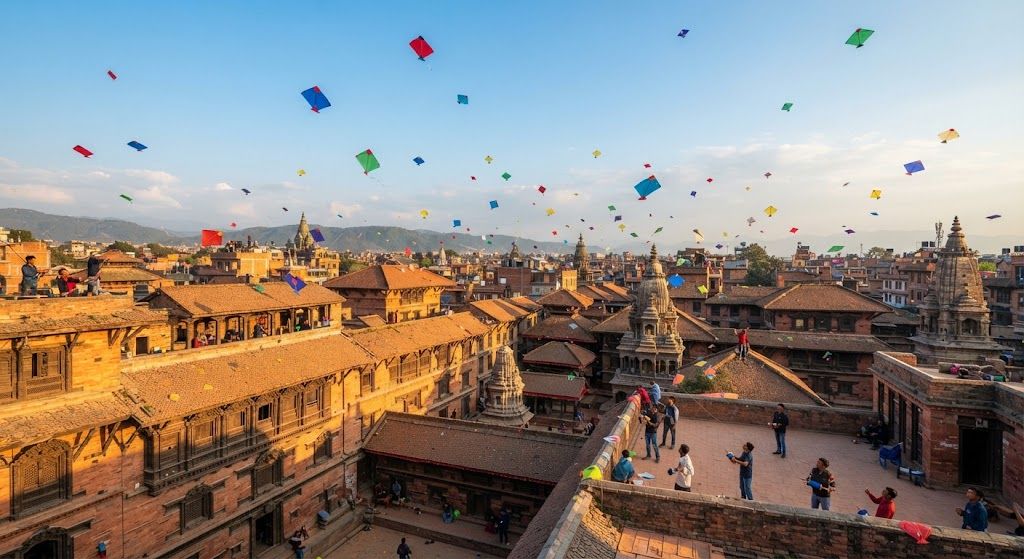
- Kites: clear October skies fill with kites, and the shout of "chet!" when one cuts another's string echoes across rooftops.
- Food: goat meat curry (khasi ko masu), sel roti, achar, beaten rice and plenty of homemade raksi in hill homes.
- Cards: families play marriage and flush for small stakes, a long-standing Dashain tradition in many homes.
- The Malshree dhun: the slow Dashain tune plays on every radio and in every shop, and Nepalis abroad say it is the sound that makes them homesick.
Tihar 2026: five days of lights, animals and siblings
Tihar (Deepawali, Yamapanchak) runs from 7 to 11 November 2026 and honours, in order, crows, dogs, cows, oxen and finally brothers and sisters. Where Dashain is about family elders, Tihar is lighter and brighter. Houses are lit with oil lamps and fairy lights, and the whole country smells of marigolds.
Day 1: Kag Tihar (7 November)
Crows are considered messengers of Yama, the god of death. Families leave rice and sweets on rooftops in the morning so no bad news reaches the house that year.
Day 2: Kukur Tihar and Laxmi Puja (8 November)
In 2026 the dog day and Laxmi Puja fall on the same date. In the morning every dog in Nepal, street dogs included, gets a marigold garland, a red tika and a proper meal. Police dog units hold their own ceremony. It is one of the most photographed moments of the Nepali year, and visitors are welcome to feed and garland dogs.
That evening is Laxmi Puja. Homes are scrubbed, a trail of red mud and rice paste is painted from the door to the prayer room, and oil lamps are lit on every window ledge so the goddess of wealth can find her way in. Kathmandu glows.
Day 3: Gai Puja (9 November)
The cow, Nepal's national animal and a symbol of Laxmi, is fed and decorated.
Day 4: Govardhan Puja, Mha Puja and Nepal Sambat New Year (10 November)
Oxen are honoured in farming families. Newar families perform Mha Puja, a ritual of worshipping one's own body and soul with a mandala drawn for each family member. It is also the first day of Nepal Sambat 1147, the Newar calendar, with rallies and cultural processions through Kathmandu, Patan and Bhaktapur.
Day 5: Bhai Tika (11 November)
Sisters walk around their brothers pouring a line of oil and water, then give them a seven-coloured tika (saptarangi), a garland of makhamali flowers that do not wilt, and a plate of dried fruits and sweets. The prayer asks Yama to spare the brother until the flowers fade. Brothers give gifts and money in return. Many Nepalis without a brother or sister receive tika from a cousin, a friend, or at temples such as Rani Pokhari's Balgopaleshwar, open only on this day.
Deusi and bhailo
On Tihar nights groups of young people and children go door to door singing deusi (boys) and bhailo (girls) songs. Households give them rice, sel roti and money. Many groups now collect for causes: schools, local clubs, and in hard years, disaster relief.
Chhath, Mani Rimdu and the rest of the season
After Tihar the celebration moves south to the Terai for Chhath (main evening offering 15 November 2026) and north to the Khumbu for Mani Rimdu (26-28 October). Both are worth planning a trip around.
Chhath (15-16 November)
Chhath is the great festival of the Madhesh and Mithila region, and increasingly of Kathmandu too. Devotees, mostly women, fast without water for about 36 hours, then stand waist-deep in rivers and ponds to offer fruit, sugarcane and thekuwa biscuits to the setting sun. They return before dawn the next morning to greet the rising sun. The riverbanks are lined with lamps, songs in Maithili and Bhojpuri, and whole families on the steps.
The most moving place to see it is Janakpur, where the ponds around Janaki Mandir turn into seas of colour. In Kathmandu, Kamal Pokhari and Gaurighat on the Bagmati at Pashupatinath draw big crowds. There is no ticket and no stage. Stand back from the water's edge, ask before photographing anyone fasting, and you will often be handed prasad.
Mani Rimdu at Tengboche (26-28 October)
Mani Rimdu is the Sherpa festival held at Tengboche Monastery (3,867 m), with Everest and Ama Dablam behind the courtyard. Day one is the Wong, a public blessing where the abbot gives long-life pills. Day two is the cham, masked dances showing the triumph of Buddhism over the old demons. Day three is a fire puja. Several trekking sources list 26-28 October for 2026, matching the Kartik full moon (langtang.com). The monastery sets the final dates by the Tibetan calendar, so build one spare day into any itinerary. Lodges in Tengboche and Deboche fill early.
Nepal Sambat New Year (10 November)
The Newar New Year falls during Tihar. Expect traditional music bands (dhime baja), Newar dress and processions on Kathmandu's streets, especially around Basantapur and Patan.
Already passed this season
Indra Jatra, with the living goddess Kumari's chariot, and the women's festival of Teej were celebrated in Kathmandu in September. If you missed them, they are next year's reasons to come back. Our insider guide to Nepal's most soulful festivals covers the full year.
Joy after disaster: how Nepal keeps celebrating
Nepalis do not cancel Dashain and Tihar after a disaster. They make them smaller, quieter and more communal, and then they hold them anyway. That habit is the clearest picture of Nepali resilience you will find, and this year it matters more than usual.
2026: the Bhotekoshi flood
On the morning of 26 August 2026, an ice-rock avalanche on the northern slopes of Langtang Lirung sent a wall of water down the Lhende and Bhotekoshi rivers and on into the Trishuli. By 6 September the NDRRMA had recorded 1,341 deaths across eight districts, from Rasuwa down to Chitwan and Nawalparasi, with nearly 5,000 people still missing (Himal Press). The government's first situation report estimated around 1.6 million people affected (NDRRMA). It is one of the worst disasters in the country's modern history.
Six weeks later, Ghatasthapana arrives. In the holding centres of Nuwakot and Dhading, families will still sow jamara, in tins and plastic tubs if that is what they have. Elders will still give tika, even if the blessing is said in a relative's spare room. Even in the destroyed settlements, the instinct to share has not gone: The Kathmandu Post told the story of a disabled couple in a flood-hit village offering strangers what little they had.
2015: Dashain in tents
The 2015 earthquake killed close to 9,000 people in April. Six months later, Dashain came during the border blockade, with fuel queues lasting all day. In Gorkha, families living in temporary shelters still gathered at the matriarch's home to receive tika, and one son described it as a particularly important tika that year (Aftershock Nepal). In Bhaktapur, a woman whose house collapsed did her Dashain puja in one corner of a relative's home (Aftershock Nepal). Nobody pretended it was a normal year. They celebrated because skipping it would have meant the earthquake took that too.
2024 and 2025: floods, then festivals
In late September 2024, record rain flooded Kathmandu Valley and the hills around it, killing more than 200 people days before Ghatasthapana. In 2025, Dashain followed weeks of political upheaval in Kathmandu and landslides in Ilam during the festival itself. Each time the pattern repeated: neighbourhood youth clubs collected relief alongside the festival budget, and families sent an extra goat or a sack of rice to relatives who had lost theirs.
What resilience looks like up close
- The extended family is the safety net. Dashain obliges you to visit every elder. In a crisis that ritual becomes a census: who is missing, who needs a roof, who needs a loan.
- Festivals are economic lifelines. Dashain and Tihar are when remittances arrive, when farmers sell goats and vegetables, and when porters, guides and drivers earn for the winter.
- Faith gives shape to grief. Durga's victory over Mahishasura and Yama's promise on Bhai Tika are stories about surviving dark forces. People say the blessings out loud for exactly that reason.
- Humour stays. You will hear people laughing at card tables and arguing over kites in villages that lost everything months earlier. That is not denial. It is how communities recover.
How visitors can help
The most useful thing a traveller can do this season is come. Most of Nepal's trekking regions, including Everest and Annapurna, are open and operating normally, and every lodge night, guide wage and meal bought in a village goes straight into the local economy that recovery depends on. If you want to give directly, the government's Prime Minister Disaster Relief Fund accepts donations, and Trekking Team runs a Bhotekoshi Flood Relief Program with Eco Himal (Switzerland). Ask us how your trip can include a day supporting it.
15 things to do in Nepal during the festival season
The best festival experiences in Nepal are participatory: receiving tika, riding a ping, flying a kite, garlanding a dog, lighting a lamp. Most cost nothing. Here is what to put on your list, roughly in calendar order.
| # | Experience | When (2026) | Where | Good to know |
|---|---|---|---|---|
| 1 | Watch jamara being sown on Ghatasthapana | 11 Oct | A homestay or a Nepali friend's home | The Dashain ghar is private; ask before entering |
| 2 | Fly a kite from a rooftop | All of October | Patan, Kirtipur, any guesthouse roof | Buy kites and glass-coated thread (manja) in Asan for a few hundred rupees |
| 3 | Ride a bamboo ping | 15-26 Oct | Village squares in Kathmandu Valley, Bandipur, Gorkha | Ask the young organisers first; a small donation is welcome |
| 4 | See the Phulpati parade | 17 Oct | Hanuman Dhoka and Tundikhel, Kathmandu | Arrive by 9 AM for space; security cordons are tight |
| 5 | Enter Taleju's inner temple | 20 Oct (Navami) | Kathmandu Durbar Square | Long queues; Hindus get priority access |
| 6 | Receive Dashain tika from a host family | 21 Oct | Homestays, family-run guesthouses | Bow, accept the tika, and say "Dhanyabad" |
| 7 | Eat a full Dashain meal | 21-26 Oct | Host families, Newar restaurants in Patan and Kirtipur | Expect goat curry, sel roti and achar; vegetarian versions exist |
| 8 | Trek to Tengboche for Mani Rimdu | 26-28 Oct | Tengboche Monastery, Everest region | Book lodges and Lukla flights early |
| 9 | Shop the Dhanteras markets | 6 Nov | Asan, Indra Chowk, New Road | Crowded and bright; watch your pockets |
| 10 | Garland a dog on Kukur Tihar | 8 Nov morning | Anywhere, including your hotel's street dogs | Buy a marigold mala and some biscuits |
| 11 | Walk the Laxmi Puja lights | 8 Nov evening | Asan, Patan Durbar Square, Bhaktapur | Best after 7 PM; firecrackers are loud |
| 12 | Join a deusi-bhailo night | 7-10 Nov | Residential lanes, hotel courtyards | Groups may visit hotels; tip a few hundred rupees |
| 13 | See Newar New Year processions | 10 Nov | Basantapur, Patan | Dhime drums and traditional dress |
| 14 | Witness Bhai Tika | 11 Nov | Host families; Rani Pokhari temple opens this one day | Travellers are sometimes offered tika by a host "sister" |
| 15 | Stand at the ghats for Chhath | 15-16 Nov | Janakpur (best), Gaurighat and Kamal Pokhari in Kathmandu | Fly to Janakpur; arrive before sunset and again before dawn |
Where to base yourself
- Kathmandu Valley (Patan and Bhaktapur especially): best for Dashain rituals, Tihar lights and Newar culture. Bhaktapur's squares at Laxmi Puja are unforgettable.
- Pokhara: relaxed, lakeside lamps for Tihar, easy access to Annapurna treks.
- Bandipur and Gorkha: hill towns where you see village Dashain with tall pings and full families.
- Janakpur: the place for Chhath and Mithila culture, and the Janaki Mandir.
- Khumbu: Mani Rimdu and the clearest mountain views of the year.
Trekking during Dashain and Tihar, and travel after the 2026 flood
Yes, you can trek during the festivals, and October-November 2026 is still Nepal's best trekking window. The mountains of Nepal are open. The flood corridor is limited to the Bhotekoshi-Trishuli valleys, and the main trekking regions are operating.
Region status (early October 2026)
| Region | Status | Notes |
|---|---|---|
| Everest (Khumbu) | Open, normal | Lukla flights regular; Mani Rimdu 26-28 Oct at Tengboche |
| Annapurna (ABC, Poon Hill, Circuit, Mardi) | Open, normal | Fly Kathmandu-Pokhara rather than drive during the festival rush |
| Manaslu, Tsum, Mustang, Dolpo | Open | Restricted-area permits as usual; Mustang via Jomsom flights or the Beni road |
| Langtang | Open via alternative route | Approach through Dhunche; the Syabrubesi riverside section was hit hard |
| Rasuwagadhi border / overland Kailash | Suspended | Kailash runs fly in, fly out via Lhasa this season |
Roads
The Prithvi Highway (Kathmandu-Pokhara) reopened to two-way traffic at Krishnabhir on 17 September after an 18-day closure, though authorities warn several sections stay vulnerable to subsidence and rockfall (Onlinekhabar). Late-September rain caused fresh blockages between Malekhu and Muglin (The Himalayan Times). Our advice: fly to Pokhara, or keep a buffer day if you drive. For route-by-route detail, see our autumn 2026 trailhead access guide.
Pros and cons of trekking in festival season
- Weather: post-monsoon skies are clear, days are mild and the views are the sharpest of the year.
- Atmosphere: lodges hang marigolds, guides share sel roti, and villages welcome you into their celebrations.
- Crowds: popular trails and teahouses are busiest in October. Book lodges and Lukla flights early.
- Staffing: many guides and porters go home for Tika on 21 October. A reliable operator plans crews around this, and some guides happily take tika on the trail.
- Transport crunch: domestic flights and buses sell out around 15-21 October and 9-12 November as people travel home and back.
A smart plan for 2026 is to arrive around 13-15 October, start your trek before the Tika rush, and return to Kathmandu in time for Tihar lights on 8 November. Or trek Everest across late October for Mani Rimdu, then finish with Bhai Tika and a Chhath side trip to Janakpur.
Practical tips for travelling in Nepal's festival season
Expect closed offices and busy transport around 17-26 October and 7-11 November, but hotels, restaurants and trekking services keep running. Plan around a few predictable crunch points and the festivals become the highlight of the trip.
What closes and what stays open
Government offices, banks and many shops close for the main Dashain days and from Laxmi Puja through Bhai Tika. ATMs in Kathmandu and Pokhara work but can run dry in Tika week, so carry enough rupees. Tourist-area restaurants, hotels, airlines and trekking agencies stay open. Permits already issued are valid; if you need a new trekking or restricted-area permit, sort it before 16 October.
Etiquette checklist
- Accept tika and food with your right hand, or both hands. Remove shoes before entering a home or the Dashain ghar.
- Ask before photographing anyone at prayer, fasting Chhath devotees especially, and never step over offerings on the ground.
- Animal sacrifice happens on Ashtami and Navami. You do not have to watch, but please do not protest at temples.
- If a family hosts you for Tika, a small amount of cash in an envelope (500-1,000 rupees) is a warm gesture.
- Say "Bijaya Dashami ko shubhakamana" during Dashain and "Shubha Deepawali" during Tihar. People light up when visitors try.
- Firecrackers are loud during Tihar. If you travel with children or a nervous traveller, stay a little away from Asan and New Road at night.
Booking timeline
- Now (early October): confirm domestic flights for 15-21 October and 8-12 November.
- Tengboche lodges: if you want Mani Rimdu, secure rooms in Tengboche or Deboche as soon as possible.
- Janakpur hotels: limited stock for Chhath; book two to three weeks ahead.
- Homestays for Tika: ask your operator to arrange a family stay. It is the single best festival experience and needs advance notice.
Weather
October and early November bring dry, sunny days. Kathmandu sits around 20-27°C by day and 10-15°C at night. Above 3,500 m, nights drop below freezing, so pack a warm layer for Tengboche. Our Nepal trekking packing list has the full kit.
Frequently asked questions
When is Dashain 2026?
Dashain 2026 begins with Ghatasthapana on Sunday, 11 October and ends with Kojagrat Purnima on 26 October. The main Tika day, Vijaya Dashami, is Wednesday, 21 October 2026 (Kartik 4, 2083 BS).
When is Tihar 2026?
Tihar runs from 7 to 11 November 2026. Kukur Tihar and Laxmi Puja fall on 8 November, and Bhai Tika is on Wednesday, 11 November.
When is Chhath 2026 in Nepal?
The main Chhath evening offering is on Sunday, 15 November 2026, with the sunrise offering the next morning. Janakpur is the best place to see it.
Is October 2026 a good time to visit Nepal?
Yes. October offers the clearest skies of the year and the biggest festivals. Book flights and lodges early because it is also peak season.
Is Nepal safe to visit after the August 2026 flood?
The flood hit the Bhotekoshi and Trishuli corridor in Rasuwa, Nuwakot and districts downstream. Everest, Annapurna, Manaslu, Mustang and Kathmandu Valley are open and operating. Langtang treks run via Dhunche, and overland routes to Tibet through Rasuwagadhi are suspended.
Can tourists receive Dashain tika?
Yes. Many host families and homestays happily give tika to guests. Bow slightly, accept it, and thank the elder. A small cash gift in return is appreciated.
Will shops and restaurants be closed during Dashain?
Offices, banks and many local shops close on the main days. Hotels, tourist restaurants, airlines and trekking operators stay open.
Can I trek during Dashain and Tihar?
Yes, and the weather is excellent. Start your trek a few days before 21 October or after 23 October to avoid the transport peak, and use an operator who plans staffing around the holidays.
What is Mani Rimdu and when is it in 2026?
Mani Rimdu is a three-day Sherpa Buddhist festival of blessings and masked dances at Tengboche Monastery. In 2026 it is expected on 26-28 October; reconfirm closer to the date.
What should I wear to festival events?
Modest clothing that covers shoulders and knees. A scarf is useful for temples. Bright colours are welcome, but avoid all-white outfits at celebrations since white is associated with mourning.
How can I help flood-affected communities?
Travel and spend locally, and donate through the official PM Disaster Relief Fund or established relief programmes such as Trekking Team's Bhotekoshi Flood Relief Program with Eco Himal.
Celebrate the season with people who live it
Come for the mountains, stay for the tika. This autumn Nepal is grieving and celebrating at the same time, and both are real. Visitors who walk into that with respect and an open plate tend to leave with the strongest memories of their trip.
Trekking Team Pvt. Ltd. has guided more than 10,000 trekkers since 1991 from our office in Gongabu, Pragatinagar, Kathmandu. We are TAAN member #1106, and our guides celebrate these festivals with their own families. We can build a trek around Mani Rimdu, arrange a family homestay for Dashain Tika, or plan a Kathmandu-Janakpur festival route that ends at the Chhath ghats.